Malta has the highest GDP per square kilometre in the European Union by a wide margin, a result of intense economic activity packed into a very limited land area, according to a senior economist at Bank of Valletta.
Speaking at a seminar organised by Bank of Valletta and the Malta Chamber of Commerce on Malta's economic outlook for 2026, BOV head of economic research Malcolm Bray described Malta's recent growth as "exceptional". He noted that the country's GDP doubled between 2012 and 2023, a pace of expansion last recorded in the 1970s.
Although economic growth is expected to moderate in the coming years, Bray said Malta is still forecast to grow by 3.7%, well above the EU average.
This growth, he argued, has largely been achieved by maximising the economic use of land. Malta's GDP per square kilometre stood at €62.4 million in real terms in 2024, more than double that of any other EU member state. Luxembourg, the second-ranked country, recorded €26.4 million per square kilometre.
Malta's figure has nearly tripled since 2000, when GDP per square kilometre stood at €21.2 million. However, Bray cautioned that this expansion has been driven primarily by higher density and a rising employment rate, rather than gains in productivity. Productivity growth, he said, has broadly tracked the EU average.
"We, as a society, have directed our emphasis on extracting money from where we are living," Bray said, noting that this approach has brought both economic benefits and social costs.
Similar concerns were raised by other speakers at the seminar. BOV CEO Kenneth Farrugia stressed the need for greater investment in technology to address Malta's weak productivity performance. Malta Chamber CEO Marthese Portelli said that while GDP levels are high, the focus on maximising space has come at the expense of wellbeing.
"We have managed to cram everything everywhere, forgetting the other side of the coin," she said.
Chamber president William Spiteri Bailey echoed these views, arguing that Malta's future ambitions can only be achieved through a shift towards productivity-led growth, supported by stronger investment in skills, governance and technology.
Bray also highlighted challenges in the tourism sector. While nominal tourist spending has increased by 76% since 2019, inflation-adjusted figures tell a different story. In real terms, spending per tourist has risen by just 1.6% between 2019 and 2025, despite continued growth in visitor numbers.
Property affordability remains another concern. Bray noted that although house prices continue to rise at around 5% annually, wage growth has slowed in recent years. He added that current price increases remain below the sharp spikes seen prior to euro adoption, when property prices surged by around 30% in 2007.
In his address, Spiteri Bailey said that from the Malta Chamber's viewpoint, three key messages are essential.
Malta can only realise its ambitions if it adopts a productivity-driven growth model. This involves investing in skills, technology, governance, and regulation that promote long-term value creation - not short-term rent-seeking. It requires shifting from a mindset of "let everyone grow and we will fix the consequences later" to one where the country makes deliberate, strategic decisions about which sectors to support and under what conditions.
Secondly, "we need a coherent and honest approach to demographics, labour, and inclusion. Malta requires foreign talent - that is a fact. But we also need proper planning around integration, housing, infrastructure, and social cohesion. The question is not whether we welcome people, but whether we manage this transition in a way that is economically sound and socially sustainable."
Thirdly, tourism, property, and all major sectors must be rooted in a forward-looking framework that rewards discipline and transformation rather than complacency. The futures framework presented today is clear: "business as usual" leads to bottlenecks, resident backlash, and a gradual erosion of attractiveness. A collapse scenario is not hypothetical - it has occurred elsewhere. Malta must choose the path of transformation: higher value, better planned, ESG-driven, and fairer in how benefits are shared, he said.
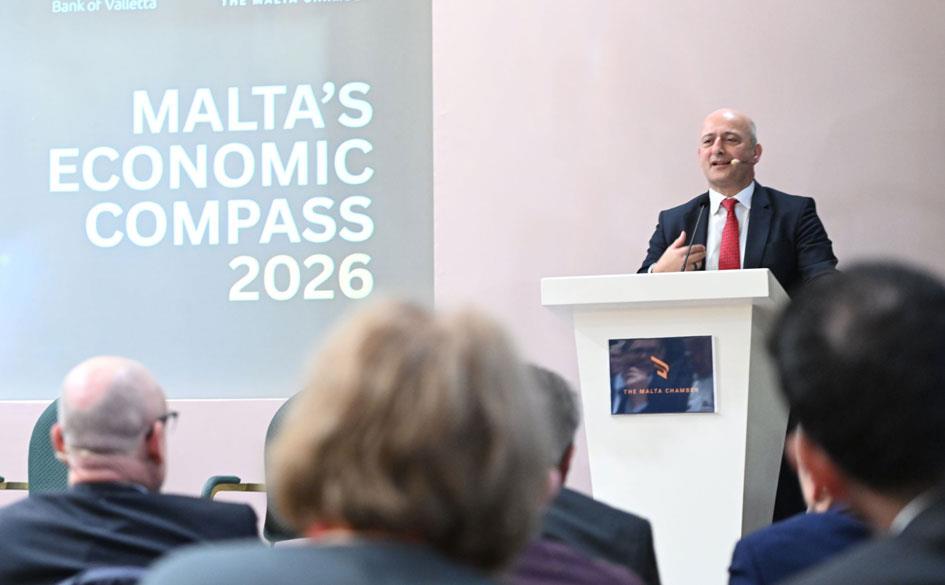
BOV Chief Executive Officer Kenneth Farrugia, who also participated in the panel discussion, highlighted the important role Malta's financial sector can play in supporting long‑term economic growth through innovation and investment in technology. He noted that companies must continue to embrace digital transformation and invest in technology, particularly artificial intelligence. "Companies are not always seeing the long‑term benefits of the investments they are making today. We need to invest now to deliver stronger profitability over the medium to long term," Mr Farrugia said. "It is all about legacy, we should be driven by the legacy we want to leave behind for future generations." Turning to pensions, he stressed the importance of being smart with money and long‑term financial planning.