'Isem il-Warda'
Author: Umberto Eco
Translation: Adrian Stivala
Publisher: Klabb Kotba Maltin / 2025
Pages: 330
In the ongoing saga of a first novel not intended for a wide audience, Umberto Eco's Il nome della rosa (1980), which was written more as a personal pleasurable challenge than at having a go at the book market, has now come to us in a fine Maltese translation by Adrian Stivala.
This novel could easily have been voted least likely to become an international bestseller, steeped as it is in medieval monastic rituals, set within the walls of a 14th century North European monastery and written in Italian by an academic, a professor of the unusual subject of Semiotics at the University of Bologna. Eco's Il nome della rosa became that strangest and most unpredictable of successes, the literary mega-bestseller in translation. It is a novel steeped in medieval Church politics, interspersed with passages in Latin as well as an invented mongrel Joycean-like European language, with plenty of arcane references and literary allusions, a novel concerned with the pursuit and detection of signs as clues which stand for things and ideas in their absence - which ultimately prove illusory. Not an obvious candidate for the bestseller lists by any stretch of the imagination,
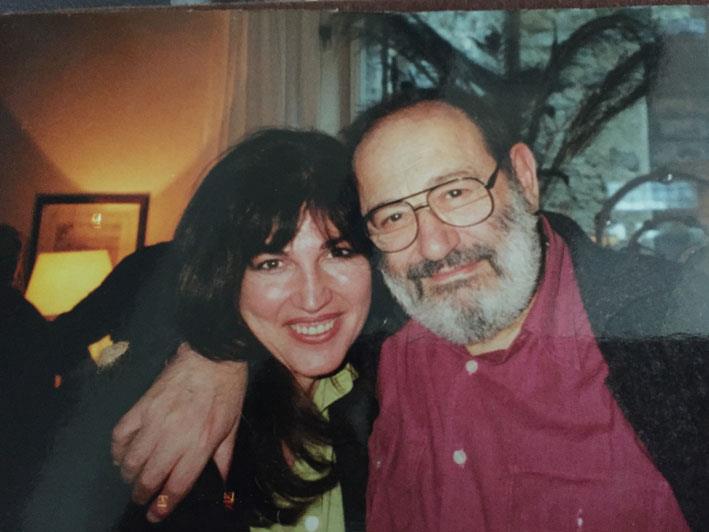
Prof. Clare Vassallo with Umberto Eco at the author's house in Urbino at his 70th birthday party in 2002
Yet, it was awarded literary prizes (the Prix Medici and the Premio Strega) and topped the lists in Italy, of course, where Eco was a well-known and respected figure in public life but, then it also did exceedingly well globally and unusually in the English-speaking world on both sides of the ocean where it sold, and continues to sell, millions of copies. In William Weaver's excellent English translation it spent weeks at the top spot on the New York Times and British Sunday Times bestseller lists.
Franco Ferruci when reviewing Weaver's translation of the book for the New York Times in 1983 wrote that "translating a book with so many voices and levels of meaning cannot have been easy", not for Weaver - and not for Stivala, either. As every translator knows, millions of decisions are taken as we plough our way through texts - and not every text is as long, as dense, and as challenging as The Name of the Rose to translate. Among the decisions Stivala took was the one regarding the frequent passages in Latin - should they be kept in Latin, as in some translations, or translated into the narrative language, as others have done. On this point, Stivala definitely took the best decision and kept every language, be it Latin or French or Spanish, as they appeared in Eco's original.
Stivala has managed to re-create (because all literary translation is an act of creation) the tone, the mood and the ambiance in which a range of subtle and intricate debates about faith, philosophy, logic and disagreements between the different Church orders, take place. These debates trip off the tongues of the various monks in Maltese that flows and moves with elegance and ease - as it does in the Italian source. For instance, in one such conversation between Guliermu and the Abbot, with the complications to the Avignon Papacy in the political background, they discuss the imminent visit of the Papal Inquisitor, Bernard Guy,
" ... U s'hawn iż-żweġ delegazzjonijiet ser jaqblu. Iżda Gui jista' jgħamel aktar, u għandu l-ħila: ifittex li juri li l-istqarrijiet ta' Perugia huma bħal tal-Fratiċelli, jew tal-appostli qarrieqa. Taqbel?"
"Qed tgħid li l-qagħda hija hekk jew li Bernardo Gui ser jgħid li ħija hekk?"
"Ejjew ngħidu li naħseb li hu hekk ser jgħid," qabel miegħu ħelu ħelu l-Abbati."(p. 270 )
Or in the library - which is the real heart of the rose in the novel, "In-nies tal-gżejjer tiegħi kollha daqxejn imġienen," qal Guliermu kburi. "Ejja ħalli naraw l-ixkaffa l-oħra."
"Virġilju."
"X'kien hawnhekk? Liema ktieb tiegħu? Il-'Georgiche'?"
"Le. 'Epitomae'. Qatt ma smajt biħ."
"Mhux Virġilju Maro, Virġilju ta' Toulouse, ir-retoriku li għex fis-sitt seklu wara Kristu. Kien meqjus bħala għaref kbir ..."
"Hawnhekk jgħid li is-suriet tal-arti huma il-poema, ir-retorika, il-grama, il-leporja, id-dialettika, il-ġeometria ... B'liema ilsien qed jikteb?" (p. 407)
It is interesting that the novel itself is based on a fiction of a translation. We, the readers are addressed directly in an Author's Note which, conventionally, is positioned outside of the fictional world of the novel and is in fact written in the first person to give the impression of the author speaking to us directly. But, Eco, a master of fictional works, is playing a game with the reader. Creating uncertainly as to whether the translation the "author" made of a manuscript written by a certain Abbé Vallet, Le Manuscrit de Dom Adso de Melk, which was given to the "author" but which was subsequently taken away from him, was real or not. And, whether the author is Eco himself, or not. Yes, the "author" tells us, in 1980 he is ready to tell the story - and it remains unclear who "he" is.
The events are narrated to us in a manuscript in the first person by Adso of Melk, who was a young Benedictine novice and William's assistant at the time of the murders in the abbey. The structure of the novel is that of the detective genre in the style of Arthur Conan Doyle (but with plenty of digressions), with a protagonist called Guliermu ta' Baskerville, which in a short skip and a jump links up William of Ockham to Conan Doyle's The Hounds of the Baskervilles, just in case we had any doubts. And, of course, the other thing the novel is about books - lots of words and lots of books. The opening lines of the Prologue, referring to John 1:1, signal that clearly, "Fil-bidu kien hemm il-Verb, u l-Verb kien ma' Alla, u il-Verb kien Alla. Dan kien jibda b'Alla u dmir kull patri tajjeb kien li jtenni kuljum b'umilta' monotona l-ġrajja waħdanija li ma tinbidilx, li is-sewwa tagħha ħadd ma jista' jiċħad u li kulħadd jista' jistqarr. Iżda videmus nunc per speculum et in aenigmate - issa ħalli nħarsu f'mera mtappna ..." (p. 13)
Isem il-Warda has as its beating heart, at the very centre of its creation, the labyrinthine intertextual connections to other books, libraries of books, Jorge Luis Borges' Labyrinths, Roger Bacon's Opus Majus work on logic and optics, Aristotle's Poetics, The Book of Revelation, Conan Doyle's novels, the history of the Franciscan Order, and the unusual list goes on. As the Italians are fond of saying, libri dai libri, or as stated in the novel, "books always speak of other books, and every story tells a story that has already been told". This endless intertextual net is as much a feature of libraries, which are our repositories of knowledge and culture, as it is of literary canons. It is also a feature of the playful postmodern novel of the late 20th century. Texts refer to other texts, signs to other signs - before they refer to the world we create and sustain through linguistic signs, through our minds and language itself.
This novel is a classic. It is still in print 45 years after its first publication in Italian, still selling both Italian and in translation. And among those translations is Weaver's English version which has also served as the basis for the screenplay of the film's intersemiotic adaptation starring Sean Connery (1986). Then in 2019 a six-part series was produced by RAI in six languages simultaneously. The novel has sold over 50 million copies, translated into 45 languages (including six Chinese versions), across 64 countries, to which we can now add Malta, in Maltese, thanks to the dedication to this work shown by Stivala.
This book was funded from the National Book Council, KNK.
Prof Clare Vassallo is Professor of Semiotics and Translation Studies at the University of Malta.