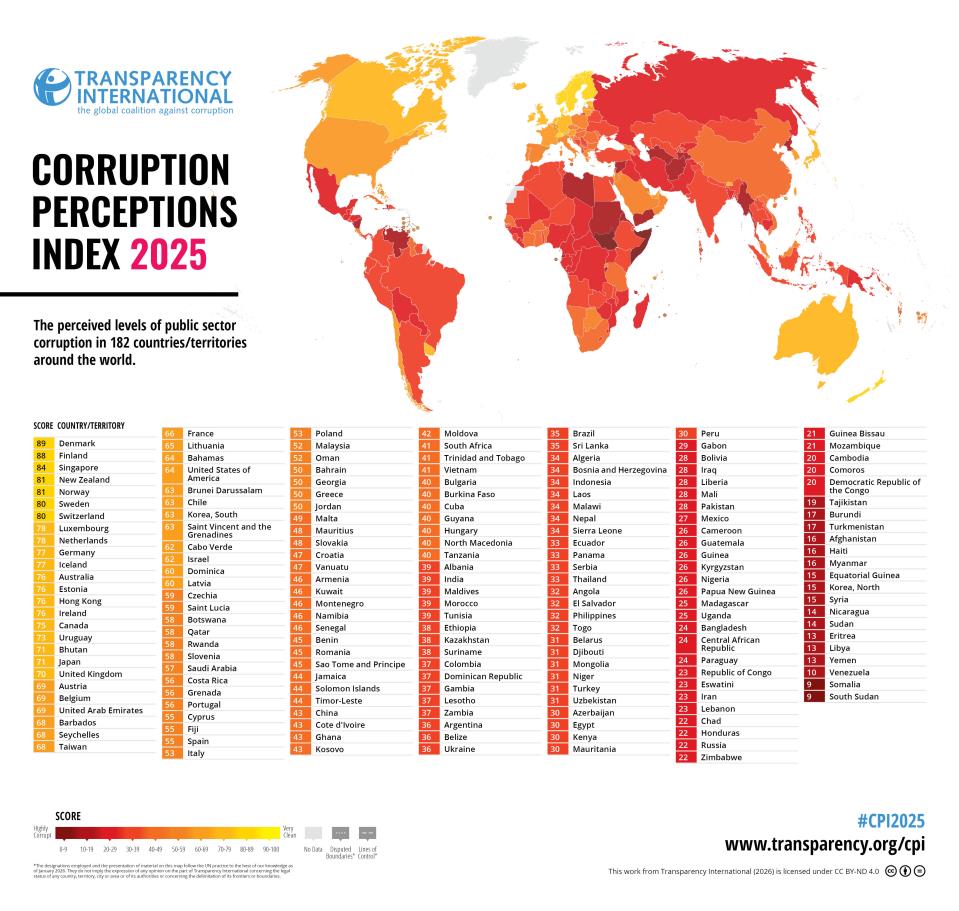
Malta received a score of 49 on Transparency International's Corruption Perceptions Index (CPI) for the year 2025.
This is a slight improvement over the score of 46 which Malta received for 2024. However it is still one the countries listed as being among the biggest decliners since 2012 in the Western Europe and the EU region.
The CPI ranks 182 countries and territories worldwide by their perceived levels of public sector corruption. The results are given on a scale of 0 (highly corrupt) to 100 (very clean). The index scores 182 countries and territories around the world based on perceptions of public sector corruption, using data from 13 external sources, including the World Bank, World Economic Forum, private risk and consulting companies, think tanks and others. The scores reflect the views of experts and businesspeople, not the public, Transparency International says.
"Among the biggest decliners since 2012 are Spain (55) down 10 and Malta (49) down 8. The UK (70) has experienced one of the most dramatic declines, down 12 since 2017," a report about the Western Europe and EU region as part of the Index by Transparency International reads. Among the biggest improvers in the region since 2012 are Greece (50) up 14 and Czechia (59) up 10, it says.
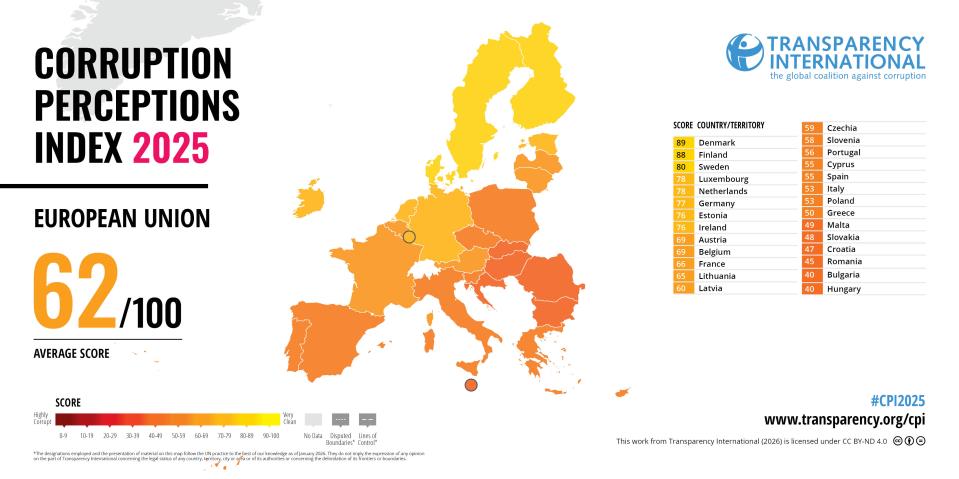
In the report about this region, Transparency International says: "Despite ranking as the world's least corrupt region, progress against corruption in Western Europe and the European Union (EU) has stalled over the past decade. The region's average CPI score has fallen from 66 to 64, with 13 countries seeing significant declines and only seven making improvements, underscoring a widening gap between anti-corruption standards, enforcement and the integrity of those in power."
"In December 2025, the EU adopted its first Anti-Corruption Directive, intended to harmonise criminal laws across member states and establish a zero-tolerance approach. However, key provisions were weakened, as a result, the Directive's final framework falls short on ambition, clarity, and enforceability, squandering an opportunity to take a collective stance against corruption. As EU member states prepare to transpose the Directive, they should treat it as a springboard, not a ceiling, for ambitious reform and enforcement. At the same time, efforts to weaken anti-corruption rules and checks and balances, along with state attacks on civil society, independent media, and whistleblowers, are undermining the quality of democracy in the region by making abuses of power harder to detect and expose."
It mentions that in Hungary (score of 40), "Viktor Orbán's party used claims of promoting transparency to justify proposed powers to shut down critical NGOs and media, an effort that ultimately failed. In Slovakia (48), the government is dismantling anti-corruption safeguards, including whistleblower protections, and weakening investigations of corruption and organised crime, especially those involving senior officials. Instead of wielding the strong rule-of-law measures available to it, the EU has sat idly by as member states have dismantled democratic protections. Elsewhere, significant decliners include the UK (70) and France (66). In the UK, the past decade has seen major domestic scandals, the awarding of favours and honours to political donors, and MPs working as lobbyists for paying clients and corrupt regimes. Even with some strong standards in France, enforcement challenges persist and there are growing risks of collusion between officials and private interests. Both countries and Spain (55), another significant decliner, have launched national anti‑corruption plans to address existing loopholes. However, for these to be effective, implementation will need to be ambitious, well‑funded, and carefully monitored."
In the European Union, Malta has the 6th worst score, with Slovakia, Croatia, Romania, Bulgaria and Hungary having poorer results.
In terms of world scores, Malta's 49 places it just ahead of Mauritius and Slovakia which both scored 48, and just behind Jordan, Bahrain, Greece and Georgia which all scored 50.
The top three overall countries ranked with the best scores are Denmark with 89, Finland with 88 and Singapore with 84.
The countries with the worst three scores are South Sudan and Somalia, both with 9, and Venezuela with 10.
Since its inception in 1995, Transparency International's Corruption Perceptions Index has become the leading global indicator of public sector corruption.