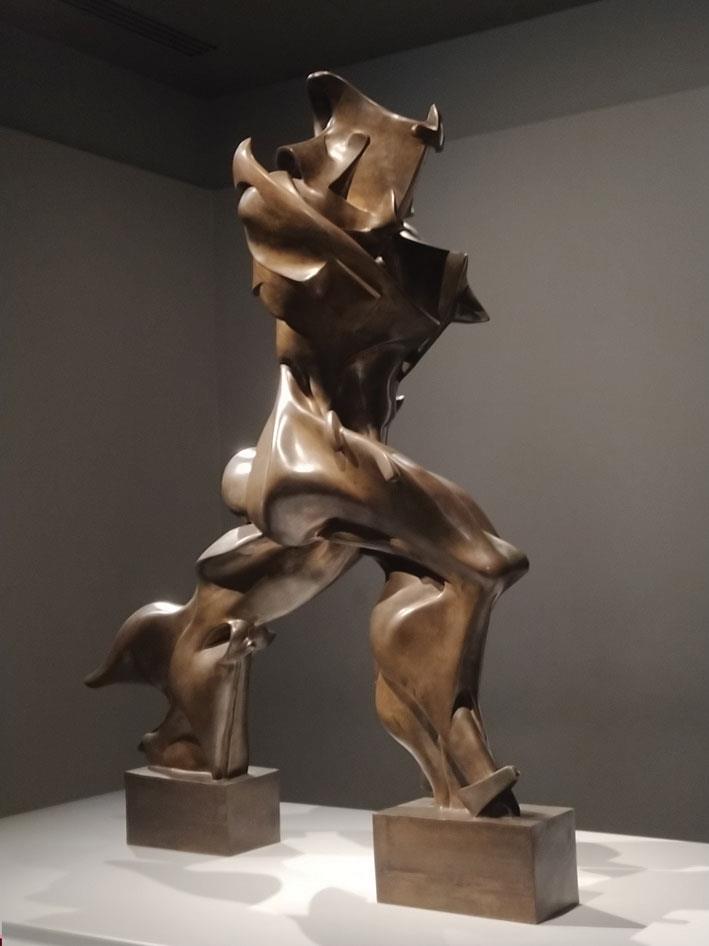
Antonio Sciortino (1879-1947) is not usually associated with Futurism, yet a close engagement with his masterpiece Speed (1937) invites a reconsideration of this assumption. My repeated visits to the Museo del Novecento in Milan have been particularly formative in this regard, especially through Umberto Boccioni's Unique Forms of Continuity in Space (1913), housed in the museum and widely recognised as the most significant futurist sculpture of the early twentieth century. Boccioni's work provides a rigorous benchmark for assessing how sculptural form can embody movement as continuity rather than as mere representation. Viewed against this benchmark, Sciortino's Speed reveals a level of formal ambition that transcends its usual classification within Art Deco modernism, aligning it closely with futurist principles.
This alignment does not imply that Sciortino should be retroactively absorbed into the futurist movement, nor that Speed emerged from a sustained avant-garde programme. Rather, it allows the work to be understood as a rare convergence between Sciortino's longstanding fascination with dynamism and the futurist philosophy of continuity in space. In this sense, Speed represents a moment of genuine futurist resolution within Sciortino's eclectic oeuvre. Its achievement lies not in stylistic imitation, but in its successful embodiment of speed as a structural condition of form.
Sciortino is a foundational figure in the development of modern sculpture in Malta. He was the first Maltese sculptor to engage meaningfully with modern artistic tendencies. His career unfolded within the intellectually and politically charged environment of early twentieth-century Rome. Amid competing avant-garde movements, rising Fascism, and the cultural tensions of Anglo-Italian relations, Sciortino developed an eclectic sculptural language that evolved from Rodinesque romanticism to Art Deco streamlining. His sculptural language reached its most radical expression in Speed, a work that constitutes both the apotheosis of his engagement with modern aesthetics and a rare, fully realised futurist statement within his oeuvre.
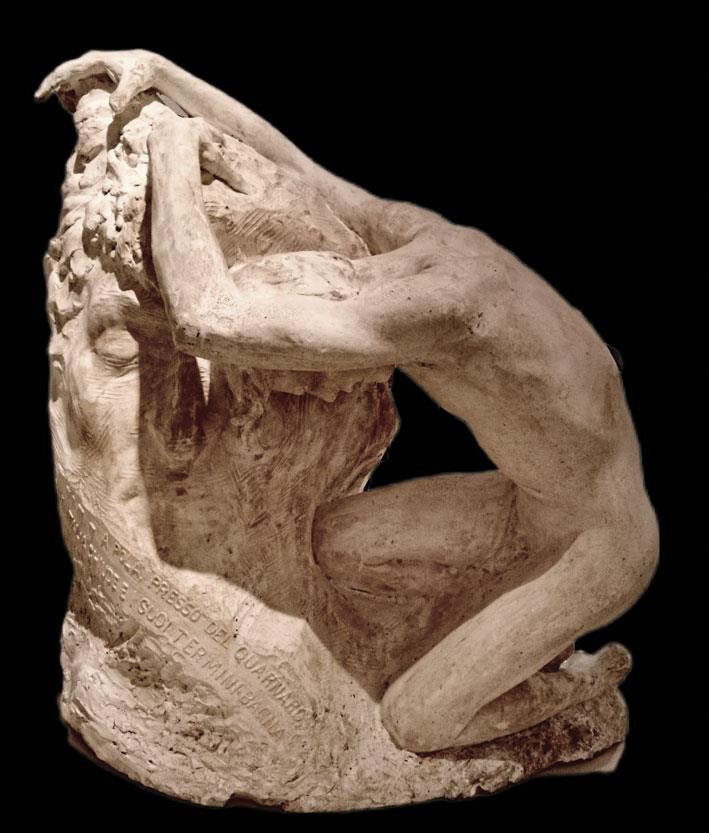
Throughout his career, Sciortino demonstrated a persistent fascination with movement. In his early works, movement was conveyed through expressive postures and dramatic modeling inherited from Rodin, while his interwar production increasingly adopted the sleek, machine-age aesthetics of Art Deco. Yet these approaches remained largely symbolic. Movement was suggested through Rodinesque surface treatment, stylised streamlines, or narrative implication rather than being embedded within the structure of the form itself. Speed marks a decisive rupture from this approach: here movement is no longer represented, it is embodied.
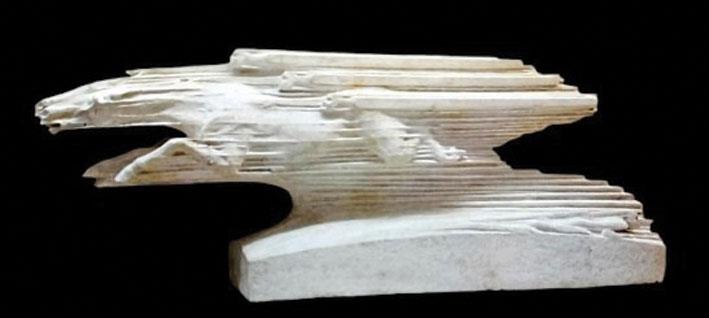
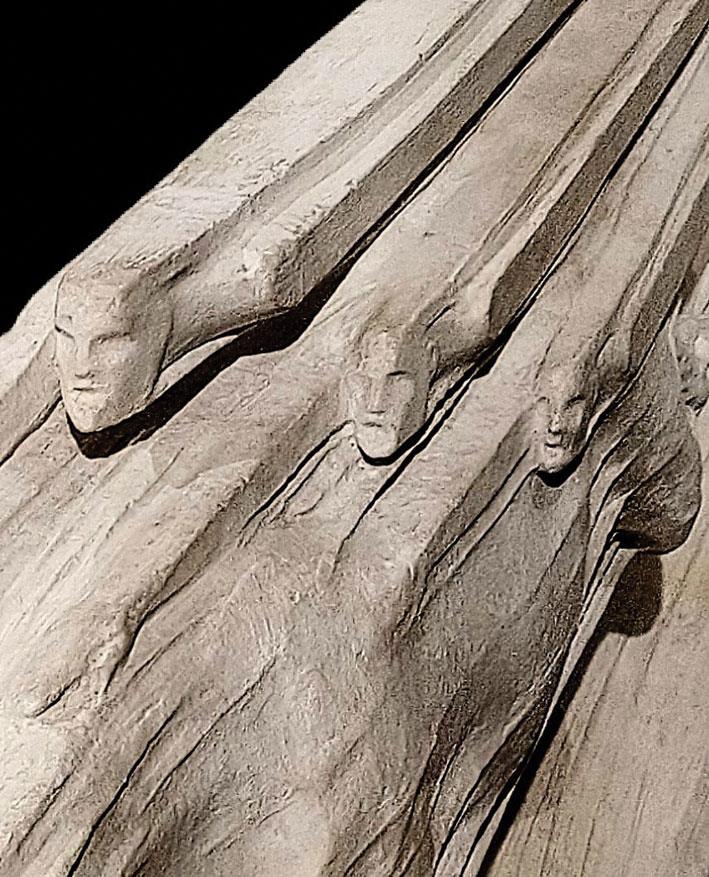
Formally, Speed depicts a horse and rider, an equestrian subject deeply ingrained in Sciortino's artistic vocabulary. Yet the traditional iconography is radically transformed. The anatomy of both horse and rider is violently distorted, elongated, and sharpened until the figures verge on abstraction. The composition is reduced to a longitudinal thrust, a blade-like form cutting relentlessly through space. This extreme linearity evokes the early twentieth-century machine aesthetic articulated by Italian critic Mario Morasso, who claimed that modern beauty lay in forms resembling a knife cutting through the air.
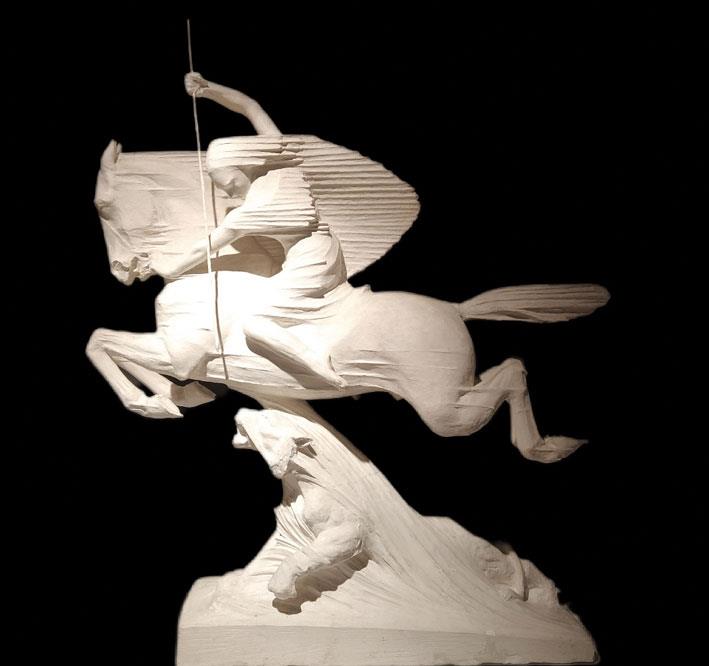
What distinguishes Speed from Sciortino's earlier Art Deco experiments is its adoption of the futurist concept of continuity. Rather than isolating the figure from its surroundings, Sciortino dissolves the boundary between object and environment, creating what Boccioni called an "environmental sculpture." The horse and rider are no longer autonomous bodies moving through space; they are inseparable from the atmospheric forces generated by their motion.
This synthesis between object and environment aligns Speed with the Bergsonian philosophy that influenced early Futurism. Philosopher Henri Bergson's concept of élan vital, an all-pervading life force animating the universe in incessant flux, finds sculptural expression in Sciortino's work. The sculpture does not depict a frozen instant but conveys duration, continuity, and becoming. Figures are merely hinted at; form dominates representation. As Sciortino himself described the work, Speed embodies "a strong power passing through and no obstacles can stop," an articulation that resonates unmistakably with Bergson's vision of movement as the fundamental condition of reality.
Importantly, the force-lines in Speed differ from the decorative streamlines employed in Sciortino's other Art Deco stylised works such as Surprised (1932) and Dangerous Sport (1937). In those sculptures, lines of displaced air surround the figure without altering its structure, functioning as symbolic indicators of speed derived from Art Deco grammar. In Speed, force-lines are structural. They deform anatomy, dissolve solidity, and generate the form itself. This transforms Sciortino's engagement with movement into a conceptual framework rooted in futurist philosophy.
Different versions of Speed, in plaster and bronze, are today housed at MUŻA. Among Sciortino's oeuvre, Speed remains unparalleled in conceptual daring and formal radicalism. Yet it also reflects the tension in his artistic identity: while capable of avant-garde experimentation, he pursued it only briefly, with most of his production anchored in public commissions and monumental subjects. While Sciortino ultimately did not sustain this radical path, Speed remains a testament to his modern sensibility and to what Maltese sculpture could achieve when liberated from historical inertia. As such, it stands as a masterpiece of Maltese modernism, one that confidently enters into dialogue with canonical futurist sculptures such as Boccioni's Unique Forms of Continuity in Space.
Rowna Baldacchino is a Maltese art historian and cultural critic with postgraduate specialisation in art history, literature, and translation, focusing on modern and contemporary art in Malta.