Frida Kahlo's image circulates so widely in contemporary visual culture that it often detaches from the complexity of the life behind it. In Fridamania, Michelle Galea returns to Kahlo not as image or style, but as presence, insistence, and endurance. Rather than treating her merely as an icon, Galea engages with the totality of her character, translating Frida Kahlo as both artist and person into a muse in her own right.
Fridamania by Galea is a 34 paintings exhibition at the Wignacourt Museum, dedicated entirely to the Mexican artist Frida Kahlo (1907-1954). Beyond her role as artist, Galea also undertook the curatorial design of the space, a challenge given architectural interruptions created by windows and doorways. Yet the set-up achieves a balance between those presented as a cohesive series with the other more autonomous works. This arrangement highlights shifts in colour, tone, and expression from one canvas to the next.
Galea (b. 1987) was born into a family of artists and has refined her artistic practice at the Malta School of Art. She also completed an M.A. in History of Art at the University of Malta and has been serving as assistant curator at the Wignacourt Museum for over a decade. While she has participated in numerous collective exhibitions, Fridamania marks her second solo exhibition. The preceding exhibition, Facing Fame in 2024, had also included two depictions of Kahlo herself.
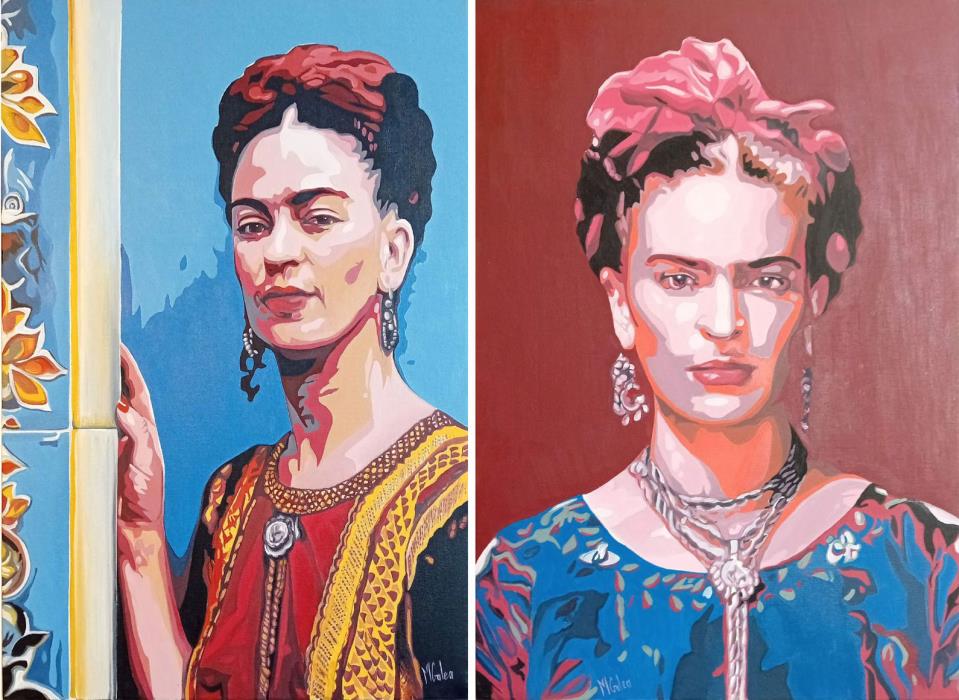
Long drawn to Kahlo, not merely for the emotive paintings but for the force of her character, Galea frames her less as an aesthetic reference and more as a model of determination and endurance - someone whose life and work collapse into an inseparable statement. This pull ultimately led to a long-held ambition: dedicating an entire exhibition to her muse. It is a connection that extends beyond the subject and into lived experience; while installing the exhibition, Galea worked through a shoulder injury that prompted a direct reflection on Kahlo's own persistence, most famously her determination to create even when confined to bed during her first exhibition. It is this endurance that resonates most strongly for Galea, as she reflects, "she gives me courage on a day-to-day basis which is what draws me to paint her more so than anything or anyone else".
These works are equally bold in their two-dimensionality, not only as a result of technique but also through process. Whereas artists, including Galea herself, are often trained to begin with lighter tones and gradually build towards darker ones, she reverses this approach, starting from black and working towards light. This method produces a heightened distinction between tonal areas, reinforcing the immediacy of the painting. Within this distinctive surface, it is ultimately the expression that anchors each work, particularly in the rendering of the eyes. As Galea explains: "The expression and the eyes are the most important, that is what I always focus on. Particularly with this style, if you do not get them right it does not feel like the person."
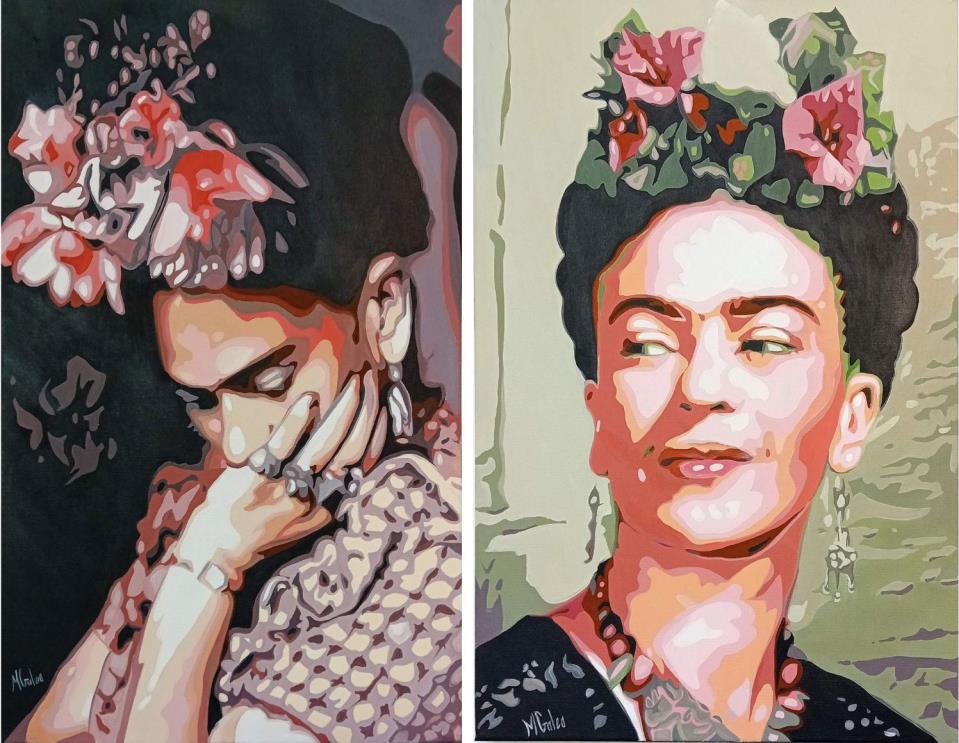
Alongside more autonomous compositions, the limited availability of portrait photographs led Galea to experiment with repetition through series. She reuses the same composition and employs monochromatic or restricted palettes that introduce a calming rhythm. Depending on the palette, the same image can assert itself differently, as seen in the blue variation when compared to its adjacent counterparts. As she notes, the effect lies not solely in composition or colour, but in the contrast created between them. Within these series, she also incorporated earrings crafted by herself, introducing a layer of handmade craft that extends the works beyond the painted surface. Across the larger exhibition space, the works operate effectively, both visually and spatially, in dialogue with the more distinct individual paintings.
This exhibition is relevant not simply as an exercise in portraiture, but as a striking instance of a contemporary artist dedicating an entire exhibition to the totality of Frida Kahlo; not her style, nor merely her recognisable image, but the condensed force of her character, endurance, and self-construction. As Kahlo herself stated: "The only thing I know is that I paint because I need to" and "At the end of the day, we can endure much more than we think we can." Galea frames the work directly: "She always suited me perfectly for my style, my character, my everything. I hope I did a well homage to her and that she would be happy about it."
'Fridamania' is open to the public until 27 April at Wignacourt Museum