We're really excited about our next exhibition at il-Kamra ta' Fuq! We are honoured to be hosting Shanice Farrugia's debut solo show, titled (UN)Expressed, curated by yours truly.
I'm pretty sure you already know who Shanice Farrugia is, and perhaps even what she looks like, given that self-portraiture has become something of her signature. But, as always, first things first! Let me share a little background on the artist before we get into the exhibition itself.
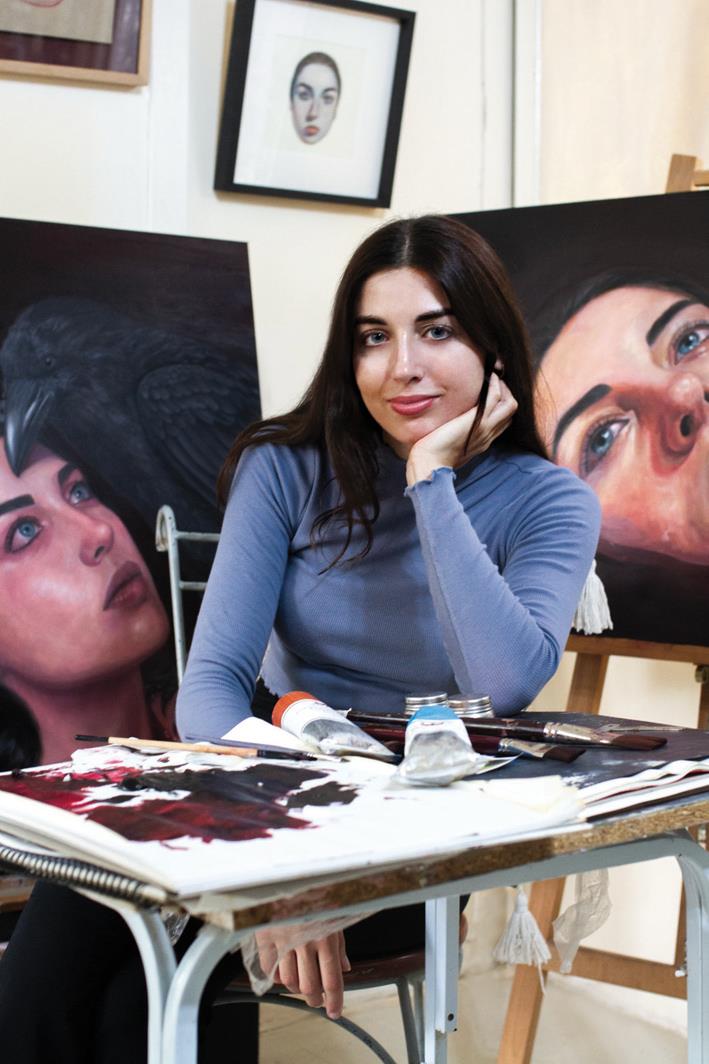
Farrugia is a young Malta-based multidisciplinary artist working across drawing, painting and installation. Rooted in self-portraiture and intimate depictions of those closest to her, her practice explores memory, perception and identity.
Although (UN)Expressed marks her debut solo exhibition, Shanice has already exhibited extensively in Malta and internationally, including in London, Berlin and Gibraltar. Her drawing Landline Lullaby received both The Gallery Choice and People's Choice Awards at the 2025 Summer Exhibition at The Gallery at Green & Stone, Chelsea, London. She was also a finalist for Visual Artist of the Year at the FreeHour Awards 2026, was selected for ARTIT's Portrait Artists of the Year 2025, and was a finalist for Best Artist-Illustrator at the Lovin Malta Awards 2024.
Back to our exhibition! As mentioned, (UN)Expressed centres on self-portraiture, but there is much more to it than depicting oneself. Farrugia uses her own image to explore emotions that are difficult to articulate, examining what lies beneath the composed exterior we learn, or are expected, to present to the world.
Developed over the past two years, these works explore emotional restraint, quiet endurance and anticipatory grief. Drawing on her own experiences, Farrugia considers how difficult feelings are often suppressed in order to remain strong and composed. Yet what goes unspoken does not simply disappear; it lingers in the body, expressed through tired eyes, flushed skin, tension and stillness.
Her self-portraits are therefore as much studies of emotional states as they are explorations of likeness. Cropped, fragmented, submerged or partially concealed, the faces create a tension between revealing something deeply personal and protecting what remains private. In Farrugia's work, less can indeed become more.
And then comes the raven.
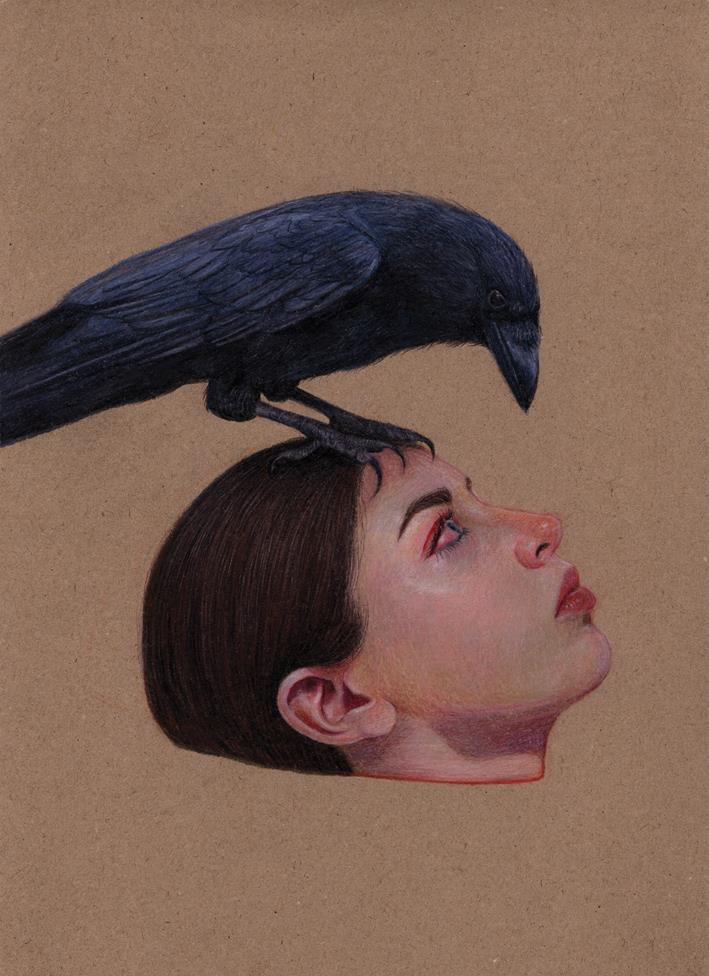
The Sound of pre-grief is the first work in which the raven appears. Farrugia looks upwards towards the bird, which hovers close to her face, almost as though she is confronting it. Traditionally associated with death, the raven gives physical form to something far more elusive: the awareness of possible loss. It becomes a presence that cannot simply be dismissed or ignored, a witness to the uneasy space between hope and fear, presence and absence, and life and the possibility of its ending.
The raven also extends the self-portrait beyond the individual, becoming an important element in the visual narrative of grief. Farrugia's exploration of anticipatory grief is deeply personal, shaped by living alongside her father's illness. Yet these works do not ask us to approach her experience as spectators looking for a story to sympathise with. Instead, they open up a space in which we might recognise our own experiences of uncertainty, fear, love and impermanence. Grief is not presented solely as something that follows loss, but as something that can exist alongside love, while the person we fear losing is still here.
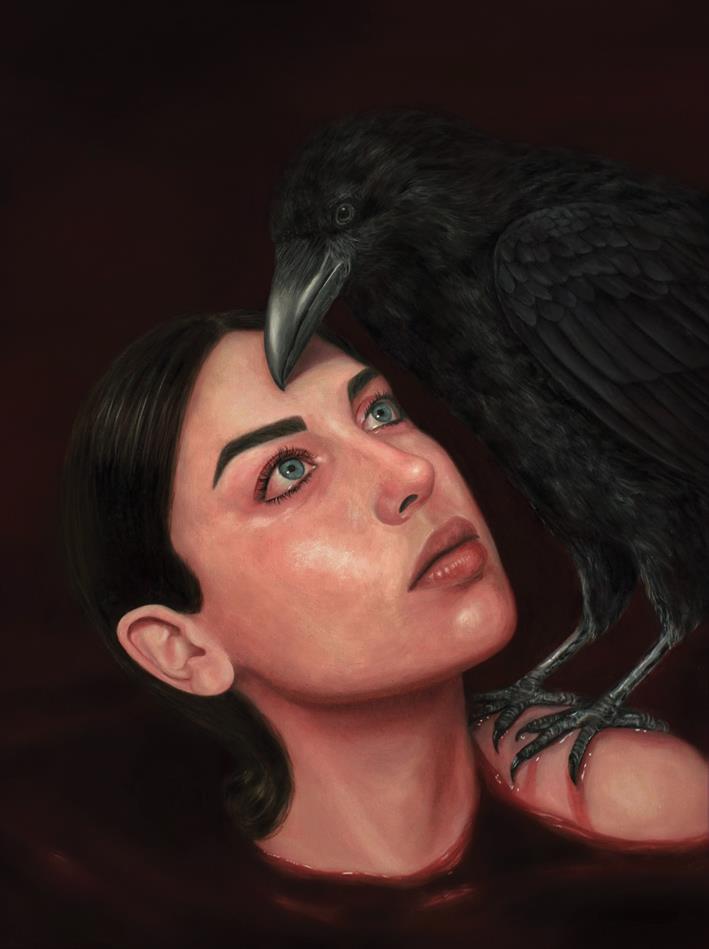
This is particularly evident in While you are still here, an oil painting that captures Farrugia in a strikingly vulnerable pose. Her head is tilted upwards, her eyes wide open and fixed on something beyond our view. Much of her figure remains submerged in a red liquid, with only her head and part of her left shoulder emerging from it. Perched on her shoulder, the raven is rendered with remarkable presence, its beak resting against her forehead. The proximity between bird and figure is unsettling, almost intimate. The raven is no longer merely hovering nearby; it has made contact. The unknown towards which Farrugia gazes remains beyond our reach, leaving us to consider what she might be confronting, and what, perhaps, we fear confronting ourselves.
The red liquid reappears in three other works. In The long before, the largest work in the collection, Shanice's face is immersed in the liquid up to her ears, her striking blue eyes staring directly back at us, almost as though pleading for consolation. There is something deeply unsettling about this gaze: she appears to be reaching out, yet whatever weighs upon her remains beyond our grasp.
Where it settled offers a different, equally powerful image. Shanice appears to be standing in the same red liquid, with only her head emerging above the surface. Her eyes are red, and her gaze meets ours directly. Her face seems to hold countless untold stories, each carrying its own sadness, yet none finds its way into words. We are confronted with the expression, but not the stories behind it. Everything remains contained within her.
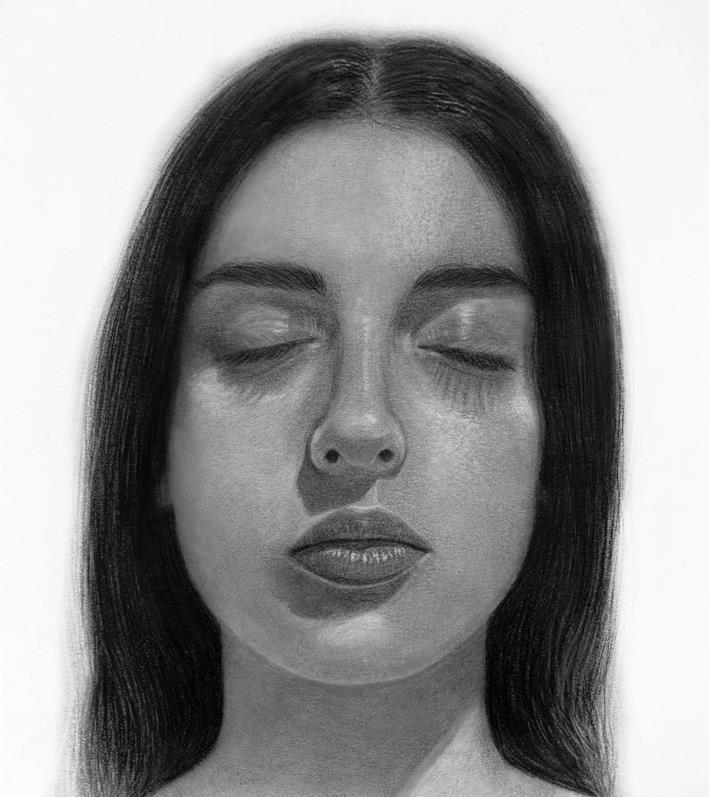
Two further works, executed in graphite, present Shanice's face frontally, yet they convey strikingly different emotional states. In Where silence gathers, her eyes are closed, and her expression appears almost serene, suggesting a moment of stillness or perhaps even acceptance. Vacant longing, however, presents a far more unsettling image. Her eyes are completely white and blank, giving her an almost otherworldly appearance. She seems present, yet somehow detached, as though something essential has withdrawn.
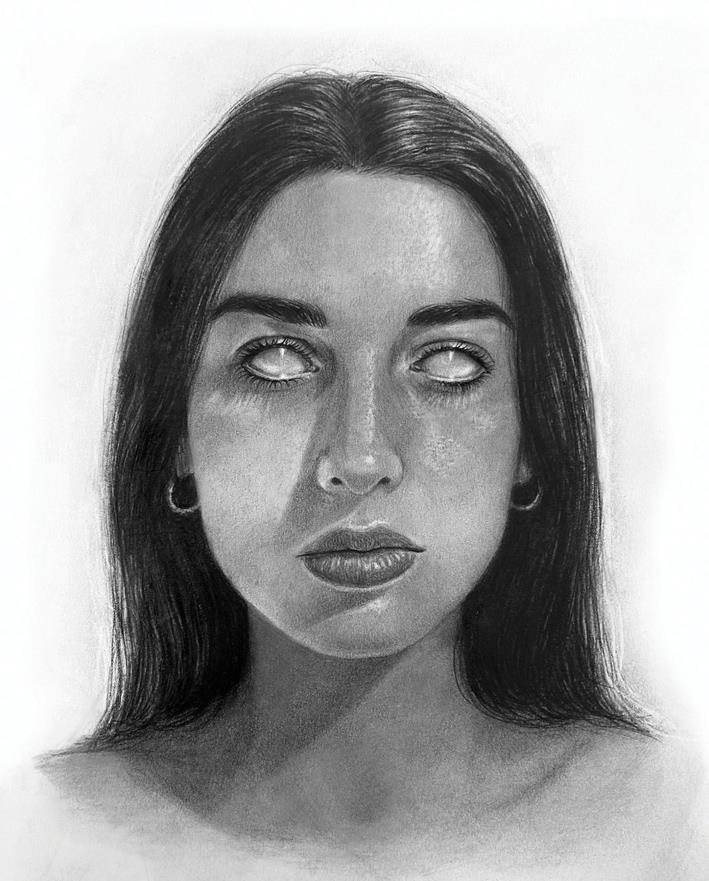
Another detail worth noticing is her earrings. Against the unsettling emptiness of her gaze, they introduce an everyday gesture of appearance and self-presentation. I cannot help wondering whether they suggest the expectation to carry on regardless: to get dressed, step out into the world and maintain the appearance of normality, while leaving difficult emotions hidden beneath the surface. It is a familiar contradiction - looking perfectly put together on the outside while feeling entirely different within.
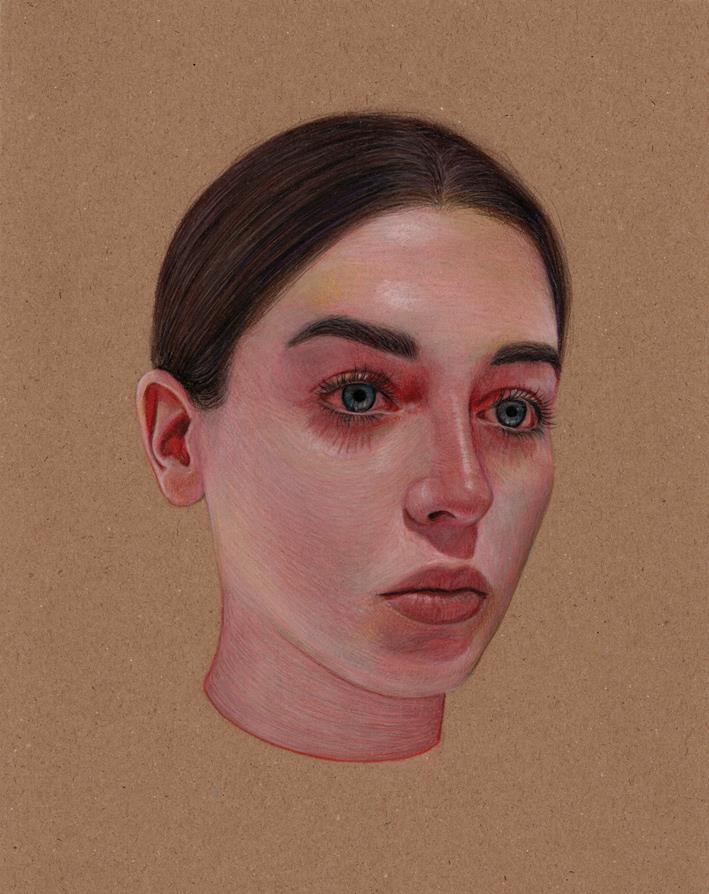
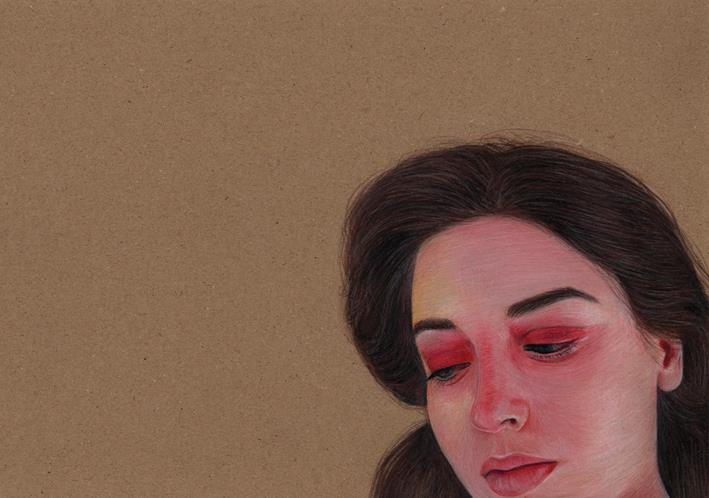
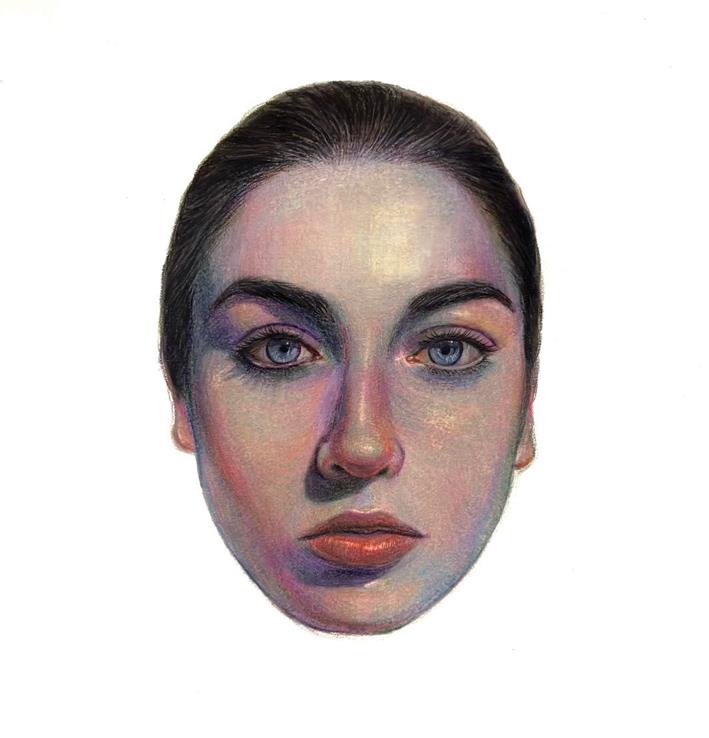
Other self-portraits are executed in coloured pencil on kraft paper, lending them a different warmth and intimacy. In As if carved, Shanice's hair is tied back, her gaze fixed and unwavering. Her face appears almost sculpted from marble, rigid and impenetrable, as though she has withdrawn into herself, unmoved by whatever might be happening around her.
This contrasts sharply with Where it softens. As the title suggests, there is a gentleness to her features. Her head seems to rest on an invisible pillow, her hair falls loosely around her face, and she gazes pensively downwards, towards something beyond our view. She appears lost in thought, withdrawn from the world, yet somehow at peace (or almost).
In other works, Farrugia plays with the physical properties of the paper itself, creating intriguing trompe-l'œil effects. In Still consumed, for instance, her face appears to be slowly swallowed by quicksand, gradually disappearing into the surface. It is an unsettling image that invites us to consider how we might slowly surrender to our emotions, becoming increasingly withdrawn and disconnected from the world around us.
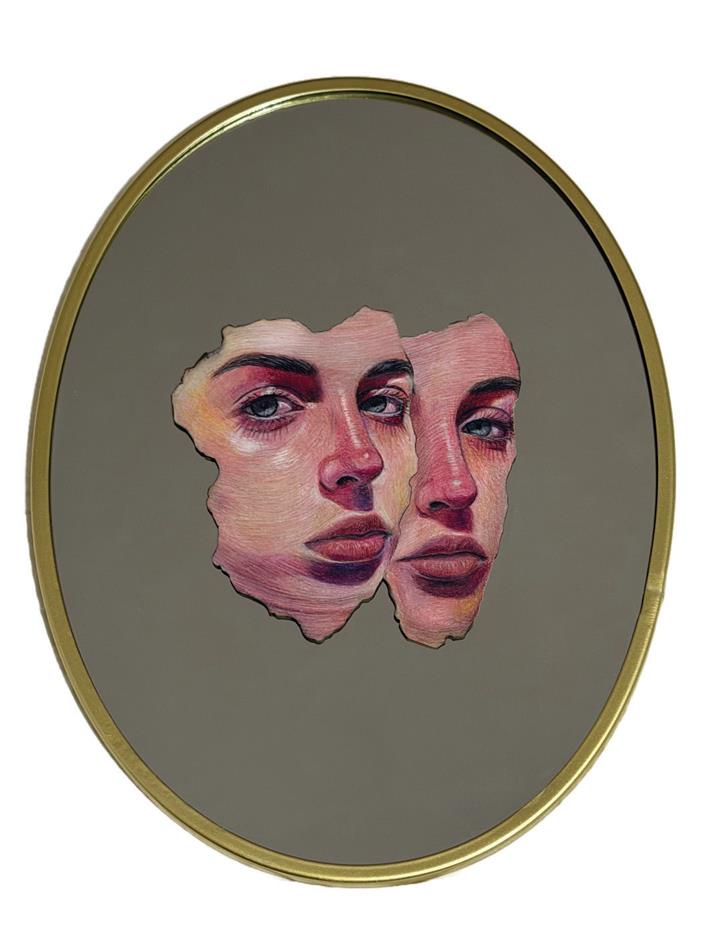
Last but not least, Mirror mirror deserves a mention. Here, Farrugia presents a duplicated self-portrait, divided into two fragments on a mirror. The work invites viewers to see themselves reflected alongside, or perhaps in place of, the artist, blurring the boundary between her experience and our own. It brings us back to one of the exhibition's central ideas: how much of ourselves do we reveal, and how much do we conceal? Whether consciously or unconsciously, we often hide our emotions, showing the world only what we wish to share, or what society expects us to show.
The exhibition runs until 8 November at il-Kamra ta' Fuq, Mqabba.
For more information follow on social media.