In the turbulent political landscape of 1930s Malta, a little-known and often misunderstood chapter unfolded-one that challenges the conventional narratives of colonial loyalty and resistance. At its centre stood Captain Frederick Oloff Samut, a decorated British officer who, paradoxically, became one of the leading figures behind a fascist movement rooted not in opposition to Britain, but in a reimagining of its imperial future. As explored in Marching On, Captain Frederick Oloff Samut and the Union of Maltese Fascists, this movement reveals a far more complex political reality than is often assumed.
By the early 1930s, Malta was a colony grappling with uncertainty. The suspension of self-government in 1933 marked a significant turning point, reverting the island to direct British rule. This decision, driven by strategic imperial concerns and tensions with Fascist Italy, left many Maltese politicians frustrated and disillusioned.
The political scene was fragmented. The pro-British Constitutional Party, the Labour movement, and the pro-Italian Nationalist Party all competed for influence, while debates over language, culture, and identity intensified. Within this complex environment, new ideologies began to take root-among them, fascism.
Yet Maltese fascism did not emerge as a simple imitation of Mussolini's Italy. Instead, it developed as a unique response to local conditions: economic stagnation, political instability, and a growing sense that existing systems were failing the island's needs.
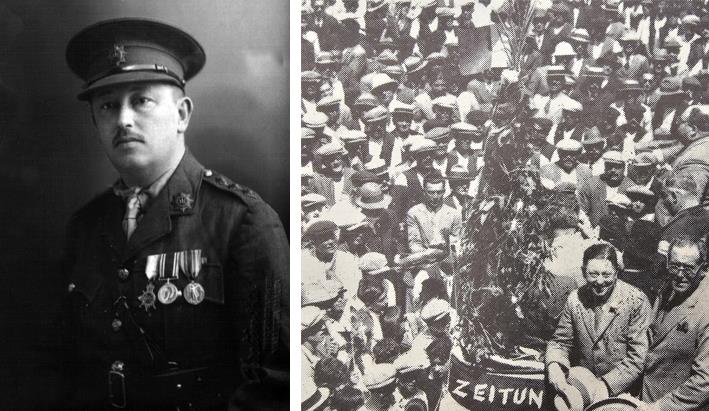
Left: Captain Frederick Oloff Samut. Source: Klaus Vella Bardon. Right: Frederick Oloff Samut at a meeting in Zejtun. Source Nationalist Party Archives
The Man Behind the Movement
Frederick Oloff Samut was an unlikely figure to lead such a cause. Born into a family deeply embedded in British imperial service, his upbringing was defined by loyalty to the Crown. His father and uncles were distinguished figures in medicine and the military, embodying a tradition of service and patriotism.
Educated in elite Jesuit institutions in Malta and England, Samut was shaped by discipline, faith, and a strong sense of duty. His military career during the First World War further reinforced these values. Serving on the Western Front, he experienced the horrors of trench warfare firsthand, sustaining injuries that would leave a lasting impact on him.
Despite this deeply rooted British identity, Samut's political journey took an unexpected turn. Upon returning to Malta after his military career, he entered politics through the Nationalist Party-a surprising move given his background. His involvement, however, was short-lived. After failing to secure a parliamentary seat in the 1932 elections, he became increasingly disillusioned with traditional politics.
It was at this point that Samut began to look elsewhere for solutions.
The Appeal of Fascism
Fascism, in the context of the 1930s, did not carry the same universal stigma it does today. Across Europe, it was often viewed as a dynamic alternative to what many perceived as ineffective democratic systems. Economic crises, including the Great Depression, had exposed the weaknesses of liberal governance, creating fertile ground for radical ideas.
For Samut, fascism offered clarity and direction. Its emphasis on strong leadership, national unity, and economic reform resonated with his belief that Malta needed decisive change. He was particularly influenced by the models emerging in Italy and Germany, where state intervention appeared to be driving economic recovery and national renewal.
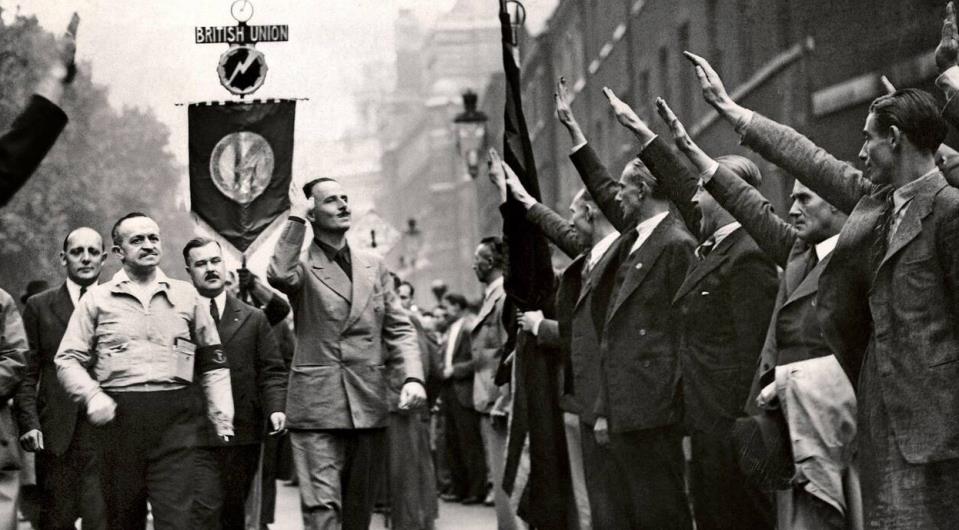
Sir Oswald Mosley takes the salute from his supporters during a fascist rally in London, 1937. Source: FWA Archives
However, Samut's vision of fascism was not purely continental. He was equally drawn to the British variant promoted by Sir Oswald Mosley and the British Union of Fascists (BUF). This version emphasised loyalty to the Crown and sought to reform the Empire rather than dismantle it.
This dual influence-Italian and British-would define the unique character of Maltese fascism.
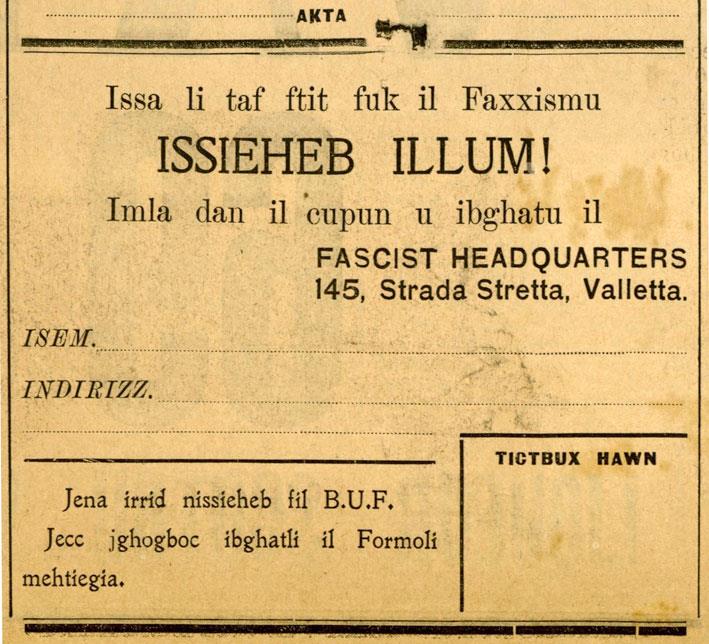
British Union of Fascists (BUF) Malta membership advertSource: National Library of Malta
Fascism Comes to Malta
The establishment of a Maltese branch of the British Union of Fascists in 1933 marked the first organised expression of fascism on the island. Led initially by figures such as Wolsey De Piro, the movement attracted members from the upper classes, including ex-servicemen and members of the nobility.
The movement's goals were ambitious. It sought to transform Malta into a "Corporate State," where different sectors of society-workers, employers, and professionals-would be integrated into a unified system of governance. This model aimed to eliminate class conflict and create a more efficient and harmonious society.
Importantly, the Maltese fascists did not advocate independence from Britain. Instead, they envisioned Malta as a stronger, more autonomous entity within the Empire, enjoying full citizenship rights while maintaining its cultural identity.
This position set them apart from both the Nationalists, who emphasised Italian cultural ties, and the Constitutionalists, who prioritised British imperial loyalty.
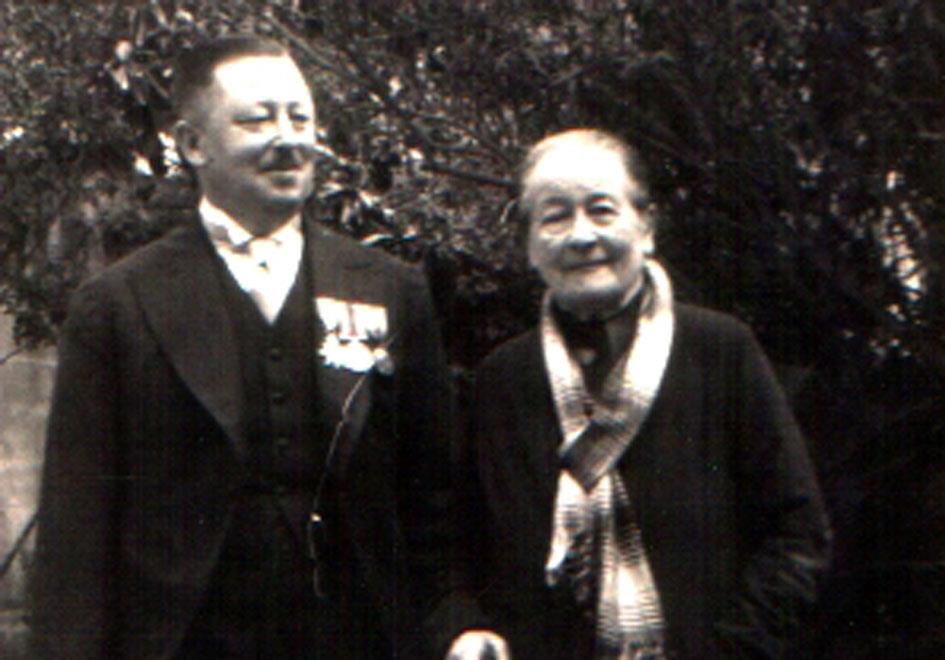
Frederick Oloff Samut with his mother Sophy. Source: Klaus Vella Bardon
A Movement of Contradictions
Perhaps the most striking aspect of Maltese fascism was its inherent contradictions. It was simultaneously pro-British and critical of British governance. It admired Italian fascism while rejecting Italian political domination. It sought radical change while upholding traditional institutions such as the monarchy and the Church.
These contradictions were not accidental-they reflected the broader complexities of Maltese society under colonial rule. Malta was not simply divided between pro-British and anti-British factions. Instead, it existed in a space where identities overlapped and loyalties were fluid.
The fascist movement tapped into this ambiguity, offering a vision that promised both modernisation and continuity.
By the mid-1930s, Samut had emerged as a central figure in this movement, eventually leading the formation of the Union of Maltese Fascists (UMF), which would replace the BUF's local branch.
Yet despite its ambitions, the movement faced significant challenges. Opposition from established political parties, suspicion from British authorities, and the rapidly changing international situation all posed obstacles to its growth.
What began as a bold experiment in political transformation would soon encounter the harsh realities of both local resistance and global conflict.