In a judgment delivered on 17 June 2026, the Court of Appeal (Inferior Jurisdiction), presided over by Mr Justice Lawrence Mintoff, overturned the decision of the Industrial Tribunal dated 24 April 2025 in the case of John Oliver George Taylor vs In My Mind Limited.
The judgment is significant because it clarifies the extent to which parties may exclude a probationary period by agreement, and how subsequent legislative amendments affect employment contracts already in force. It addresses three interrelated issues of direct relevance to employers and employees, namely:
(i) the validity of a contractual waiver of the probationary period;
(ii) whether to apply the applicable law as it stood at the time of the contract or as subsequently amended; and
(iii) whether there was an unfair dismissal.
Background to the dispute
The appellant, John Oliver George Taylor, had been engaged by In My Mind Limited, a music management company, as chief executive manager under an employment contract dated 1 December 2022 for an indefinite term, without any period of probation. His contract of employment contained a single-line entry on the question of probation, stating: "Probation Period: N/A".
Three months later, on 28 March, 2023, his employment was abruptly terminated by the company. He claimed that he had not received any prior warning nor were any disciplinary proceedings ever taken against him. The effective date of his termination was recorded as 5 April, 2023.
Taylor referred his claim for unfair dismissal and compensation to the Industrial Tribunal, arguing that the Company had no good and sufficient reason to dismiss him.
The Company, in reply, contended that, irrespective of what was specified in the employment contract, the mandatory statutory probationary period applied by operation of law. It argued that, as Taylor was dismissed during his probation, it was not obliged to justify its decision.
The legal framework
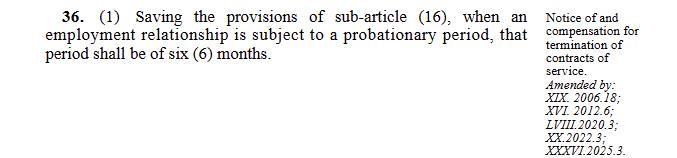
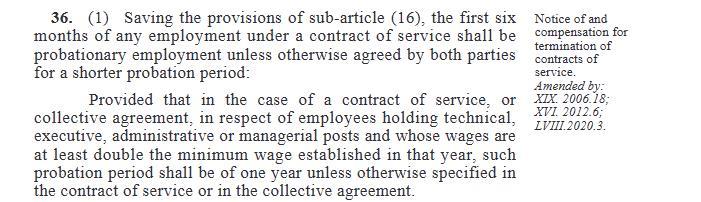
Central to the dispute is Article 36(1) of the Employment and Industrial Relations Act (Chapter 452 of the Laws of Malta) (EIRA), which governs the probationary period in employment contracts.
As it stood on 1 December 2022, the date on which the appellant's employment contract was signed, Article 36(1) provided that the first six months of any employment under a contract of service shall constitute a probationary period. During this period, either party may terminate the contract without the need to establish any reason. However, the parties may agree to a shorter probationary period.
In the case of employees occupying technical, executive, administrative or managerial positions whose salary is at least double the national minimum wage, this default period is extended to twelve months, unless otherwise specified in the contract of service or in a collective agreement.
In practical terms, therefore, Article 36(1) as it then stood established a default probationary framework: six months for most employees and twelve months for those in senior positions. Crucially, however, the Article allowed the parties to deviate from these defaults, at least as regards the length of the period.
The key question before the Court of Appeal was whether that flexibility extended to excluding the probationary period entirely.
It is important to note that Article 36(1) was subsequently amended by Act XX of 2022, which entered into force on 20 December 2022, approximately three weeks after the appellant's employment contract was concluded. Under the amended version, the framework for probation was restructured and the question of whether, and to what extent, the parties could contract out of the probationary period was altered.
For ease of comparison, the current wording of Article 36(1) of EIRA is reproduced below:
By contrast, at the time Taylor's employment contract was entered into in December 2022, Article 36(1) of EIRA provided as follows:
The Industrial Tribunal's decision
The Tribunal found in favour of the Company and dismissed Taylor's claims on the grounds that his employment was terminated during his period of probation. According to the Tribunal, under 36(1) of EIRA, there was a period of probation in an indefinite contract of employment by operation of law, regardless of what was stated in the contract.
In the Tribunal's view, the statutory provision prevailed over the terms of the contract. For a role at the highest executive level, such as CEO, the mandatory statutory probationary period under Article 36(1) was twelve months and applied in the circumstances.
The appeal: three core questions
On appeal, the Court of Appeal considered three principal legal issues:
1. Which version of Article 36(1) EIRA applies:
While the employment contract was concluded on 1 December 2022, the amendment to Article 36(1) introduced by Act XX of 2022 entered into force on 20 December 2022. The termination occurred in late March/early April 2023 and the proceedings before the Tribunal were initiated in June 2023. The appeal was filed in May 2025. The Company argued that the amended version of the law should apply, in accordance with the principle of lex posterior derogat legi priori (the later law prevails over the earlier law).
The Court rejected this argument. It applied instead the principle of tempus regit actum (the law at the time the act is done governs the act), referring also to Article 12(1)(b) of the Interpretation Act (Chapter 249 of the Laws of Malta).
Article 12(1)(b) provides that the repeal or amendment of a law shall not, unless the contrary intention appears, affect the operation of any law before its repeal or anything made or done under any law so repealed.
The Court held that the critical date was 1 December 2022, the day the employment contract was signed, because it is at that point that the probation-related rights and obligations of the parties took effect. On that date, the amendment to Article 36(1) had not yet come into force and the amended law therefore had no application to this contract.
The Court also considered that it would be unfair for the terms regulating an employee's probationary period to change during employment solely as a result of a legislative amendment enacted after the contract was signed. Such an outcome would also be difficult to reconcile with EU Directive 2019/1152 on transparent and predictable working conditions, which Act XX of 2022 was enacted to implement.
2. Could the parties contractually exclude the probationary period?
Having established that Article 36(1) EIRA, as it stood at the time the contract was signed, governed the contract, the Court considered whether the "N/A" entry in the contract was legally effective.
The Tribunal had held that a probationary period is mandatory and cannot be contracted out of. The Court of Appeal disagreed.
Recalling the language of Article 36(1) as it stood at the date of the contract, which, in relation to executive employees, stipulated a twelve-month probationary period unless otherwise specified in the contract of service, the Court noted that this wording does not merely allow for a shorter period. It permits the parties to specify otherwise, which by its plain meaning encompasses an agreement to exclude the probationary period altogether.
This interpretation was supported by the earlier judgement in the case "Sammy M. Hazzouri vs Jesmond Formosa et" (Court of Appeal, 22 February 2016), where the Court confirmed the interpretation that Article 36(1) EIRA did not preclude the parties to exclude the probationary period in its entirety. The provision is not an absolute minimum in the employee's favour that cannot be waived, it is a default rule which the parties are free to modify or disapply by express written agreement.
The Court therefore concluded that in this case the parties excluded the probationary period. In application of the principle of pacta sunt servanda, that agreements freely entered into must be honoured, the Court stated that the parties were bound by what they had mutually agreed, and that their agreement was not contrary to the applicable law at the time of contract.
This meant that Taylor's employment was not terminated during his period of probation and that the company had to have a good and sufficient reason to dismiss him.
For these reasons, the Court of Appeal upheld Taylor's appeal, revoking the Tribunal's decision and remitting the case to the Tribunal, to be differently composed, to decide the merits of the case. The parties were permitted to present additional pleas as a result of this Court's decision.
Conclusion
In the light of this judgment, it is recommended that any probationary clause in a contract of employment should be drafted expressly and assessed by reference to the law in force at the time the contract is entered into, particularly in the case of executive employees.
Dr Karl Grech Orr is a Consultant at Ganado Advocates and Dr Emma Attard Bondi is an Advocate at Ganado Advocates
Disclaimer: This law report has been compiled by Ganado Advocates, who were not in any way involved as legal advisor for the parties in the judgement being covered in this law report. This report is for informational purposes only and does not contain or convey legal advice. The information contained in this report should not be used or relied upon in regard to any particular facts or circumstances without first obtaining legal advice.