Consumers in Malta spend five out of every eight euros they produce, compared to three out of every eight euros spent by the government. This means that they save three out of every eight euros. Here I am talking of personal saving, in other words the saving of households but not of businesses or government. What we call the personal saving rate ̶ the ratio of total personal saving to disposable income ̶ implies a trade-off between current and future consumption.
Individuals receive a certain amount of after-tax income that they can spend or save. What is not spent is obviously saved; that explains why saving and spending are inversely related. A low saving rate implies higher current consumption but lower future consumption and vice versa.
One would think that, if we were to save more (and therefore consume less), economic growth would suffer. But ironically, that is not the case. Indeed, a rise in the savings ratio can have a very significant impact on economic activity.
In principle, there's nothing wrong with a 'savings investment culture.' Higher savings can help finance higher levels of investment as well as boost productivity in the longer term. Why? Because, if people save more, it enables the banks to lend more to firms for investment.
The overall level of investment is one of the main determinants of long-term economic growth. Business investments in physical capital (i.e., machinery, buildings, and factories) allow the economy to produce more goods and services with the same amount of labour or raw materials, increasing the productive capacity of the economy.
When savings are very low, the economy can be said to be preferring short-term consumption to long-term investment. If the economy is starved of investment, this can lead to future bottlenecks and shortages. These tenets are behind the so-called Harrod-Domar model of economic growth, which suggests that the level of savings is a key factor in determining economic growth rates.
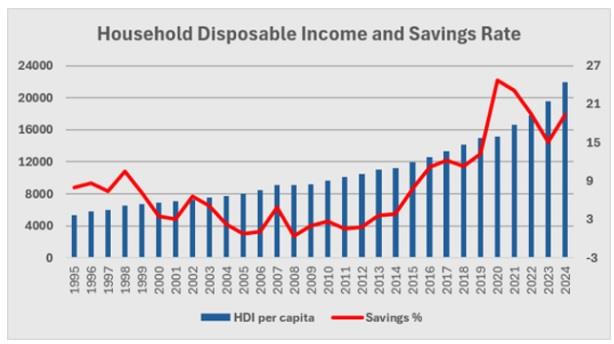
Mind you, this does not hold all the time. In fact, while savings are an important factor in determining investment in the long-term, a rapid rise in savings in the short term can cause a fall in consumer spending, which can lead to a recession. This is exactly what happened when the Covid pandemic broke out. This was also the case of the financial crisis of 2008, when consumer reluctance to spend was a significant factor prolonging economic stagnation.
According to the National Statistics Office, the household savings rate in 2024 was 19.4%, down from a peak of 24.7% in 2020 but still one well above the 14.5% in the EU. The graph shows how the rate dipped during the financial crises years 2008=2012, even though household disposable income per capita kept rising. On the other hand, the rate reached a peak during 2020, when consumers were wary of spending too much given the impact of the Covid pandemic on economic prospects.
When the economy is already in the doldrums, a rapid rise in saving does not cause an equivalent rise in investment. While the banks see a rise in their deposits, they are reluctant to lend to firms because of the pessimistic economic outlook. Even if banks are willing to lend at low rates, businessmen may prefer to wait until there are signs of an economic recovery. It's the usual 'chicken or egg' dilemma.
It's rather a paradox. Savings are good and virtuous, but at the right time. However, if everyone saves at once, it can cause a drop in total demand and cause a recession. The famous economist John Maynard Keynes called it the "Paradox of Thrift." Similarly, there is also the "paradox of savings" - people tend to save more when they think it's a bad time to save and save less when it's a good time to save!
John Citizen is disposed to think that what applies to him personally also applies to the community in general. This is the famous household analogy, where a deficit in household finances is thought to be the same as a deficit in national finances. The rhetoric is false as it assumes that a government is simply a large household that must limit its spending to its current income. I do not intend to go into that here, but interested readers may read what the economist and Nobel laureate William Vickrey, stated in 1998 (https://en.wikipedia.org/wiki/Household_analogy)
In this vein, a freeze in public spending would also be damaging to aggregate demand when there is a recession. Instead, when times are bad, governments should spend more, offsetting the cuts in private sector spending. The consequent increased borrowing by the government compensates for higher private sector surpluses. Contrarily, higher government savings when an economy is strong - like the Maltese economy is ̶ are advisable.
A country's saving rate is often related to a country's current account balance. The latter is a macroeconomic indicator that measures the net flow of money in and out of a country. It is the sum of a nation's trade balance (exports minus imports of goods and services), net income from abroad, and net current transfers, such as foreign aid or workers' remittances.
Countries like Germany and Netherlands have high savings and this is reflected in their current account surpluses. The UK and US, with their low savings, unsurprisingly have current account deficits. Malta is in the same boat as Germany. In fact, during the same period shown in the chart, our current account balance has moved from a negative 10.2% of GDP to a positive 7.12% of GDP in 2024. The average surplus in 2025 was €4.97bn.
All this is very relevant for the macro economy, but it is individuals who at the end of the day are taking decisions. What influences their decisions whether to spend or save?
For a start, there is the question of financial security. Having a nest egg tucked away can be a lifesaver in emergencies like unexpected expenses, job loss, or sudden health issues. A pool of savings also provides peace of mind, in that having money set aside can ease stress and anxiety about the future. It gives the individual a feeling of control over his finances, allowing him to focus on other aspects of his life without constantly worrying about money.
Another factor is that saving allows the individual to work towards his dreams. It could be buying a car, travelling the world, or starting a business. Putting money aside regularly brings people closer to making those aspirations a reality. Or it could open opportunities to invest in assets that have the potential to generate higher returns than the average savings account.
Then, there is the question of preparing for retirement. Although this might be a long way off, early and consistent saving for retirement can significantly impact one's quality of life in later years. Contributing to work pension schemes or a private pension sets up the person concerned for a comfortable retirement. Alternatively, investing one's savings in stocks and bonds can accelerate the growth of one's savings.
However, there are also downsides to savings. One of them is budget stress - putting aside savings reduces the money that is left to budget for spending. An excessively tight spending budget can lead to stress, frustration, and reduced enjoyment of everyday life.
Too much saving can sometimes lead to missing out on social opportunities that require spending, such as attending a concert, dining out with friends, or taking a vacation. Not to mention that inordinate frugal habits may strain family relationships or produce feelings of isolation.
Earlier, I mentioned investing saving for retirement. Many investments can offer attractive returns over the long term, but on the other hand, some ̶ such as real estate or certain retirement accounts ̶ may restrict access to funds or involve penalties for early withdrawal. Therefore, one has to keep in mind that such investments may not be suitable for short-term financial needs or emergencies requiring immediate access to cash.
In addition, an overemphasis on saving can occasionally create a psychological barrier to spending, leading to frugality or self-neglect. So, while saving is essential, it's equally important to strike a balance and allow the opportunity to enjoy experiences that enhance quality of life.
Coming back to the country's savings, Malta is awash with cash. The Maltese still love cash. According to a survey by the Central Bank of Malta, 86% of us carry some cash in our wallets. Cash is particularly prevalent among older age groups, with 99% of respondents aged over 64 reporting that they carry banknotes, compared to 77% of 18- to 24-year-olds.
The most commonly cited reason for preferring cash is the sense of control it offers on spending (17%), followed by convenience and the absence of transaction fees (13% each). Meanwhile, those favouring digital payments primarily cite convenience (24%) and the ease of online shopping (17%).
What we don't carry in our pockets or stash at home, we put in savings accounts with the banks. In fact, the commercial banks are sitting on enormous piles of money that they cannot find productive uses for. Cash and customer deposits held by major commercial banks in Malta total over €27 billion, reflecting high liquidity buffers and conservative lending criteria.
At the same time, our society faces urgent and obvious needs. We need new affordable housing, better public transport, upgraded energy distribution systems, proper drainage, climate change defences, schools, hospitals, and environmental restoration. All of these are underfunded and require sustained long-term capital commitment. The social return on these investments would be enormous, and the economic returns could be substantial too.
The resources to fund these investments exist, but the connection between savings and social need has broken down. Our growing economy has created the financial wherewithal to use savings for investments. Government revenues have swollen, but the government has preferred to fuel recurrent expenditure rather than capital spending.
We badly need to change our strategy towards the use of savings, incentives, and investment frameworks. Only in this way can we actually promote the social benefits that could transform our society.