You have been publishing poetry for almost 40 years. Italy - and, by extension, the world - has changed radically since you started writing. How has your writing changed, if at all, over the decades?
My poetry is a child of the 20th century - of a literary tradition that, from the Middle Ages through the 20th century, maintained a sociocultural role that remained largely unchanged in terms of its forms, figures, mythologems, and ideologies. Descended from the classical fathers, from Dante to Montale, and serving as a (younger) sister to the greatest daughter of Italian 20th century poetry, Amelia Rosselli, my poetry is born as postmodern, allusive, and hyper-literary. It was shaped against the backdrop of a process - underway particularly since the second half of the last century - of female authorial self-definition: a phenomenon I termed "authorisation to write" (autorizzazione a scrivere) in my essay collection Figlia di solo padre (Macerata, Seri Editore, 2021). This process of female authorship required a tragic phase (marked by the devastating suicides of many female poets) to secure that authorisation: breaking a taboo and transforming from a muse-like "You" into an "I" entailed assuming the paternal role. It meant writing foundational poems rather than mere love lyrics. This is how my first two ripe books evolved: Comedia (Milan, Bompiani, 1999) and Lo dittatore Amore. Melologhi (Milan, Effigie, 2004).
The turn of the century and the millennium brought about a rhythmic shift, following a seven-year silence after my final phase, the phase of the melologue. The texts became more concise, and the rhythm - often proparoxytone - evoked, in Crolli (Florence, Le Lettere, 2010), the slow-motion collapse of our civilisation: that Spenglerian "Decline of the West" which, alas, has not merely failed to materialise as predicted but has - through capitalist madness - infected the entire globe, condemning humanity not merely to a sunset, but to a night, perhaps a final one.
This strikes me as the core of our contemporary era, defined by a global and ceaseless state of warfare driven by capitalist consumption. The languages of my subsequent books evolved from this one; yet, in those later works, I also reclaimed - albeit through different rhythmic modes - the "melological" function, given that theatre has been the art form closest to my poetic voice from the very beginning. My latest book, Tande (2023), named after my childhood transitional object and also an anagram of "Dante", stands as a 21st century response to the 20th century Comedia. I believe these two works mark the opening and closing of a cycle: a reckoning between my poetrice self and those "hated-and-loved" literary Fathers, as well as my own background - including its confessional aspects (as evidenced by Anne Sexton, whom I translated for 30 years and whose complete works I have just rendered into Italian for the first time) - culminating in a sense of "authorisation" and gender parity in authorship, something unthinkable until the last century.
You are a poet, performer and translator (of Anne Sexton, among others), as well as an essayist and a teacher of literature and the art of reading poetry aloud. In Italian, you describe yourself as a "poetrice", combining "poetessa" (poetess) and "attrice" (actress), because your work with text, body and voice is inseparable. What opportunities exist for reading poetry aloud today, and what is the power of this practice?
Compared to the 1990s, a time teeming with poetry festivals and evenings dedicated to poetry and music, venues for live poetry readings and performances have significantly dwindled today.
Unfortunately, virtual spaces such as YouTube and podcasts, even those of excellent artistic quality, have largely replaced the live experience, at least in Italy.
Have you ever found yourself revising a text after reading it out loud in public?
Many times! The final versions of my texts always emerge after repeated attempts at voicing them. Rhythm and vocality are paramount in my verse writing; the writing originates in the voice and returns to it.
Your poetry brings together a variety of registers, including formal vocabulary, colloquial speech, technical terms and dialect. (Interviewer's note: for an example of this variety, I recommend reading the poem 'Penelope'. Now that Christopher Nolan's 'Odyssey' is in cinemas, it's interesting to discover another of the countless rewritings of Homer's epic). Does your work on language come after the first drafts of your texts, or does it happen at the same time? If we were to look at your computer or a notebook of yours while you were writing, what would we see?
The preparatory work for writing can last an indefinite amount of time, during which I jot down linguistic fragments that appear by chance. Intuition indicates the fragments I catch in conversation, reading, or literary recollections are linked to content taking on a rhythmic form within the poetic mind, perhaps the unconscious, or perhaps Broca's area ...
These notes might coalesce into a text after a short time or a very long one. My only task is to reread them as they accumulate and let them work within my ear and mouth. Then, once the materials point toward a series of texts or a long poem - such as Penelope (Naples: d'if, 2004) or the more recent Unamedea (Livorno: Valigie Rosse/Ciampi Prize, 2021) - I move on to drafting the text and, subsequently, to the many stages of revision.
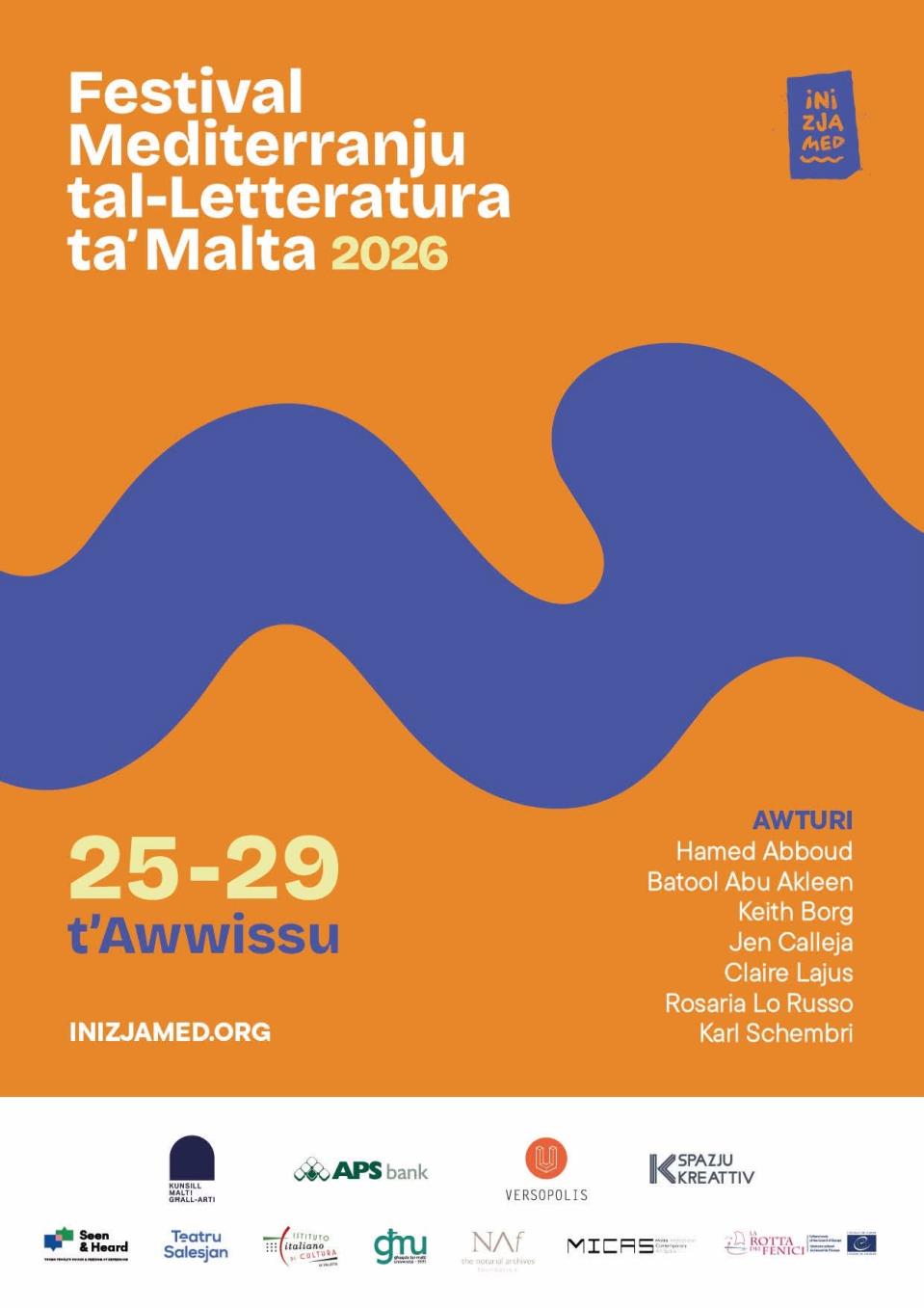
About the festival
The 21st edition of the Malta Mediterranean Literature Festival will feature seven leading authors from six different countries: Jen Calleja (United Kingdom), Claire Lajus (France), Karl Schembri (Malta/Kenya), Keith Borg (Malta), Hamed Aboud (Syria), Rosaria Lo Russo (Italy), and Batool Abu Akleen (Palestine/France).
The festival, organised by Inizjamed, will be held between Tuesday 25 and Saturday 29 August. This edition is being held in partnership with the Malta Arts Council and with the support of Versopolis. The festival is collaborating with Spazju Kreattiv and also has the support of APS Bank, Għaqda tal-Malti - Università, Istituto Italiano di Cultura di La Valletta, The Data Knitters, Merlin Publishers, Merlin Library, Notarial Archives Foundation, and Teatru Salesjan.
For more information follow on Facebook, Instagram, and Inizjamed's website www.inizjamed.org.
Serena Alessi, a former director of the Italian Cultural Institute in Malta and Cultural Promotion officer at the Italian Ministry of Foreign Affairs and International Cooperation