The Malta Bankers' Association (MBA), in collaboration with EY, hosted banking professionals and industry stakeholders at BOV Centre for a focused discussion on Frontier AI, cybersecurity and the resilience of Malta's financial services sector.
Opening the event, MBA chair Kenneth Farrugia said the fast pace of artificial intelligence requires banks to think beyond individual institutions and respond with a shared sense of responsibility. "The challenges facing our industry, particularly those arising from artificial intelligence and cybersecurity, cannot be addressed effectively by institutions working in isolation," said Farrugia. "They require shared expertise, open dialogue and a clear commitment to protecting the resilience of our sector and the trust of the communities we serve."
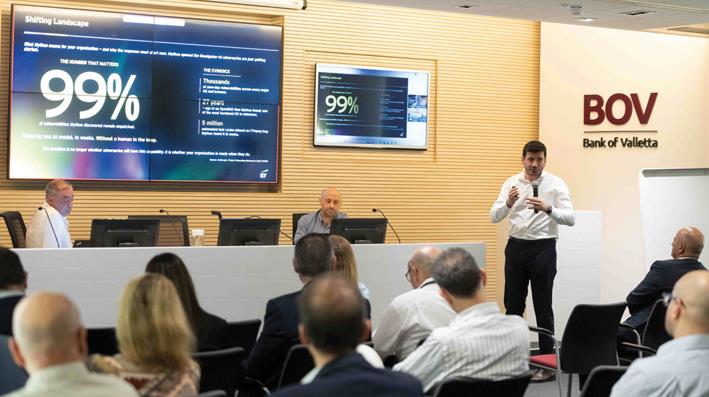
The session brought together expertise from EY cybersecurity specialists Curt Gauci, partner in Technology Consulting at EY Malta; Christos Yiacoumis, partner in Technology Consulting Cybersecurity at EY Cyprus and Panagiotis Papagiannakopoulos, EY Europe Central Financial Services Cybersecurity leader and EMEIA Microsoft Cloud Security Centre of Excellence leader.
The EY speakers noted that Frontier AI is moving quickly from productivity support to an operational capability that can reason, analyse complex information and execute multi-step workflows. For banks, this opens the door to greater efficiency and innovation, but also raises the urgency of managing cyber threats that are becoming faster and more sophisticated.
A central message from the discussion was that banks need to be both AI-enabled and AI-resilient. This means embracing the opportunities of AI while ensuring that governance, cybersecurity and operational resilience frameworks remain strong enough to keep pace with change.
Drawing on EY's Global Cybersecurity Leadership Insights' study, the presenters highlighted the importance of visibility across increasingly complex technology environments. EY's research indicates that 36% of organisational assets globally fall within the "vulnerability zone", while 80% of cybersecurity leaders believe their most significant risks sit in blind spots.
Farrugia said the discussion reinforced the MBA's role as a forum where member banks can examine common risks, exchange experience and strengthen collective preparedness. "The pace of technological change means that resilience cannot be treated as a one-off exercise. It calls for continuous investment, sound governance and close cooperation across the industry," he said. "Through the MBA, member banks can build a stronger understanding of emerging risks and contribute to a banking sector that is more resilient, informed and future-ready."
Farrugia also thanked EY for bringing international expertise and research into the local industry conversation. "Partnerships of this nature help ensure that Malta's banking community remains informed, prepared and responsive as the technology and risk landscape continues to evolve," he added.
The discussion also addressed continuous asset and identity visibility, stronger third-party risk management, faster vulnerability remediation and the responsible use of AI-assisted cyber defence. Participants were encouraged to view Frontier AI not only as a technology matter, but as a strategic resilience priority for boards, senior management and leaders across technology, risk, operations, data and business functions. "By combining knowledge, experience and a shared sense of responsibility, we will be better placed to harness the benefits of innovation, respond to emerging threats and protect the trust on which banking is built," Farrugia concluded.
The event underscored the need for continued dialogue and cooperation as banks seek to harness AI's potential while safeguarding resilience, security and trust.