Two Maltese university students have returned from the European Space Agency's Alpbach Summer School with awards after being selected among a pool of international participants to spend nearly two weeks in the Austrian Alps designing spacecraft to explore different planets of their choice.
Karl Caruana and Liliana Francalanza gave exclusive comments to The Malta Independent on Sunday about their experience at the summer school and the mission concepts they helped design.
The Alpbach Summer School has built a reputation in the space sector for launching careers, with alumni going on to senior roles across the field. Josef Aschbacher, now director general of the ESA, took part in the programme in 1989.
Participants spent their first days attending lectures on high-energy processes and system engineering before splitting into their groups each evening to begin planning their missions, working with tutors who remained on hand throughout the week to guide the competing teams. A hike up a nearby mountain and a swim in a lake gave participants a break roughly halfway through the 10-day stint, before the final push to complete and present their proposals to fellow teammates and judges.
Both Caruana and Francalanza said they were grateful to Xjenza Malta for sponsoring their participation in the programme.
The organising committee opened the programme with an address before the preliminary lecture days began, covering everything from the specifics of high-energy processes to system engineering and the practicalities of designing a space mission. Participants said the pace was relentless from the outset, with early starts for lectures followed by late nights of mission planning, leaving little time for sleep across their working stint.
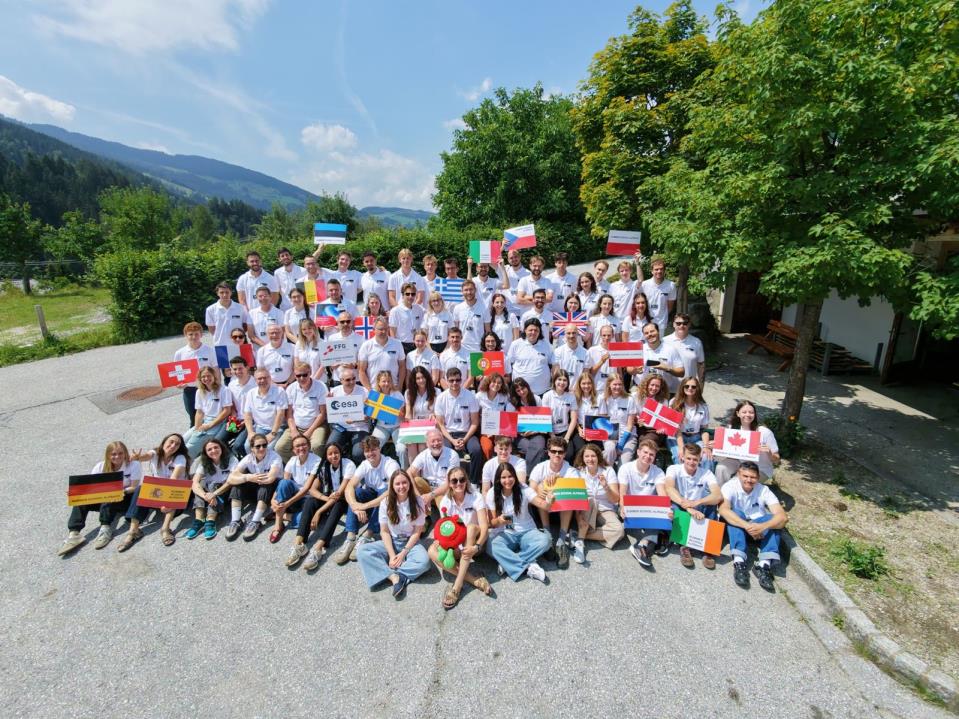
Caruana said he first heard about the programme from a previous Maltese participant and came across the application form online, applying partly out of curiosity and partly to see how the experience might shape his future academic direction. Being selected to represent Malta, he said, came as a pleasant surprise.
Caruana's design for a mission to Jupiter
Caruana worked with the Red Team on AEGIS, a dual-spacecraft mission concept aimed at understanding how energy moves through Jupiter's plasma environment, magnetosphere and upper atmosphere. The proposal would see an equatorial and a polar spacecraft take synchronised measurements to help resolve aspects of Jupiter's magnetosphere and the effects of moon-driven mass loading, with potential lessons for the study of similar systems elsewhere.
Over the course of the programme, Caruana and his teammates produced a technical proposal spanning literature reviews, instrument studies, orbital calculations, subsystem research and budgeting, bringing together science, engineering and financial planning within tight deadlines. For Caruana, much of this meant learning a largely unfamiliar field from scratch while working out how best to contribute to the team. Their work earned the team the Best Concept of Operations award at the programme's closing ceremony, in recognition of what organisers judged the most well-thought-out operational strategy among the proposed missions.
Caruana said the experience gave him the chance to put his academic knowledge into practice while rapidly getting to grips with an area of study that was largely new to him. He described picking up an unfamiliar topic and learning to work effectively within a team of near-strangers, who quickly became close friends, as both the most challenging and the most rewarding part of the experience. Beyond the late nights and the hikes, he said, it was the people he met that made the two weeks especially memorable. As a mathematics and physics student, he added that he was particularly thankful to Xjenza Malta for fully sponsoring his participation.
Francalanza's design to making it to Uranus
Francalanza was part of the team behind UMEO, a mission concept that would send a spacecraft to Uranus to investigate its unusual magnetosphere. Uranus has been visited only once, during Voyager 2's 1986 flyby, an encounter later found to have coincided with a rare solar wind event affecting fewer than 5% of observations, raising questions over how representative some of its findings were.
UMEO's proposal focused on five gaps in current knowledge of the planet: its radiation belts, aurorae, atmosphere, magnetosphere and magnetic reconnection processes. Francalanza said the team repeatedly ran into difficulties, particularly around payload considerations for a mission travelling that far from Earth, and more than once thought they might have to abandon the concept altogether, but said the team's combined skillset meant a solution was usually close at hand whenever a problem arose.
As a third-year mathematics and physics student, Francalanza said she had far less experience in space science than many of her fellow participants and had to work through a steep learning curve to get her bearings. She credited the support of teammates and tutors, alongside her own individual research, with helping her contribute meaningfully to the mission over the course of the programme. After 10 days of research, planning, writing and revising, the team's finalised proposal went on to win the Most Ambitious Feasible Mission award, a result Francalanza said she was proud of, given how much work had gone into it.
Francalanza said the best part of the experience was, unsurprisingly, the people, describing the tutors as motivating and the organisation as polished, and calling the working environment in Alpbach one that kept participants engaged through the long nights despite the demanding schedule. She said the experience would not have been possible without the sponsorship of Xjenza Malta.
Both students said the fortnight left them with skills and contacts they expect to draw on as they continue their studies at the University of Malta. With Alpbach 2026 concluded, Caruana and Francalanza said they hope the experience will encourage other Maltese students to apply for future editions of the summer school.