The growing sophistication of financial crime, geopolitical volatility, regulatory transformation and the rapid development of artificial intelligence were among the challenges addressed at a conference organised by the Malta Bankers' Association (MBA) in collaboration with EY Malta, on 29 September 2026, which brought together representatives from across the financial services sector to examine the evolving threat landscape and the response required.
Held under the theme Navigating Complexity: Modern Defences against Financial Crime, the conference, organised with the instrumental involvement of the MBA's Financial, Cyber Crime and Fraud Standing Committee, explored issues ranging from sanctions evasion and proliferation financing to the effectiveness of anti-money laundering controls, human trafficking, and the opportunities and risks presented by artificial intelligence.
Opening the conference, MBA Chair Kenneth Farrugia highlighted the extent to which the financial crime landscape has evolved over the past two decades. He noted that what was once a relatively straightforward transaction-processing environment has developed into a far more complex ecosystem, encompassing advanced transaction-monitoring systems and controls, evolving regulatory requirements and increasingly sophisticated forms of criminal activity. Geopolitical tensions and the sanctions arising from them have added further layers of complexity.
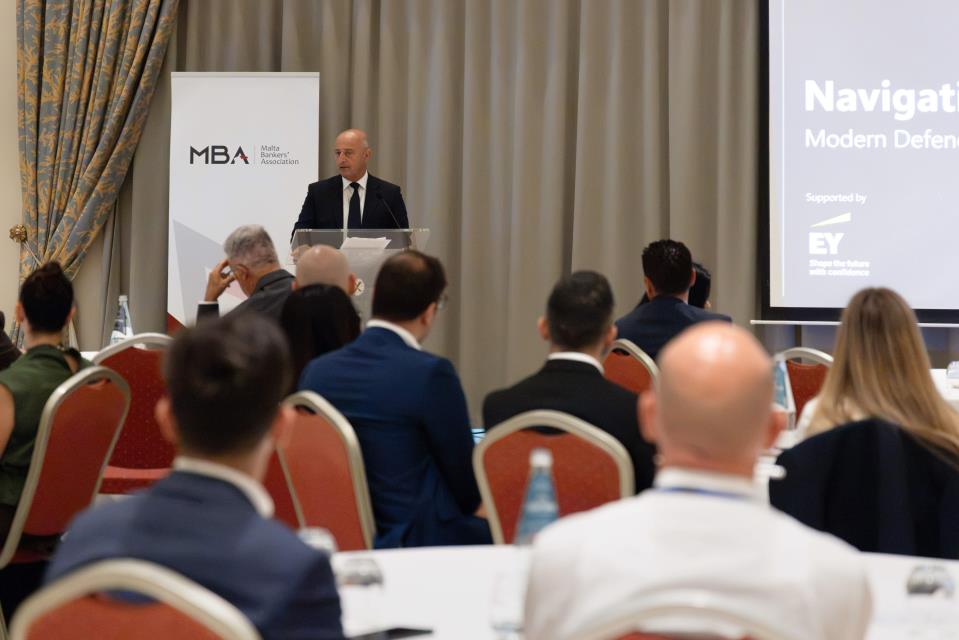
Mr Farrugia stressed that responding effectively to these threats requires collaboration across the financial system, rather than institutions operating in isolation, with banks and other financial institutions, regulators, enforcement authorities and other stakeholders working together. "Our responsibility is not only to protect our respective organisations. Our responsibility extends itself to the national dimension," Mr Farrugia said, highlighting the wider reputational and economic consequences that financial crime can have for a jurisdiction.
The changing nature of financial crime and the need to anticipate emerging threats were also emphasised by Cynthia Borg, Chair of the MBA's Financial, Cyber Crime & Fraud Standing Committee. She identified regulatory transformation, geopolitical volatility and artificial intelligence among the forces reshaping the work of financial crime compliance professionals, noting that the challenge is no longer simply to keep pace with change, but to anticipate it.
Throughout the morning the varied and insightful programme was delivered by; George Grech - GREX Strategies, Michael Stellini - Stellini Advisors, Ruth Dearnley from the NGO Stop the Traffik, Dr Dylan Seychell - University of Malta, Neil Micallef - Malta Digital Innovation Authority, Manuel Delgado - EY Spain. Moreover, representatives from the Financial Intelligence Analysis Unit, the Malta Financial Services Authority and the MBA member banks, participated at two thought-provoking panel discussions.
A recurring focus within all the interventions was on how institutions within the financial services sector can respond effectively to increasingly complex risks, moving beyond a 'tick-box' approach to financial crime controls. The evolving European regulatory landscape also featured prominently, including the role of the EU's Anti-Money Laundering Authority (AMLA) and the move from interpretation to implementation of new anti-money laundering requirements. The discussions also reflected the wider responsibilities of the financial sector, from its role in identifying and addressing the financial dimensions of human trafficking to balancing the opportunities offered by artificial intelligence with the risks and accountability challenges it presents.
Closing the conference, MBA Secretary General Karol Gabarretta said that, while the issues examined throughout the day were diverse, they were connected by a common message: effective financial crime prevention cannot be achieved by institutions acting alone. He emphasised the need for sustained cooperation between the financial sector, regulators, supervisors and enforcement authorities, as well as technology experts, academia and civil society. Mr Gabarretta added: "Our task now is to translate today's insights into stronger cooperation, more effective application of controls and enhanced oversight, ultimately leading to greater protection for our institutions, our customers and society in general."
The conference forms part of the MBA's ongoing work to support dialogue and knowledge-sharing on issues affecting the banking sector, bringing together member banks and relevant stakeholders to exchange expertise and perspectives on emerging challenges.