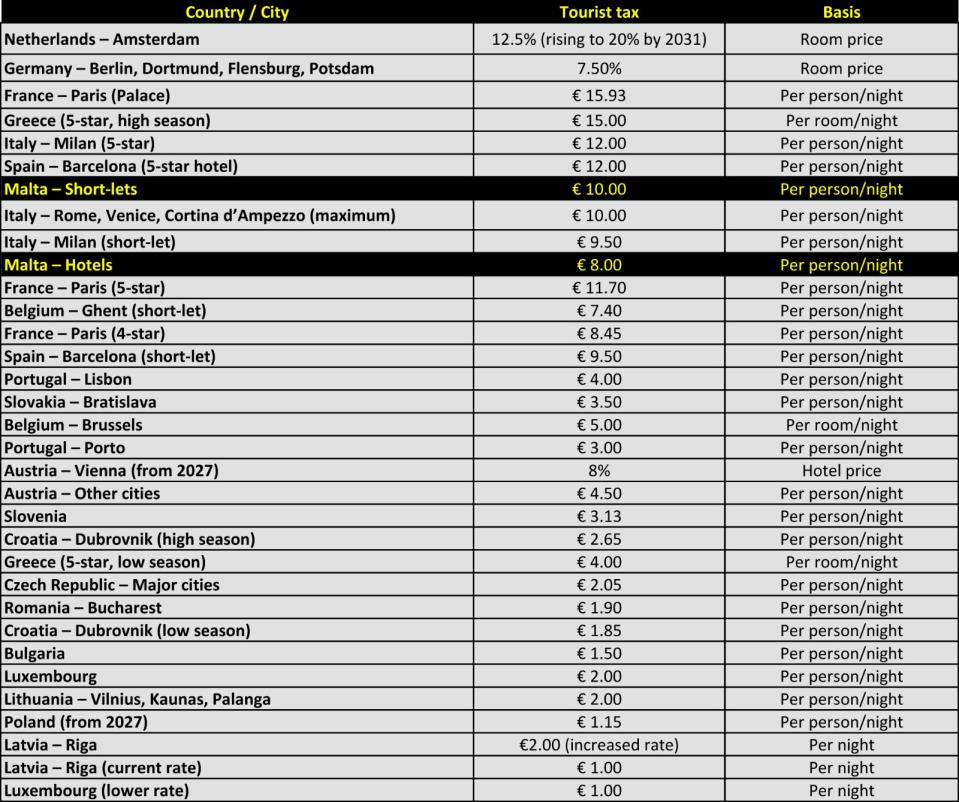
Malta's newly revised tourist taxes will be among the highest across the whole European Union once they are implemented, an analysis by The Malta Independent on Sunday shows.
Malta's tourist eco-contribution tax initially sat at €1.50 per person per night, with no distinction made on whether the person is staying at a hotel or a short-let apartment.
In his Budget speech last Monday however Finance Minister Clyde Caruana announced that the eco-contribution would be increased to €8 per person per night for people staying in a hotel and €10 per person per night for people staying in short-lets such as apartments or farmhouses.
Research by The Malta Independent on Sunday shows that Malta previously ranked as having one of the lowest tourist taxes in the EU, but will now rank among the highest across the bloc.
Tourist taxes come in various forms, have varying names, but intrinsically are backed by the same principle: that a levy is imposed on someone making us of touristic accommodation in order to make up for the impact that they have on the place.
Some countries - like Malta - charge a flat rate, others have a rate which is dependent on the quality of accommodation that a person stays in, and others impose a percentage of the value of the room as the tax rather than setting out a fixed fee.
Ireland and Sweden both do not have any form of tourist tax. Estonia and Finland join that list, but there have been thus far unsuccessful discussions in both countries for a tourist tax to be introduced.
Denmark also currently has no tourist tax, but this may not be the case for much longer, as a 20 kronor (around €2.60) per night tax may be introduced in Copenhagen and Aarhus.
Cyprus theoretically does not have a tourist tax, but a €2.50 per person per night 'Green Tax' effectively serves as such.
A host of other countries then do impose tourist taxes along roughly similar lines.
Poland has is the most recent country to join the tax club: a tourist tax of a maximum of 5 zloty (around €1.15) per person per night will come into force at the start of 2027, having been signed into law last week.
The tourist tax in Bulgaria ranges from as little as €0.10 up to €1.50, depending on the municipality; Latvia has a €1 per night tax in its capital city Riga, although that is set to increase to €2; Lithuanian cities Vilnius, Kaunas, and Palanga charge a €2 per night tourist tax; and Romania has a 10 Leu (around €1.90) tax for staying in the capital city Bucharest.
The tax in Slovenia ranges between €2 and €3.13 per person per night, while in Slovakia's capital Bratislava it is slightly higher at €3.50 per night. Luxembourg's tourist tax varies between €1 and €2 per night, but a couple of areas instead charge a 3% tax based on the hotel fee as the tax.
In Croatia, the fee varies by season: for instance visitors to the tourist hotspot of Dubrovnik would pay €2.65 per person per night between 1 April and 30 September, but that would fall to €1.85 per person per night at any other point of the year.
Visitors to the Czech Republic pay 50 Czech Koruna (around €2.05) per night in major cities, Portugal has a €3 tourist tax in Porto and a €4 tourist tax in the capital Lisbon, and Hungary charges a tax of 4% per person on the cost of the room.
In other countries which are perhaps more known for attracting tourists, the taxes are higher.
In Austria, the tax in most cities varies between €2.50 and €4.50 per person per night, but in the capital Vienna as of next year the tax will increase from 5% of the hotel fee to 8% - which is noteworthy since the average hotel price is, per Eurostat hotel price index, above the EU average.
Greece is one of the great Mediterranean tourist hotspots and its tax, which is officially known as the Climate Resilience Tax, varies based on the standard and size of the accommodation and on whether it is high season or low season.
Between November and March, the tourist tax on hotels ranges between €0.50 per night in 1 and 2 star hotels and €4 for 5 star hotels. Between April and October though, the tax is considerably higher, starting at €2 per night for 1 and 2 star hotels and rising to €15 per night for 5 star hotels.
The key difference with other tourist taxes is that the tax is calculated on a per room per night basis, rather than on a per person per night basis. This means that if a group of four people book a single night in a 5 star hotel and stay in the same room, the tax would still be €15, even though it is split between four people.
Belgium's capital city Brussels has a similar per room per night system, with tourists paying a tourist tax of €5 per night. The city of Ghent is also one of the few where, like in Malta, there is a differentiation between hotels and short-lets in favour of the former: tourists pay €4.40 per night if they stay in a hotel and €7.40 per night if they stay in a short-let.
Like Greece, France's tourist taxes are pegged to the standard of the hotel. The capital Paris has the most expensive tourist tax in the country, but it ranges from €2.60 per person per night at a 1-star hotel or a hostel right up to €15.93 per person per night for a Palace.
The tax for a 4-star hotel (€8.45) and a 5-star hotel (€11.70) in Paris are both more expensive than the €8 hotel tourist tax that Malta will charge, but lower standard hotels in Paris have a cheaper tax than there will be in Malta.
In no other French city, even if you stay in a Palace, would you have to pay a tourist tax that is more expensive than Malta's. Bordeaux is the city with the second highest tourist tax, and that ranges from €1.15 for a 1-star hotel to €7.06 for a palace.
Italy too has differing tourist taxes across different cites which are pegged according to hotel standards: in Milan for instance you would pay a €3 per person per night tax if you stay at a 1-star hotel, rising up to €9.50 if you stay at a short-let, and €12 if you stay at a 5-star hotel. The rates are slightly cheaper in shoulder months, but only by a couple of euros.
€10 per person per night is also the upper end for Roma, Venice, and Cortina d'Ampezzo - but the tax is lower for hotels which are not 5-star.
Regional variance is a theme in other countries too. In Germany there is no tourist tax whatsoever in Munich, but visitors to the cities of Berlin, Dortmund, Flensburg, and Potsdam would have to pay a 7.5% tax on the room cost - no small figure when you consider that, per Eurostat, the average hotel price in Germany is the 8th highest in the EU.
Spain also has similarly wide variances: there is no tourist tax in the capital Madrid, but tourists in Barcelona can expect to pay between €6 and €12 per person per night. The cheapest rate is for youth hostels and the most expensive is for a 5-star hotel.
People staying in short-lets in Barcelona would pay a tourist tax of €9.50 per person per night - €0.50 cheaper than the tax set out for Malta, in a city which has taken short-lets as such an affront that it has banned them. All short-lets in Barcelona are expected to be phased out by November 2028.
However, and perhaps surprisingly, far and away the most expensive tourist tax can be found in the Netherlands, specifically in Amsterdam. Here, the tax is set at 12.5% of the roommate but there are plans to increase it incrementally every year until it reaches a whopping 20% by 2031.
Couple this with the fact that, per Eurostat data, the Netherlands has the 4th highest hotel prices in the EU, and it means that this is where you would expect to pay the most in tourist taxes.
The trend across Europe is that the vast majority of countries have some form of tourist tax, and many cities are increasing those tourist taxes much like Malta has done.
However, taking into consideration the tourist taxes across the EU, Malta has evidently gone from being one of the countries with the lowest tourist tax to having one of the highest.