Schools have important role in structuring the healthy eating habits for children, Environment Minister Leo Brincat said today.
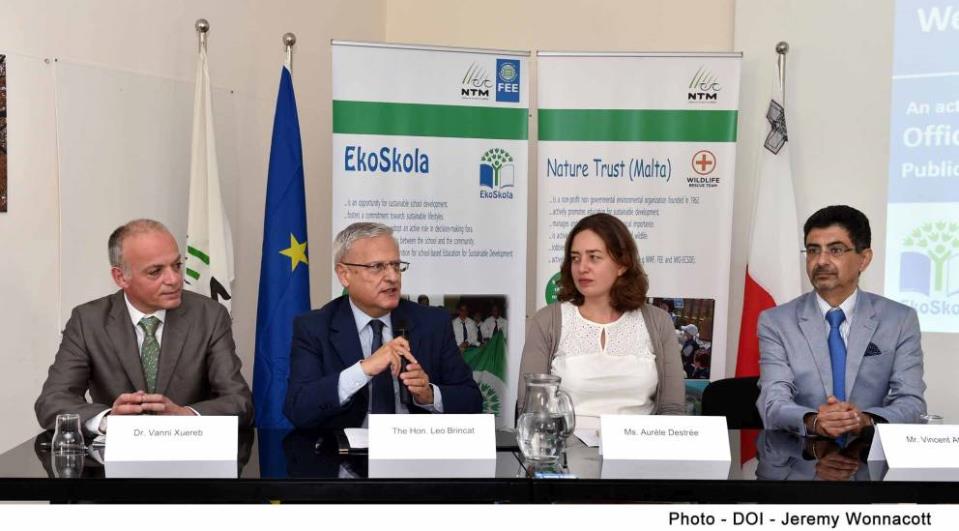
He was speaking at the launch of an EU Funded 3-year project called ‘We Eat Responsibly’, at the Xrobb l-Għaġin Nature Park and Sustainable Development Centre. The project is being carried out in collaboration with eight other EU member states and forms part of the Eko-Skola international network. It is aimed at raising awareness about food consumption and the how EU initiatives are focusing more on security, sustainable consumption and the reduction of food waste.
Mr Brincat said there are six pivotal aspects that we should constantly bear in mind. “The food we eat affects not only our health but also that of the environment. Education is the key to the process. One needs to be aware that our food choices impinge upon the demand, the production and the distribution of food. This reality makes a strong case for the EU wide and global initiatives currently underway towards food security, sustainable food consumption and food waste reduction.
Eating responsibly means that we should seek to understand not only what we are eating and where it originates from, but also the effects of our eating habits on the Earth’s environmental systems.
Thus, learning how to take charge of our eating habits may prove, to ultimately, be the most important weapon we have in effectively combating the global threats of climate change and the destruction of biodiversity.”
Effectively every aspect of our life is fair game for taking responsibility, including our eating habits. We owe it to ourselves to be well informed about our eating options and what makes a healthy diet.
The Minister said we need to become committed more than ever to encouraging a healthy lifestyle. “A case in point are the sweeteners. It is becoming increasingly evident that apart from being loaded with chemicals we are still not sure of their lasting effect even psychologically. Health wise the scariest part of what is often referred to as fake sugar is that the products are too new to know what the long term effect of the chemicals are going to have on us.
This is where corporate social responsibility comes into play too. Finding out the liability side when it is too late comes at a very costly price. Pesticides have long been shown to cause a variety of illnesses. The same goes for certain fertilizers. They can negatively affect both our bodies and the land itself. This goes to prove why organic food should not be dismissed lightly as a mere social fad.
What should definitely help accelerate the path leading towards positive and innovative thinking in this regard is the increasing need for current food labelling practices and transparency standards to be ideally strengthened and enhanced further. Some countries have even set up task forces on preventive action that can be taken to influence healthy food.
The importance of schools in this whole process cannot be underplayed or underestimated. They play an important role in structuring the healthy eating habits for children. Sustainability will really happen when they together with other educational sectors, be they governmental, private, independent or church run, adopt further healthy food policies that limit or eliminate foods high in sugar, salt and fat while providing healthy food and drinks. Parents also need to keep an eye on what their children are eating if we want the problem to be tackled holistically.
“While I intend to co-sponsor and support any such initiatives that may arise within the Council of Ministers of the EU, in conclusion it is very good to note that only two weeks ago MEPs in the European Parliament backed measures to teach healthier eating habits by emphasising that both the EU and its member states should do and spend more to encourage kids to eat healthy and local foods. Not only did they call for healthy eating lessons, but also for school milk, fruit and vegetables from EU schemes. Particularly since consumption of fruit, vegetables and milk has been declining across the EU, with many negative consequences for society itself.”
Mr Brincat said obesity was recently described as the new smoking. “By arguing that obesity had become the key battle for public health while hoping that parents and teachers would do a similar amount to discourage consumption of sugar as was done with salt. Particularly since one in five cancer deaths are now caused by obesity. In order to succeed we cannot limit ourselves to targeting the educational sector. It is also important to reach out to responsible retailers and food producers and distributors. It has long been established that sugar consumption can cause cancer, diabetes and heart disease. With more lessons, better choices, and fairer funding things can move ahead at a higher level too.”