It was a bravura performance, no doubt about it.
Finance minister Edward Scicluna yesterday held a Business Breakfast as part of the pre-Budget consultation process. The meeting was held at the Casino Maltese in Valletta.
More than a presentation, to which we have become accustomed, the minister gave a professorial lecture which was very illuminating to the listeners.
In it he explained the decisions the government took over the past two and a half years and how through these decisions Malta avoided falling into the same austerity trap other member states fell through following the Commission's austerity path.
At first, in the present legislature, there were a lot of divergent views as to what should be done.
Many were of the opinion the new government should above all bolster demand. But the government argued that for a long time Malta had ignored the supply side, that is the labour force, investment and energy.
The Commission, on its side, was urging severe cuts and austerity measures. Had the government listened to this, Malta would have gone the same way as Greece, Ireland and other stressed countries and such measures, as has been proved in these countries, did not affect the public debt situation.
In the pre-2013 years, growth averaged 0.5% and the new government told the Commission that with an increase in exports, the economy would improve. Then Commissioner Olli Rehn accepted this reasoning and stood behind the government.
To this bold decision, the government added another one: it decided to go along with the Budget prepared by the previous government, which was approved in April 2013. The coming one will be the third Budget totally prepared by this government.
In its successive budgets, this government tried to change the behaviour patterns of the economic factors.
The availability of social security payments had created a dependency and people concluded it just did not pay to work.
The government decided to break down this pattern, even if some social partners were against.
Through the changes introduced later by the government, no less than 2,000 Long Term Unemployed returned to the job market. In particular, the government did not allow those under 23 from getting social security unless they joined the Youth Guarantee Scheme. In this manner, the government avoided creating a generation of young able-bodied people who spend their day watching TV or playing games.
These people returning to work contributed in no small manner to the growth that has been registered.
The next obstacle to be tackled was children seen as a burden by those who otherwise would have gone to work. So incentives were given for childcare facilities.
As to productivity, Malta has one of the highest tax burdens on labour in the EU.
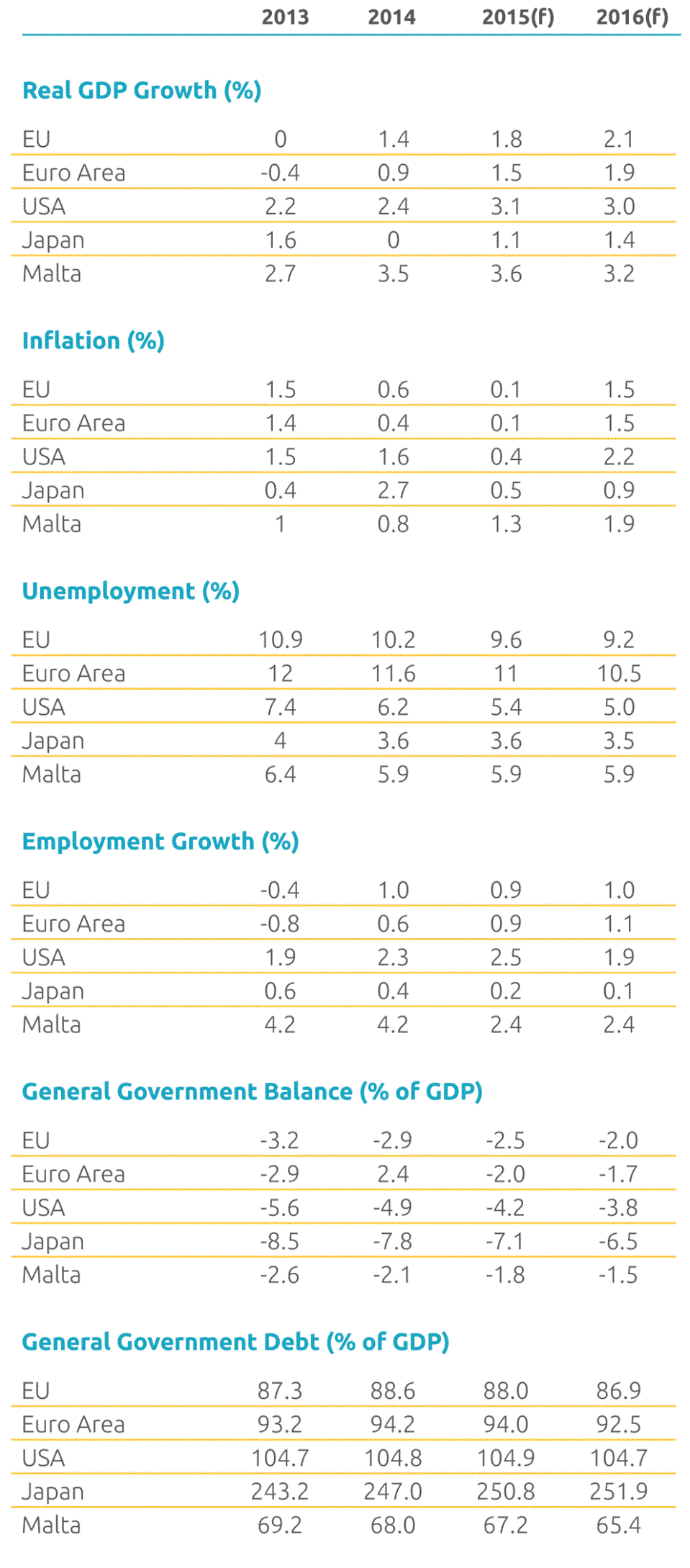
Growth giving results
As a result of these reforms, there has been a 12% growth of jobs, mainly in the private sector since employers see the economy is doing well.
Other countries in Europe have bigger problems but Malta along with Germany is at the top of the league tables in this regard.
The growth in jobs came first in the construction industry, then in professional and scientific sectors such as accounting and IT. The Maltese economy is changing. Many outside Malta have woken up to the changed economy of Malta and Malta responds very well to those companies on international levels who relocate here.
Many comments are being made on the foreigners who are coming to work in Malta. Malta is competing in the world and if Sicilians have problems at home, it stands to reason they come to Malta. They do so without increasing inflation, as would happen if the gates of Malta are shut.
At the same time, Malta is avoiding deflation, which is very damaging to countries. A 2% inflation is ideal, the oil that moves the engines. Malta's inflation is over 1% and rising.
Forecasts
The ministry looks closely and compares the various forecasts that are made by the Central Bank, the ministry's economic planning unit, the Commission and the ratings agencies. The newly set-up Fiscal Committee is still too new to venture its own forecast.
The problem with forecasts is that if they are too optimistic, the government is then made to increase its expenditure in anticipation of this growth. Later in the year, this may mean the deficit would have gone up and the government would be unable to correct it, as has happened.
The risks
Minister Scicluna came up with a bombshell which no one predicted.
As a result of Malta's success, Malta has to pay more into the EU budget. The 'tax' is 1% of the total income and the success of the growth of the past year means Malta must pay €30 million more to the EU budget.
This, he explained later, averages around half of the proposed cut in the deficit or 0.4% of GDP.
The second risk is Enemalta about which more later.
The third risk is the restructuring the government is doing in the public sector.
The fourth risk is health, which is a very sensitive issue.
And the fifth risk is education which does contribute to growth but which has a lot of lacunae such as the high number of school children who leave school unqualified. Education needs more investment.
The last risk is the national debt which is still increasing. However, getting the deficit down means that then national debt increase is being slowed. Government debt will be at the 60% mark in 2018.
Rating institutions focus on the national debt figure so this is very sensitive. Investors too look for this figure first.
The government has taken a gradualist approach, as can be seen. Others would have wanted to see the deficit brought to nil but the government reasons this must be gradual and there must be no shocks to the economy.
Future directions
Finally, the minister dealt with what the government sees as the future growth lines of the economy.
Following the growth path of recent years which have seen financial companies and online gaming attracted to Malta, the government feels the next wave of growth can come from investment in the educational and health sectors as targeted to neighbouring countries.
With these countries in disarray, the minister said later, Malta can offer secure educational facilities for the youth of these countries as it can offer healthcare which would be far more expensive in London or New York.
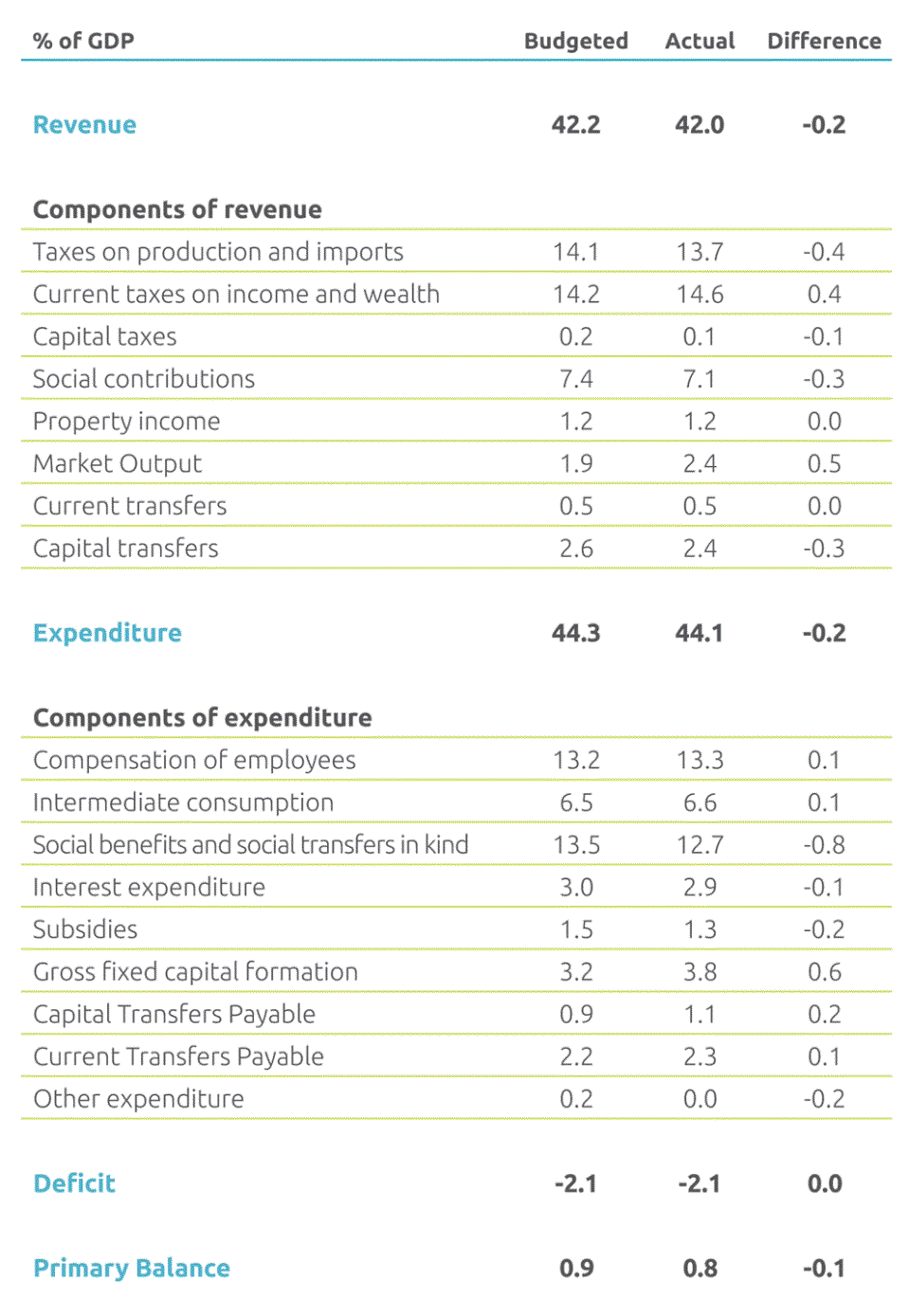
Governing by indicators
The minister said he is asking his ministerial colleagues to justify their expenditure by using a set of indicators. This is being used especially in the educational and health sectors where among the questions being asked is: how much overtime is being done?
Among the indicators that are still down, one is the duration of the working life where Malta is just over the 30-year mark while others such as the UK and Sweden are on the 40-year mark.
Future reforms
Lastly, the minister listed the reforms the government will be working on in the coming months:
- The institutions
- Education
- Infrastructure
- The environment
- Energy
- Health
- Gozo
- Social inclusion

Pan-European timeline
In previous years, Budget consultation used to be a meeting with constituted bodies at MCESD just a few days before Budget Day, when the Budget Speech would already have been printed.
Today, things are different, also because of new EU and eurogroup regulations.
By 15 October, each member state must present the draft Budget to the Commission.
So as to avoid leaks, the member states will announce their Budget on 12 October.
Parliament will then begin discussing it but final approval will be put on hold until the Budget is presented to the Commission and the member states who should give their approval by early November.
If there is a problem with a particular Budget, the Commission may ask that country to amend the draft Budget.
The final parliamentary approval will come after the end of this consultation.