Why are you submitting your nomination for the post of University Rector?
Having been Pro-Rector for 10 years, the thought of going for the post of rector does cross your mind, but it was mainly a result of my colleagues urging me to apply. It wasn’t just the Deans (and, mind you, Deans – being elected rather than appointed members of the leadership structure of the University – have an extremely important and democratic voice) but several others both in the university administration and fellow academics asked me to consider, and I would have felt disloyal if I did not accept.
What unique attributes can you bring to the table?
I had the privilege of working with current Rector Juanito Camilleri as well as Pro-Rectors Mary Anne Lauri, Richard Muscat and Joe Friggieri. I feel that was a great team. Clearly, a good rector would involve his team in decisions that need to be taken. I am familiar with the demands of the job. It is fair to say that probably nothing that would come my way in this line of work could take me by surprise. I think that a good rector – and Professor Camilleri has been a very good rector – discusses matters with his team. Hence I had the opportunity to influence decisions in the Rectorate, as did my colleagues, and this interaction between us allowed us to arrive at the best outcomes.
Aside from knowing where he (or she) wants to go, a rector must also be prepared to engage in dialogue, to listen and perhaps to listen some more and then to decide, firmly and resolutely. I think I’ve got what it takes to perform this job correctly, thanks to the experience gained in 21 years of university administration.
Do you see the support of the Deans as an advantage?
It is, without any doubt, a tremendous advantage. The Deans are the ones who make things happen. If the deans are not behind a project you propose, you might as well forget it.
Rector Roger Ellul Micallef wanted to stay on as rector for a third term, and the Deans supported him, however this ended up working against him…
I wouldn’t say it worked against him, but rather it wasn’t sufficient enough to work for him. Neither am I saying that it is sufficient enough now to work for me in this election. There are two Deans on the Council, but that’s two out of 32 votes. However, if the elected Rector has the support of the Deans, I believe there would be far fewer problems down the line.

You’ve been Pro-Rector for 10 years. What would you do differently as Rector?
I was one of the Pro-Rectors yes, but the direction we took the university in was decided by our team as a whole. As a rectorate, we embarked on a number of initiatives that are, at the moment, still work in progress. We focused on initiatives aimed at increasing the material resources of the university. There are projects we need that have not yet been concluded and others that have just started.
At the last Council meeting, the Council approved a €10 million project through a public-private-partnership to design, build and operate a residential and community centre, which would establish a place where students and lecturers can live on campus, should they so choose. It would also include amenities and entertainment facilities.
The project will hopefully come to fruition within the next two years and promises to turn the entire campus into a far more interesting place than it can ever be without it and more like campuses elsewhere that I’m familiar with. There are other buildings planned that need to be funded from capital sources and if I am elected rector, I commit myself to continue on the visionary path that Professor Camilleri has forged. In my view, it will be folly for any new Rector to consider moving at right angles to this path in search of some new and brighter solutions. With regard to building developments, the sun at Tal-Qroqq is already shining and is not waiting for a new rector to push it over the horizon. Whoever is chosen to go forward is, to my mind, indeed lucky in that respect since s/he will find most of the groundwork done already.
There are of course other aspects to the university besides buildings, such as the quality of teaching and learning. Measures for quality assurance of the teaching provision have been worked on for eight years, but I feel there is more we can do here.
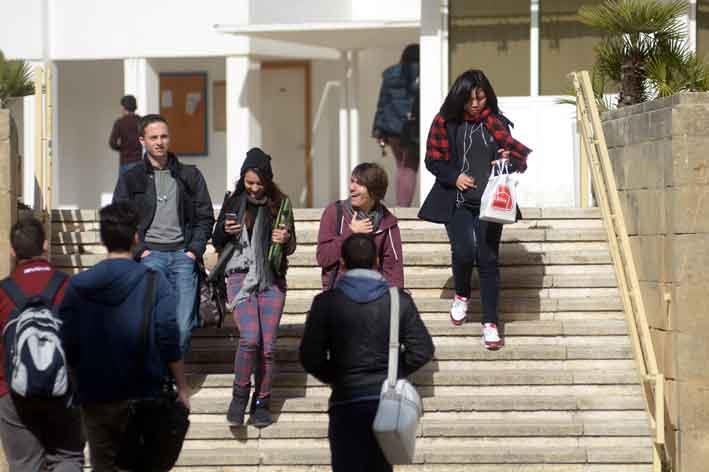
We must also look at the regulatory framework that our students navigate in order to complete their courses. My daily routine has allowed me to deal with numerous problems faced by students, and some tweaking of the framework may be needed to address emergent needs. No doubt, as soon as we modify some regulation or other, other problems may arise as things develop over time. The trick is to be flexible and able to exploit and do what you can to improve the learning experience for students while keeping an eye on fairness and equity and especially the maintenance of standards without which the university and its degrees and diplomas would risk losing credibility.
We are already making the university more accessible to people, and are implementing more measures for non-traditional students such as those who work and can only study during the evenings or perhaps online. We have recently introduced a liberal arts and sciences programme that allows students to choose from a wide variety of study modules without the need for any connection between them: this is just one way that people could use the university to enrich their knowledge, especially when they’re not interested in reading for a full degree or diploma.
We need to find a better way to encourage individuals who have never been to university to consider doing so now, possibly building on the skills and competences that may have been acquired at their place of work or in other ways. We must also improve and consolidate the bridges between academic and vocational education.
A real university cannot renege on its research mission. We have to have a much larger population of master and especially doctoral candidates active on campus doing research. Without PhD students, who need to be maintained financially because they also have to eat and live, it is pointless talking about increasing the research effort at Tal-Qroqq! We give stipends to undergrads but postgraduate students can only get a maintenance grant if they win scholarships, so the research effort at university is actually controlled by those who have this money.
Limited local and much bigger – but very competitive – EU funds are the lifeline for research at our university because local industry is not particularly forthcoming when it comes to funding research. This is a pity, since products created through research could be turned into marketable prospects. The current rector established ‘TakeOff’, as well as the Centre for Entrepreneurship and Innovation, because we recognised that enterprise and the business mind-set could be part of the formal skills-set taught to students that could significantly change their future.
Having structures in place that would allow lecturers to access EU and other funds more easily would be extremely beneficial and would promote the research effort. In fact, we have just set up a Directorate for Research intended to provide assistance to staff in their endeavours to compete for and win funds for research and as Rector I would ensure that this initiative blooms and flourishes.

How will you take the university off its pedestal and better integrate it in society?
Saying that the university is not integrated in society is wrong. This idea of the university being some form of ivory tower, distant from the needs of citizens and society, is so wrong. Like several of my academic colleagues, I myself have, on numerous occasions, served in the Magistrates’ Courts as a forensic expert in the investigation of fire and explosions – work that I’ve been doing for 30 years – and, like me, so many other lecturers and professors serve the community professionally. Need I mention Edward Scicluna, currently serving as Finance Minister? But there are so many others who give their services to government, local industry and the business community as experts in their field, be it finance, banking, accountancy, medicine, law, engineering, sociology, the arts, etc. Did you think that all academics do is lecture?
The university has around 1,600 lecturers, and a large number of them fear voicing their opinions on a number of public issues. If elected rector would you be vocal on issues and push lecturers to do the same?
Well, over the years I have shown that if I have an opinion about something important to society, I will speak out. In 2013, I spoke clearly about the risk of placing an LNG tanker in Marsaxlokk harbour, saying that this risk was manageable and should not be overstated – and that must have irritated a section of the population. I have been particularly vocal about the invisible chemical peril that excessive fireworks are causing to Maltese society and that must have irritated another, possibly different, section of the population.
I have spoken about air pollution and the black dust problem, nitrates in local tap and bottled water, benzene in the air, etc. I think academics should not shy away from stating their minds; if they do stay silent, they create a vacuum in the social discourse that quickly fills up with inane and mindless drivel and nonsense from uninformed individuals. Naturally, if elected Rector I will be very careful not to embroil the university in any hot issues but I would secretly be praying that somebody else from Tal-Qroqq would be giving sensible, honest and loud public advice instead.
From these lines I would urge my collegial friends to be as vocal as can be – yes, we owe it to society.

What do you think of your competitor Godfrey Baldacchino?
I like Godfrey, I have a lot of respect for him and I am convinced he wants only what is good for the university. I wish him well if he is chosen to lead the university forward.
If he is elected to the position of Rector, would you stay on as Pro-Rector?
I’ve already made it clear publicly that I have done my stint as Pro-Rector. I’m sure he could find suitable alternatives.
If you are elected, would you consider appointing him Pro-Rector?
Wittingly or unwittingly, Godfrey is pushing me to declare my team of Pro-Rectors as part of my strategic vision: I would have preferred to name the Pro-Rectors after the result of the election. Be that as it may, if I have to declare the team beforehand, that would clearly exclude him – which is a pity.
What are your views about the agreements with Barts Hospital?
I don’t know what agreements have been signed between the government and Barts, but I know what was signed between the government and the University of Malta in relation to the facilities at Mater Dei and elsewhere that our medical school will continue to use. I find this arrangement acceptable and it assures our students that they will have all the facilities they need.
What do you think about the agreement with the American Institute of Malta?
I have no problem with other tertiary institutions coming to Malta allowing government to earn revenue. International education is big business, but the UoM has its hands tied since it can’t really compete for international students in the near field, seeing that we cannot charge any fees for EU students. How can you market yourself under these condi tions? That apart, I don’t think the Institute will be a threat to the UoM, as it is unlikely to significantly influence negatively our student base.
Given that most of your experience is local, you haven’t really focused your studies abroad apart from your PhD. Do you think this puts you at a disadvantage?
I wouldn’t know. My understanding of what other universities are doing comes through frequent contact with fellow university leaders during our frequent meetings abroad, often organised by the European University Association and similar associations. At such meetings, speaking with fellow pro-Rectors and Rectors of European universities, one realises how common our problems are. I don’t feel isolated at all from what is going on abroad in the higher education area, especially in Europe.
The university is an academic institution, but leading a university also requires entrepreneurial leadership. Do you believe you have such skills and what are your plans in this regard?
I’m an academic and my interests have always been in this area of work. I would be delusional if I said I had some form of astounding business acumen: my acumen is normally applied to resolving sometimes complex and difficult problems but not to running or opening businesses. By the way, the media hype notwithstanding, a superman I am not. But this is where having a good team around you comes into play.
The new University of Malta Act, which has been in gestation for many years, is likely to be a very interesting development in this regard. Will it propose structures intended to promote a more business-like approach to university governance?
The university is a critical service for citizens of this country, but it wouldn’t be a bad idea if its finances were put on a sounder footing, with perhaps less reliance on direct hand-outs from government that are agreed on a year-by-year basis.