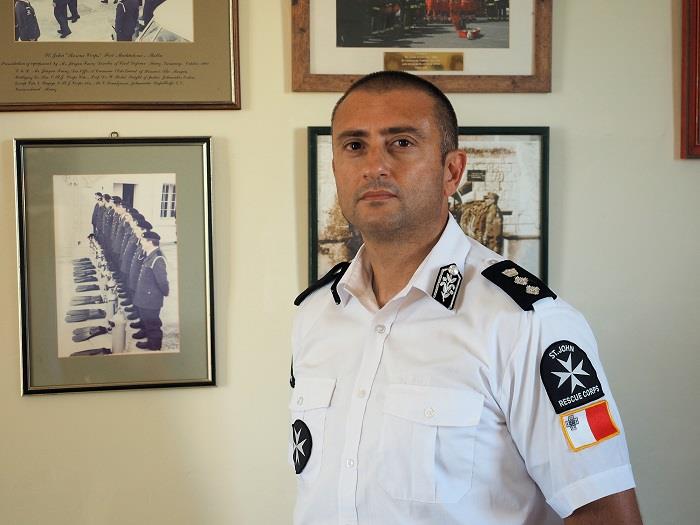
For the past 30 years, the St John Rescue Corps has been the only one of its kind worldwide, Deputy Commissioner of the St John's Rescue Corps Christopher Borg Cardona told The Malta Independent on Sunday during an interview, explaining that elsewhere in the world one would find St John's Ambulance, but not a rescue unit.
As from this year however, St. John Ambulance in Malaysia have set up an Emergency and Rescue Unit which is inspired by the works of the St. John Rescue Corps. The Rescue Corps has entered into an agreement to provide St. John Ambulance of Malaysia with technical assistance in the development of their new unit.
The corps in Malta is one of the larger voluntary rescue organisations on the island, and is made up solely of volunteers who perform firefighting and rescue activities after having undergone intensive training.The St John's Rescue Corps was raised in 1986 to meet the need in Malta of a support civil defence unit consisting of adult volunteers fully trained in rescue and first aid. St John Rescue Corps is part of St John Association Malta, and operates under the auspices of The Most Venerable Order of the Hospital of St John of Jerusalem.Their mission statement is to provide a uniformed voluntary Corps of organized and fully trained adults, able to carry out rescue operations and first aid efficiently.
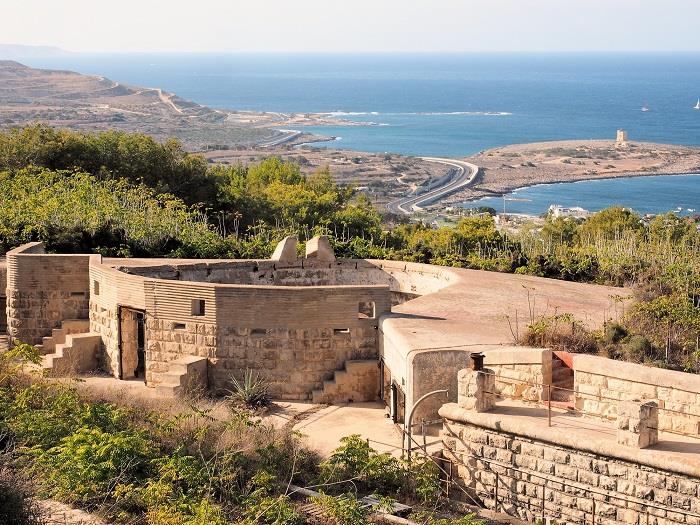
They are to be prepared to go into action as an individual unit, in support of the constituted authorities of the Maltese Islands, when officially called upon by them. Their Headquarters is in Fort Madalena which they share with the Armed Forces. "Since the Corps' inception, the fort has been our headquarters and training school," Mr Borg Cardona explained.
Back when the corps was set up, there was no Civil Protection Department, and the police had their own fire and rescue teams. The corps was formed in order to have rescue volunteers that can support the local authorities in case of emergencies.The voluntary rescue organisation is funded through public donations. Most of the equipment is also donated by foreign entities. "This is what helps our operation keep on running. We have no paid members, everyone is a volunteer," Mr Borg Cardona said.The Fort is, however, maintained by the Rescue Corps. "The cost of maintaining the fort is no small matter, and the Corps are now looking at acquiring EU funds to help restore certain parts.
"We are looking into EU funding opportunities to help restore it. We take care of the day to day works etc, but now we need major works, major reconstruction of some areas, and this is why we are looking at applying for EU funds". Mr Borg Cardona described the fort as ideal for high-angle rescue training. While the entrance is large enough for most vehicles belonging to the Corps to pass through, the fire trucks are stationed at fire houses elsewhere, as they do not pass through the gate.A year and a half ago, the Corps started a water rescue training programme. "There was great interest shown by our members, and recently we managed to secure immersion suits, wetsuits a dinghy and other related equipment. We have an exchange training partnership with the German Life Saving Society of Constance. They are helping us train in water rescue operations and we are learning a lot from their experience".
The Water Rescue Courses run throughout the year with volunteers progressing to different skill levels based on swimming rescue techniques, stamina training, boat rescue and first aid. The organisation also has two fully equipped fire engines and a number of support vehicles for transportation. "If for example, there is a flood, we have a van outfitted with the equipment required for rescues in such situations. The Corps has around 90 volunteers, most of whom are involved in rescue operations whilst others are involved in logistics, support and administration personnel."When one joins the St John's rescue Corps, they undergo a basic training programme before becoming rescuers. It takes between six to eight months, and includes first aid, casualty handling, the use of stretchers, basic firefighting, use of ropes, map reading and radio communication. These are the skills required before one can undergo more advanced training. Following this, one can opt to undertake the firefighting training course that takes nearly a year to complete, or Urban Search and Rescue training which also incorporates high-angle rescue training. In addition, there is the water rescue branch," he said.
Discussing their recruitment process, he explained that the corps normally holds a recruitment drive in January, when most courses start. "The reason is that the basic training course ends when the most advanced courses begin, so volunteers can jump right in. Our courses are modular, however, so those joining late can start and can take the missed modules later".The Rescue Corps is well established locally, he said, and is aiming to start sending volunteers when major crises occur in neighbouring countries within the next few years. "We see these larger scale scenarios occurring in other countries around us, like earthquakes etc, where we can help by sending volunteers abroad. That, however, requires a huge logistical capability and setup. If one is going to help another country, you cannot be a burden on them. You need to have your own tents, cooking facilities, food, water etc. You can't go there wanting to help, then having to ask for accommodation or food. You also need the equipment. We are looking at expanding in urban search and rescue equipment, to help recover persons, drill through collapsed walls etc. Such operations abroad, also need to be 24 hour operations, and one would need to have round the clock rescue teams, so alternating members out is important".
The corps is also engaged by the authorities during mass events, such as the Isle of MTV. "These events are planned in advance. During such events, one would know what to expect, deploying resources depending on what is needed".
In 1995, the St John Rescue Corps proved itself in its first major national call to duty, when the Libyan tanker Um El-Faroud exploded in the Malta Drydocks, tragically claiming the lives of nine workers. Members of the Corps involved in the rescue operation were highly commended for their bravery in assisting the Special Assignment Group Police Rescue Team to recover the remains of the workers, in a very difficult and hazardous operation.Since then, the Corps has taken part in many operations.
Corporal Karl Grech has been volunteering with St John's for five years. He always wanted to help the community, and did so by joining St John's Rescue Corps in order to help others. "My primary role is that of the fire engine driver. I started off volunteering through the swimming course, and then moved into fire-fighting," he said."The biggest operations he took part in were the industrial fires at the Foster Clarks factory, the Bulebel factory incident, and the recent Birzebbugia scrapyard incident. Recounting the Birzebbugia fire, he said it was a long and drawn out situation. "It took us quite some time to put the fire out, and a number of fire-fighters were medically treated".
That blaze had seen five Civil Protection officers treated for smoke inhalation."When you're on the ground, everyone will be scared. Its dangerous, but the most important thing is to remain calm and focus on the job at hand, while listening to the officers when they guide us in tackling the situation".
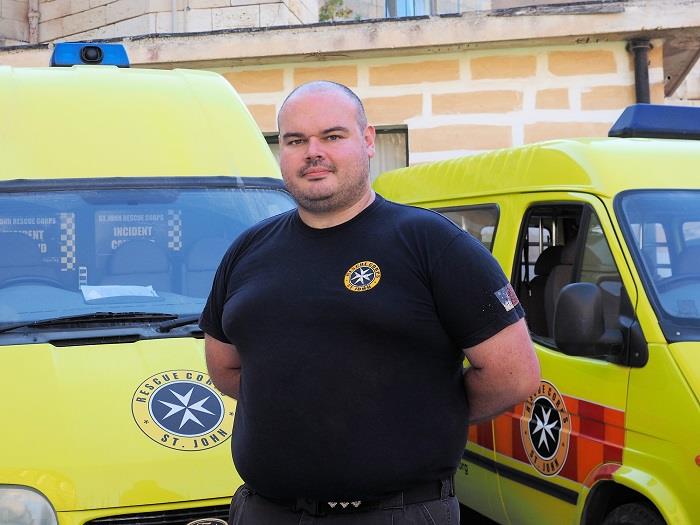
Rescue Superintendent- Edward Midolo , who handles the organisation and planning or rescue operations, has been with St John's Rescue Corps for 12 years. When he was young, two friends of his were involved in an accident and he wanted to see how he could help persons in that situation. He then came to St John's for a training session and has remained a volunteer ever since. When planning a major event, such as the Isle of MTV, "one of the basic things we need are the government entity requirements, such as the Civil Protection Department. After that, we organise our personnel resources, logistics, food, drinks equipment etc. After that, we go into the finer details, such as how to coordinate our teams arriving on site. A lot goes into organisation and planning. We also carry out our own assessments of the area, see the potential hazards and cater accordingly. We have a vast array of equipment, for firefighting, marine rescue, high-angle rescue etc", he said, mentioning the need for personnel to be trained in such skill-sets.When it comes to emergency situations, "we plan throughout the year just in case, and when such an incident does occur, we generally receive a request for assistance from the CPD. We then advise all personnel skilled in that area to be on standby. If it's an immediate deployment we begin assigning them to their tasks immediately, such as assigning teams to the fire trucks and deploying them. Aside from our first response teams, logistics teams begin transporting items such as water, food etc. Personnel work on 40-minute rotations, so if an incident lasts ten hours, personnel need to be rotated in and out".
Sergeant Robert Attard handles the firefighting training for the rescue corps. Training, he said, begins with volunteers learning hose laying basics, and we then build on that, with hose drills, how to use the branch of the hose, how to utilise the breathing apparatus, how to tell where a fire is, the building level of a fire, Road traffic collision training etc.The foundation firefighting course takes a year, and the advanced course takes an extra year, he said.