As part of the cultural programme for Malta's EU Presidency, an exhibition of Norbert Francis Attard's works will be held at the European Court of Justice in Luxembourg next month.
Entitled Between the Setting and the Rising Sun: history re-imagined, the selection of works deals with the less agreeable aspects of Maltese and Western society, past and present, in a direct manner.
On many levels, Attard's works attest to the several ways in which images may be used and reused, rediscovered and re-presented. Such practices are commonplace in contemporary art; appropriation and juxtaposition have become standard methods of art production. It is the choice of images that draws one into Attard's large photographic and digital prints. Choice and juxtaposition project overlapping narratives - historical, cultural, political, and religious - that comment on the consequences of political dissidence. The images' immediate flatness, chromatic appeal, and familiarity work to incite our memory. Interaction with this series of direct and cleverly manipulated pictures raises a number of critical points and contentious questions. Literature, local and global politics, pop culture, history, text, motifs, and the media world posit a variety of cross-cultural associations.
The sixteen works are all interconnected by means of subject matter and their non-temporal specificity. Few were conceived concurrently as part of a single series. Each piece came into being during the past fifteen years, during which time Attard's art began to evince an explicitly political voice. A new image-focused dimension erupted that transformed face-value appearances into blatant visual statements on or against power, a tone marginally projected by his previous work.
Immigration, exile, imprisonment, violence, suffering, sin, eroticism, surveillance, and bodily fragility are prominently exhibited with the representation of objects, people, signs, and symbols that embody the tensions of their interrelating political fields. There is no fixed historical chronology from which the components are borrowed. Each image transcends temporal, and sometimes even spatial, categorical logic.
Popular images were contradictorily used in the attempt to portray tumultuous histories. For example, one work features Marilyn Monroe's ubiquitous portrait which is overlaid with diminutive stamps of a military aircraft that may only be deciphered at close range. The notorious sex symbol reappears in EROTICISM-VIOLENCE, which makes use of similar patterned motifs. Also referring to the theme of war is an image portraying Valletta's cityscape as a site of violence, alluding to the female lower-body and the experience of domination.
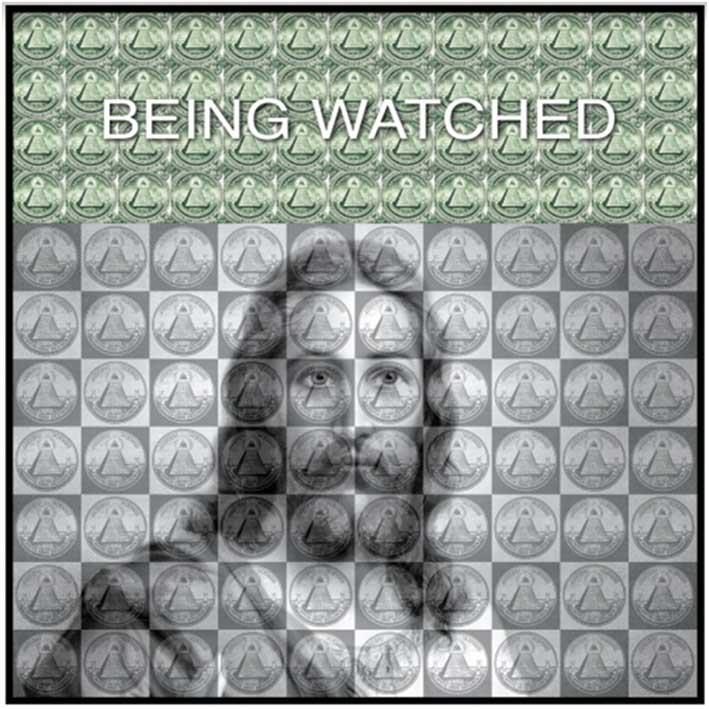
The notion of surveillance was explored in some of the works. BEING WATCHED is reminiscent of the non-autonomy of self. Attard interestingly linked the magnitude of the reach of contemporary surveillance to that of Jesus Christ; unseen, untouchable, and pervasive.
One of the more noteworthy pieces that falls under the rubric of the excommunication/exile theme is IL-BANDIERA TAL-MALTIN, titled after the Maltese radical socialist newspaper repeatedly pictured in the left half of the canvas. Manwel Dimech's political activism resulted in his being excommunicated from the Roman Catholic church in 1911. He was exiled in 1915, dying in Alexandria. The work's chromatic division mimics that of the Maltese national flag.
It is truly significant that Attard turned to the representation of the Maltese political activist. For practically the entire twentieth century, artistic reactions to local historical events were absent from the development of Maltese modernist art. Art historian Giuseppe Schembri Bonaci has repeatedly analysed this self-abstinence from overt ideological representations and dismissals of hegemonic power. Such a practice has proved to be damaging to the assertion of Malta's national identity. Attard's image appears almost 100 years after Dimech's death, when the dust has settled and been swept away. The choice to return to an event untouched by art leads us back to its time and reignites memory, yet is filtered by physical and temporal distance.
In the works presented in this exhibition, history is projected as a playground of images; juxtaposed, superimposed, repeated, both manipulated and untouched. Yet, commonality is retained throughout. Attard plays with the surface of history to produce quasi-cartographical mementos of the people who endured imposed or self-inflicted unmitigated torment.
Attard's hanging images provide an overtly political view that is disquietingly missing in Maltese art. Needless to say, art doesn't have to have visible signs of political figures and events to make a statement. Throughout art history, several ingenious artists turned art creation itself into a defiant praxis. It is refreshing to see a Maltese artist responding to the oppressive mechanisms of twenty-first-century power structures - namely, the subject of surveillance - and showing us that contemporary society is not as democratic as we might wish it to be. This link between the injustices that are unfolding before us as we speak and those from the past enables us to establish a relationship with events that we did not witness or experience.
Images that provoke memory are crucial during times when it is being obliterated. As Schembri Bonaci argues, power negates art that which is capable of keeping collective memory alive. Paradoxically, Attard's images will being shown in a veritable centre of power.
In cases like these, when political subjects are unequivocally projected, I do question whether it is sufficient simply to picture the past and the present if we are to empathise with the plight of others. Can an image within an image within an image of Julian Assange's portrait, one that is heavily reproduced across media channels, help us to understand what it means to be accused of criminal activity when trying to tell the truth? Is a picture of a bomb-covered Valletta sufficient to remind us of the harrowing nature of war and the extent of the Maltese people's misery?
I very much doubt that images can replace experience, especially when a temporal gap exists. This is why it is essential for artists to react to their particular historical moment; memory-as-experience is embodied by art objects. In fact, Attard's surveillance images resonate the most, because they deal with something that is changing our lives at present and of which we are as yet unaware of the ultimate repercussions.
Between the Setting and the Rising Sun: history re-imagined is open from 15 May to 30 June 2017. A Malta preview of the exhibition is open from the 8th until the 23rd April at GOZO Contemporary in Gharb as part of the visual arts programme for the VIVA Curatorial School. The exhibition is curated by Nikki Petroni