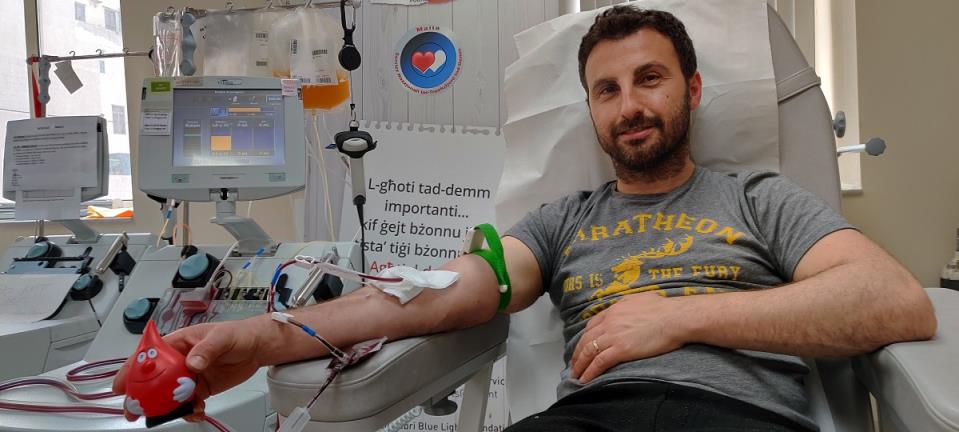
Due to the Covid-19 situation in Malta many places including schools, restaurants, churches and entertainment establishments have had to close their doors, but the National Blood Transfusion Service centre is still open and welcomes blood donors.
“We encourage people to come and donate blood. It is not only safe to do so, but vital, as it can save someone’s life,” explained the centre’s medical director Dr Alex Aquilina.
Malta currently has, since the beginning of the outbreak, registered 444 cases of Covid-19; with 276 active cases. 165 people have recovered from the virus and three people died. So far, there are no confirmed cases of any form of coronavirus being passed on through blood or platelet donations, the director said.
Back in March, when Malta registered the first cases of Covid-19, Aquilina explained how a number of procedures, operations and treatments were postponed. “Any non-life threatening operations or procedures were postponed to later dates, therefore the number of blood units distributed to Mater Dei Hospital was much lower,” the director explained.
He said that at the time, the supply of blood units were good. Now that certain operations and procedures are taking place, blood distribution is slowly increasing, but the number of blood donations is not. “This is a huge concern for Malta, as if we do not see the number of blood donations increase, we will not only face the threat of Covid-19, but also the threat of an empty blood reserve.”
Statistics provided to the newsroom showed that in Week 1 (9-15 March) 456 units of blood were distributed to the Mater Dei Hospital Blood Bank of which 259 units were transfused. In the second week (9-15 March) there was a fall in both numbers; 230 units of blood were distributed and only 202 transfusions took place. In the third week (16-22 March) 205 units were distributed and 180 transfused. In the fourth week (23-29 March) 194 units were distributed and 185 transfused. In the fifth week (30 March-5 April) 219 units were distributed 163 transfused.
The lowest numbers were seen in the sixth and seventh week with a shortfall of 27 blood units in the sixth week followed by another shortfall of 99 blood units in the seventh week.
“Whilst the numbers are low, we were also seeing a decrease in blood donations. If this continues, we will be in a crisis next week,” said Dr Aquilina.
He explained that usually the clinic would issue a call for blood donors if supplies are low, yet due to the situation, the clinic does not want to have groups of people at the centre all at one time.
“Instead we are messaging and calling blood donors, asking them to come and donate. Currently we receive around 20-25 units of blood donations per day, when the hospital is using around 35 units of blood per day.”
Clinic in top condition for donors
Dr Aquilina explained that the clinic has taken new measures to ensure the safety of both blood donors and staff. “All precautions possible have been taken. We understand people are afraid that they might come in contact with the virus, and that is why our staff are trained in using hygienic precautions, and alcohol hand gel is provided to all members.” He noted that it is important for the public to be aware that the clinic does not test donors for Covid-19.
He explained that donors who do come to the clinic will be asked a number of questions with regards to Covid-19 and that if any donors or individuals who wish to donate blood are not feeling well, be it with a headache or a cold, should not come to the Centre. “We have always followed this principle, that donors are not to come here when not feeling well,” the director said.
Apart from the Gwardamanga Blood Donation Centre which is open daily between 8:00am to 6:00pm, on Sunday 26 April from 8:30am to 1:00pm there will be a Mobile Blood Donation Unit next to the Mgarr Parish Church. On the same Sunday there will also be a Blood Donation Unit at Xewkija, available between 8:00am to 1:00pm. (The same health measures taken at the Centre will also apply at the Mobile Blood Donation Unit.)
For any queries people are advised to call 8007 4313 or 7930 7307.