I am hooked on World War II and it has always held a special fascination for me. The main reason surely must be because of all the books I read about that period starting at school, which lay the foundation. Or perhaps because I am a child of those years where the whole world was involved in that war.
One of my favourites was The Man Who Never Was. When a book starts off with "But where could we find a body?" you know it's going to be great. It is considered to be the best book about wartime espionage written by an active participant. It was a dangerous game to play. It is the remarkable story of Operation Mincemeat which was part of Operation Husky which we have been celebrating. In the early hours of 30 April 1943, a corpse wearing the uniform of an officer in the Royal Marines was slipped into the waters off the south-west coast of Spain. With it was a briefcase, in which were papers detailing an imminent Allied invasion of Greece. As the British had anticipated, the supposedly neutral government of Fascist Spain turned the papers over to the Nazi High Command, who swallowed the story whole. It was perhaps the most decisive bluff of all time, for the Allies had no such plan: the purpose of 'Operation Mincemeat' was to blind the German High Command to their true objective - an attack on Southern Europe through Sicily. Though officially shrouded in secrecy, the Operation soon became legendary (in part owing to Churchill's habit of telling the story at dinner). Ewen Montagu was the Operations mastermind and in his celebrated post-war memoir, The Man who Never Was, he reveals the incredible true story behind Operation Mincemeat.
A girlhood full of Evelyn Waugh novels and later films and tv mini series, lately watching the BBC Tv miniseries Fleming the Man Who Would Be Bond, which dramatized some aspects of Operation Mincemeat, and Fleming's connection to the operation, I was bound to get very excited when I saw that at the Mediterranean Conference Centre there was going to be a concert with the Goldberg Ensemble singing a whole lot of lovely 'war songs' and playing Glen Miller music.
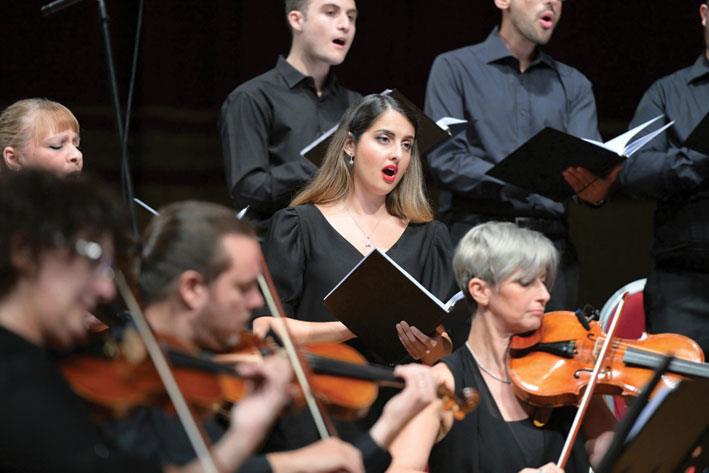
The choir was made up of ten women and ten men. The musicians did not form part of the Goldberg Ensemble but were guest musicians.
I was half an hour early to make sure I did not miss anything. Not even a note. It was not wasted time as I popped in to see at the Sacra Infermeria Hall an exhibition about Operation Husky. It included Militaria, original vehicles, documents etc. It was well worth a visit. Pity if you missed it. MCC intended to highlight the importance of history's largest wartime amphibious operation ever attempted focusing on Malta's pivotal role in it.
The Exhibition recalled how Malta's Lascaris War Rooms housed the massive underground military complex from where this remarkable operation was launched, as directed by U.S. Allied Supreme Commander General Dwight Eisenhower. Also how Malta's own 231st Infantry Brigade formed by some of the British Regular Infantry Battalion's defending Malta during its siege in WW2, also took part in the landings as part of the Eighth Army.
At last the concert began. There was a huge noise coming from the back, sort of cannons perhaps, to put us in the mood.
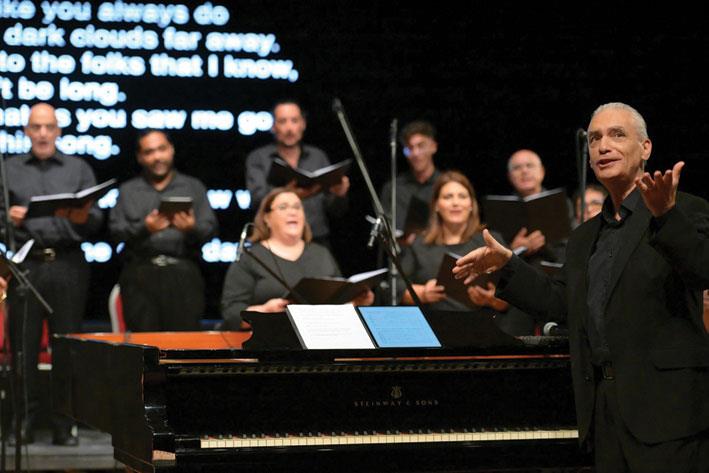
Maestro Michael Laus was not only conductor and pianist but was also presenter who told us all about the music before each piece. He had also prepared all the song arrangements himself: "Hard work but I loved every minute of it," he told me on email.
He also explained that the musicians playing that evening were all guests. The performers were Marcelline Agius and Vincenzo Picone, on the violin; Nadia Debono on the viola, Daniel Xuereb, on the cello, Anthony Saliba, double bass and Jessica Ellul clarinet.
The concert started with Lili Marleen, the German love song. The version I am acquainted with is that sung by Marlene Dietrich accompanied by an accordion. All melanchony. She sang is in the film Judgment at Nuremberg. It was in her line-up when she was touring the world in one-women cabaret shows. "Now, here is a song that is very close to my heart. I sang it during the war...the soldiers loved it..." I love it too whether it is the German or English version.
This was followed by C'est si bon. I love Yves Montand's version best. But the choir gave us an enjoyable version. Later the Ensemble sang Autumn Leaves (Les Feuilles mortes) which is an absolute favourite with me. The French lyrics are by Jacques Prévert and the music by the Hungarian Joseph Kosma. The two were introduced in Paris and collaborated on the song for the 1946 film Les Portes de la nuit. They were to collaborate on some 60 to 70 songs after that.
There are so many recorded versions of this nostalgic song but my preference goes to the version sung by Yves Montand in French. And the beautiful lyrics... Here are the last verses of this famous song.
Mais la vie sépare ceux qui s'aiment
Tout doucement, sans faire de bruit
Et la mer efface sur le sable
Les pas des amants désunis
If these words don't make you cry then nothing will!
The musicians that evening sung it in English and I loved it, too.
Next another favourite: Piaf's La Vie en rose, her signature song. She wrote the lyrics and it soon became a favourite with audiences and made her internationally famous. Encouraged by its success she went on to write 80 more songs. That evening it was beautifully sung in French by soprano Alexandra Camilleri Gambin.
Two short videos were shown: one of Operation Husky and later on one of Operation Mincemeat. So many lost their lives. "War does not determine who is right, only who is left."
Inevitably no evening of 40s music could possibly leave out Glenn Miller from the programme. His music is so evocative of WW II. He led one of the best known big bands. The musicians played In the Mood and Moonlight Serenade, surely his two best known compositions which make you want to get up and dance. Glenn Miller's plane disappeared in the English Channel on the way to France. He was merely 40.
I enjoyed Foxtrot tal-ghasafar. I may be wrong but I believe it was composed by Andrew Alamango and Alexander Vella Gregory. A most pleasant song.
I loved Alexandra Gambin, Maryse Briffa and Maria Azzopardi singing Boogie Woogie Bugle Boy in imitation of the Andrews Sisters... such fun and so beautifully done by the three girls. There was a lot of clapping. What talent!
You cannot have an evening like this without an Italian song or two. One was Mamma, universally loved and that evening sung by baritone James Agius, with great feeling. The other Bella Ciao which reminds me of our friend Lianna in Sicily in whose home and car we sang many songs with other friends including Bella Ciao. "O partigiano, porta me via, bella ciao, bella ciao, bella ciao, ciao, ciao. O partigiano portami via che me sento di morir."
What nostalgia! How sad that she is gone.
Another famous piece was beautifully played Take the 'A' Train the signature tune of the Duke Ellington orchestra. It brought Ellington and his band financial success and became his theme song. It was composed by Billy Strayhorn. "The music flowed into his head as he was travelling up to Sugar Hill where Duke Ellington lived."
How do you finish off such an evening if not with We'll Meet again made famous by Vera Lynn. That evening it was sung by soprano Maryse Briffa...Maestro Laus invited the audience to sing. The verses were displayed on a screen and the Maestro urged us to sing along... some did. I have no voice so had every excuse not to... but tears were falling and I did my best to stop them.
That was an evening that was... there were many stars that evening but the one that shone brightest was Maestro Laus. I hope there will be other evenings of this kind of music for us Oldies.
[email protected]
Photos: Courtesy of Mediterranean
Conference Centre