I admit I learned about Sarah Maria and her work in the last year or so, thanks to my colleague and artist Darren Tanti who kept suggesting that we should invite her to exhibit at our space. Following a quick look at her website, I was immediately excited to get in touch and meet her. To cut the story very short, here we are with a body of works executed in a medium and through a process that we had never exhibited before at il-Kamra ta' Fuq.
The inspirations for these works came from two main sources - one being a real-life experience and the other from a book. Months ago, our artist had to deal with a never-ending bureaucratic mesh while trying to deal with a particular government department which caused her unnecessary stress and which led pretty much to nowhere. During the same period of time, the artist was reading the book The Castle by Franz Kafka. In the story, we follow the main character "K", who arrives in a town governed by people in this castle. Everything seems engulfed in mystery and it is impossible to get any straight answers but everything is imbued in an infinity of bureaucratic entanglements. Sarah Maria reflects on The Castle, how it "represents an unattainable goal, an elusive destination that forever haunts the protagonist, as well as the reader. It embodies a seemingly endless labyrinth of bureaucracy, uncertainty and delusion".
One has to keep in mind that the book was written 100 years ago (and it is still delving into a situation that remains so relevant to this day and age). Kafka died while he was still working on this book, in fact, the book finishes in mid-sentence. He had strictly forbidden the publication of the book, but the book still made its way to readers, after his death.
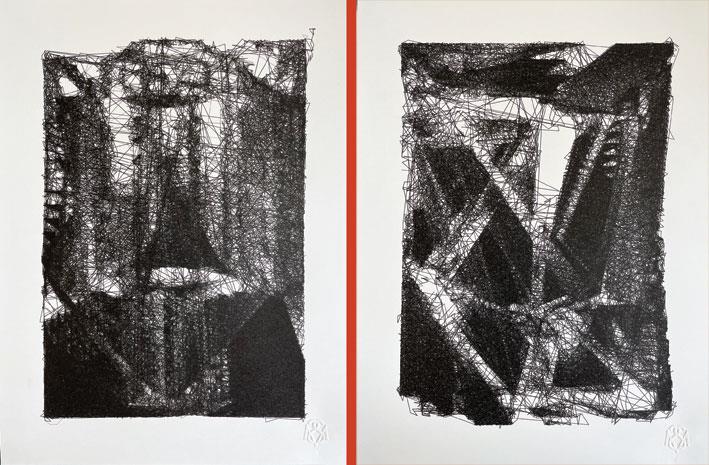
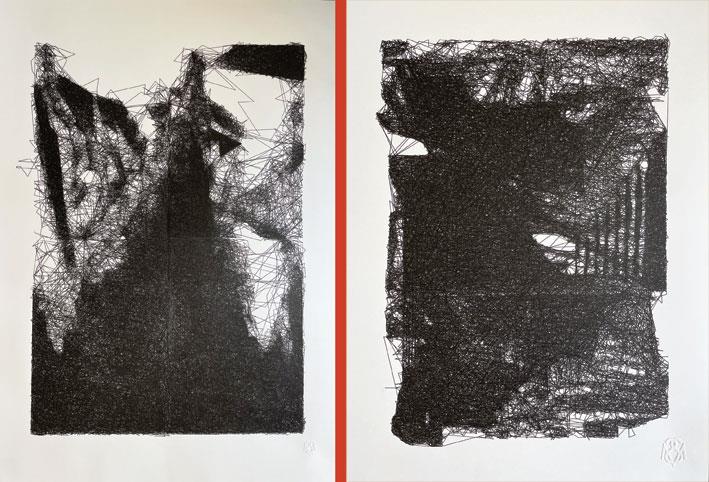
As I mentioned before, the medium employed for these works is quite particular. In fact, the works are created by a pen plotter, controlled via a software programme that was amended by Sarah Maria to produce the required outcome. The artist created digital renditions of landscapes and architectural spaces mentioned in the book. Following this, via her software, she is deconstructing these digital images into a huge number of lines, which are then drawn via a pen plotter, all executed in black ink. Just to put things into perspective, the smaller works in the collection, measuring 50cm x 37cm, contain around 40,000 lines! And each of these takes around eight hours of pen-plotter-sitting by Sarah Maria, to monitor the execution of each piece, the level of ink in the pens and to control the complexities in the execution of the much larger pieces which require a seamless assemblage of smaller artworks onto one piece and with a total amount of lines reaching the 16,000 within one artwork. I find it particularly interesting how she decided to and managed to re-interpret a 100-year-old book, using such a techy medium as her tool. The process employed is an integral part of the artist's works and here we can feel the patience required in the creation of the works mirrored in the theme of the waiting and the perseverance one needs when dealing with the world of bureaucracy.
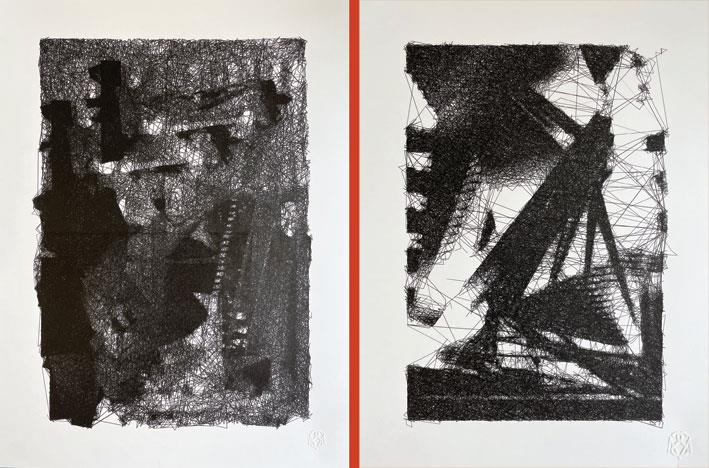
All of this can be observed in the artworks, quoting from the artist's statement, where "each line becomes a path, a possibility, an illusion, a knot that cannot be untangled. As these lines intertwine and weave together, they form labyrinthine structures that mirror the intricate architecture of our own desires. They become the mazes we create, the mental constructs we navigate and the illusions we sometimes mistake for reality".
The works become like abstract surrealism. The maze of lines and paths symbolising our goals and dreams are like paths and routes undertaken in a parallel universe, by ourselves or by someone else, but still with the same outcome, a "reality" which is not in our cards and thus will never materialize.
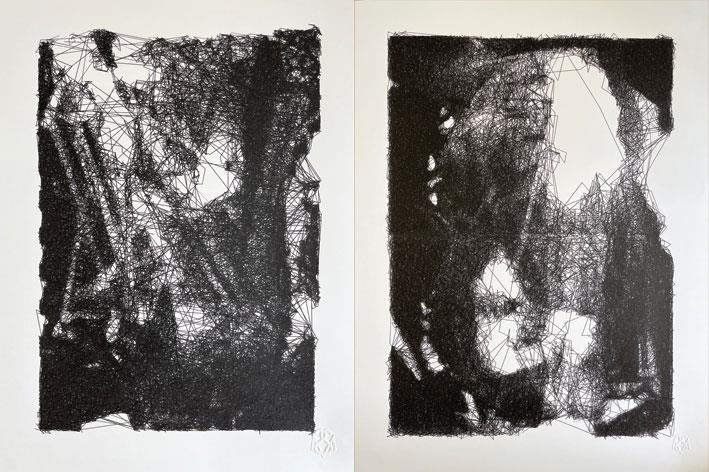
The works presented are masterpieces of intricacies. The viewer is invited to interpret the works freely, but the artist provided a teaser with witty titles. The titles are all phrases found in the mentioned book and I think they add a playful level of intrigue to the works. Just to name a few, You don't tell me the truth either, which shows a complex series - of what appears to me - to be a series of staircases, all leading to everywhere and nowhere reminiscent of Hogwarts' moving staircases in the Harry Potter movies. In The most complete and strange silence I imagine some "law courts" building hinted at by the perhaps series of balustrades on the right of the composition - but who knows!
My heart still skips a beat when remembering the first time I saw this artwork during a studio visit at Sarah Maria's, titled We all belong to the castle where one cannot not see this majestic dark castle filling up this one-metre-long artwork. Perhaps the strongest piece in terms of how this works conquers the viewer's space. It's captivating in its grandness, darkness, crookedness, and "Tim-Burton-ness". My fantasy dwells on and I spot two imaginary cobwebby wings, one on each side of the castle, ready to seize its next "victims" and their hopes.
Official decisions are as shy as young girls is one of the few works which exhibit rather large areas of white voids - in this case resembling a cavernous aperture that is emitting shy rays of light within it. In the artwork Every minute of the previous afternoon was just as decisive I imagine a construction site, boasting an imposing (and too familiar) crane-like structure juggling its limbs on a semi-constructed staircase.
But enough about what I am imagining and dreaming of. The important thing is what you will imagine and how you will be transported into Sarah Maria's parallel world when you visit the exhibition.
The Infinite Labyrinth can be interpreted as a wake-up call - a call to seek what is really attainable in life. Sometimes we waste too much time dreaming of the impossible instead of focusing on realistic goals and we end up stuck in our own personal labyrinth.
Sarah Maria is a lecturer at MCAST Institute for the Creative Arts. Her work is a continuous exploration of ritual and systems, with a strong emphasis on the process. Scicluna's work varies from installation to silk screen printing, while often using digital media as a starting point and using new technologies as part of the process.
The exhibition 'The Infinite Labyrinth' is on at il-Kamra ta' Fuq until 10 September. For more information follow il-Kamra ta' Fuq on Facebook / Instagram