The latest issue of Treasures of Malta, Summer 2023, No 87, is 100 pages of scholarly but not too scholarly articles and visuals for those who are interested in Malta and Maltese history.
In the editorial, Judge Giovanni Bonello starts off by mentioning the Perellos tapestries which have recently been restored and are now hanging in their proper place, the nave of at St John's Co-Cathedral. "The interminable queues of visitors and admirers marvel at how so much splendour can dazzle under one single roof." The Knights of Malta may have been reluctant to leave Rhodes and move to these dry and barren islands but once here, they certainly made the best of it and left us so many treasures. We have to forgive their misdemeanours for this alone.
Judge Bonello, then writes about books, published and to be published. He is enthusiastic about a 'big' event, an exhibition In Search of Line, "which will be housed in our new, and freshly refurbished, palazzina, in St Paul's Street, Valletta." And there is another volume to be published to record this exhibition. He gives us information about what is happening in Palazzo Falson, in Mdina. The curator is the energetic Caroline Tonna who keeps busy with tours and activities for children.
The editor also encourages students of history of art and related subjects to submit their findings to Treasures.
The first article in this issue is by Prof Paul Sant Cassia: An Artist of Matter and Metis: Gabriel Caruana (1929-2018). The author pays tribute to Malta's foremost master of ceramics, from his early popular 'folkloristic' works to his most complex and personal explorations. I remember this affable artist at the windmill in Birkirkara, where I would pop in if I was there shopping, to see his latest colourful creations. The windmill is still associated with him. I could not understand why he was so well-known. Well thanks to this article I understand him better. Prof. Sant Cassia writes: "Gabriel Caruana was one of Malta's most extraordinary artists who resolutely ploughed his own artistic furrow, determinedly followed his aesthetic intuition, and transcended boundaries. His distinctive greatness was that he was impossible to classify... Gabriel burst into Malta's artistic scene in the early 1960s, seemingly from an unrecognisable and unknown outside." And moreover: "Gabriel was instrumental in pushing the boundaries of art in Malta... Caruana showed that art did not have to be pretty; it needed to be bold and innovative..." Now I understand Gabriel Caruana better. This is an eight pager which is very well illustrated.
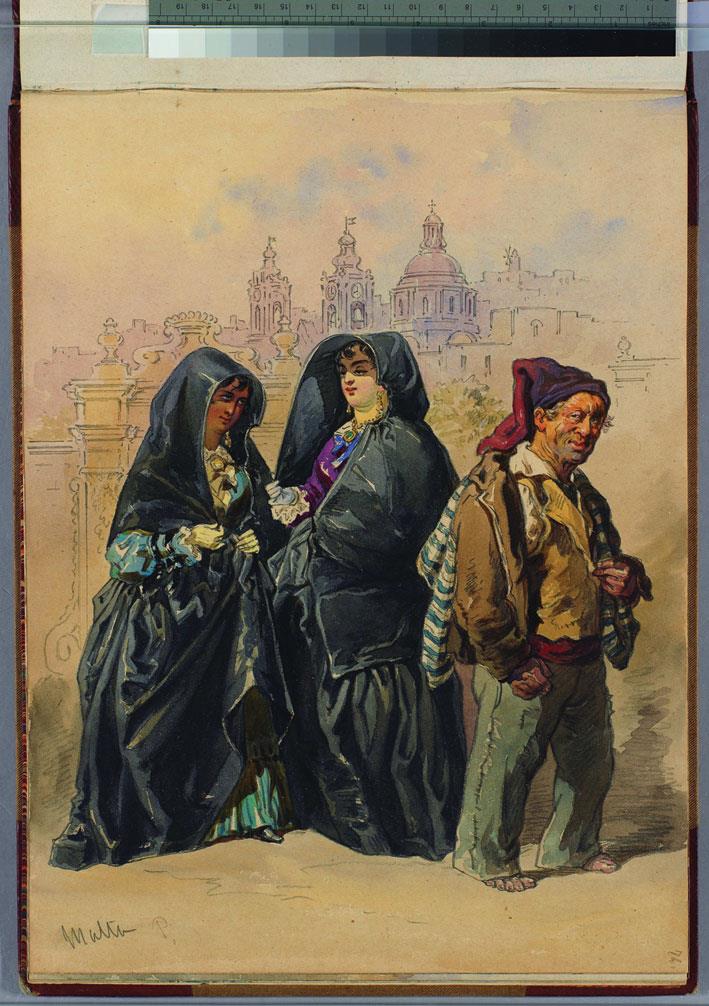
Another article is by Rachel Abdilla. The title: Amadeo Preziosi and Orientalism: the Question of Authenticity. What interests me in this article is not so much the authenticity but Amadeo Preziosi and his art as for some reason or another I have always admired Orientalism and Amadeo Preziosi's colourful life. Now Ms Abdilla's M.A. dissertation was Amadeo Preziosi and Orientalism: A Study of his Art in Istanbul and Beyond. This ten-page article in Treasures is very well illustrated.
Count Preziosi was born into a noble Italophile family. His father, Gio Francesco Preziosi, was the fourth count, while his mother, Margareta, née Reynaud, was French. "The Preziosi family was considered to be one of the most influential families on the island with strong ties, with the Knights of St John and, later with the British colony. Count Preziosi was also a prominent figure during the Treaty of Amiens and lobbied for Malta to become a British protectorate in 1802."
It seems that although the young Preziosi showed an interest in art from an early age his father was keen that he should become a lawyer. Preziosi was sent to France, to study law at the Sorbonne (1839 and 1840) but instead enrolled at the Ecole des Beaux-Arts. No details of this period of his life but it is possible that he became acquainted with Orientalism during this time, the author writes. He travelled to the Levant in 1842. The author gives clear explanations of what was happening at the time in Europe and the Levant. Amadeo Preziosi was indeed a mixture of cultures, as many of us are here. He was an Orientalist artist working in Istanbul, "while having a strong relationship with European officials and being himself a colonised subject."
His medium of choice was watercolour washes with pencil and chromolithography. He set up his workshop in Pera right beneath the British Embassy. There were the officials of the British Embassy who commissioned paintings but also passing tourists. He was also commissioned two costume books by the private secretary of a British ambassador and of course so it goes on.
The costume books still exist in some form or another. One at the Victoria & Albert Museum, and another a complete book at the British Museum, unless it is one of the objects recently stolen.
Ms Abdilla gives us a detailed account of his paintings and an excellent analysis. I really cannot do her article justice but if you are interested in the subject this is a well-documented article to read. She ends the article as follows: "Thus Amadeo Preziosi's narrative of the Orient was based on what his audience would have expected to receive. Hence the preconceived narrative expected in Orientalist representations challenges its authenticity. The Orientalists exerted a certain power over the subject through their knowledge and would thus be perceived as authentic. Amadeo Preziosi's life in Istanbul established him as an artist that represented Ottoman culture authentically. However, aestheticism and romanticism within Preziosi's representation detaches the narrative presented from the socio-cultural environment that was truly present in the second half of nineteenth-century Istanbul."
I must go and have a look at Preziosi's work at the V & A next time I am in London.
I will cover the other interesting articles in Treasures next week.
[email protected]