An exhibition that we have been so waiting for, is finally here, at il-Kamra ta' Fuq - straight from Berlin, we have three weeks with Daniel Borg and his artworks.
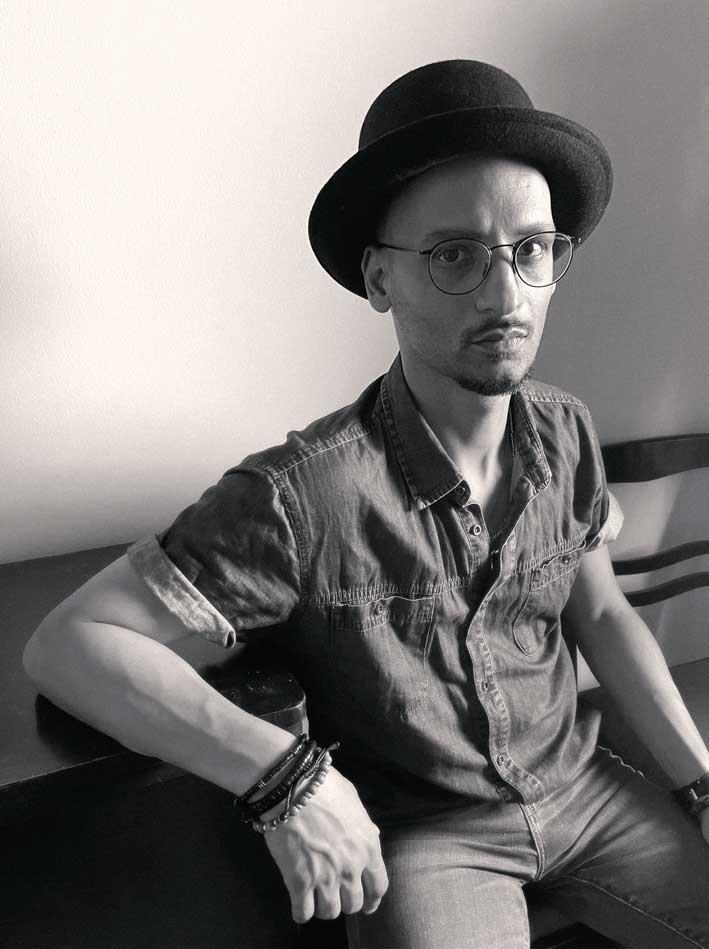
Borg started his artistic journey quite out of nowhere and out of Covid times when all of a sudden this star artist materialized. I already had the pleasure of working with him on a couple of collective exhibitions, namely Art Interrupted held at Kamra ta' Fuq, and It's 5 o'clock Somewhere, held at BOCO Boutique Hotel. And then I mustered the courage to invite him for a solo exhibition at Mqabba, and here we are... and what a show.
Everything is a bit different with Daniel - starting from his works and the unconventional angles of life he chooses to portray, to the enigmatic artwork titles, the exhibition title, the meticulously planned chaotic, and precise exhibition layout, and the poster (aptly designed by artist Alexandra Aquilina).
As mentioned Daniel has been living in Berlin for some years now and all the works within this exhibition have been created there. 'Studio visits' were all virtual, and along the way I had the pleasure of seeing some of the works that he was bringing over to Malta during his frequent visits.
The title GO BLIND ERA is an anagram wittily morphed from the artist's name. The use of an anagram strengthens the aspect of duality and opposing ideas that the exhibition is ultimately all about. I have to quote from the exhibition synopsis, beautifully written, again by Alexandra Aquilina: "In an era marked by unprecedented upheaval and uncertainty, humanity often seeks solace and solidarity among like-minded individuals, inadvertently nurturing one-sided belief systems within the echo chambers of the internet. This organic shift compels us to shun the duality that defines us, gravitating instead toward rigid convictions in a quest for belonging within the anonymity of a seemingly detached world.
Borg's art offers a window into various contemporary vignettes, akin to fragments of a film collage-a mesmerizing dreamscape where moments, both significant and mundane, intertwine seamlessly. Within these vivid visuals, Borg deftly navigates the multifaceted themes of mortality, childhood, desire, relationships, and fear. These themes evoke contradictory emotions that wax and wane with time and circumstance, mirroring the complexity of the human psyche."
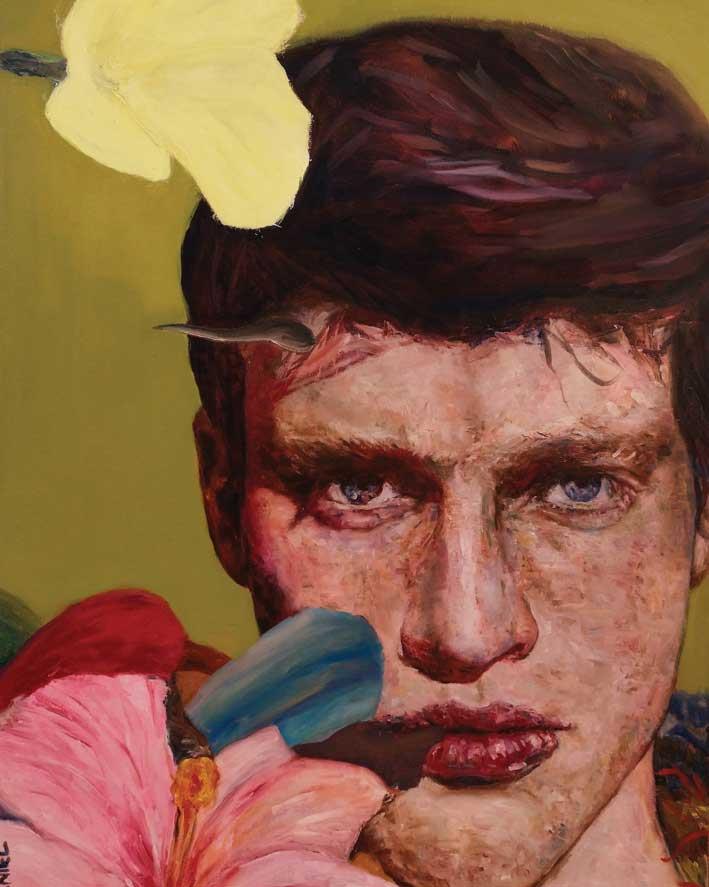
At first glance, when seeing these artworks together, I feel that I am surrounded by snippets from multiple movies. Still, the collection is such a harmonious one. Upon closer examination, one notices differences in the techniques employed by the artist. Some works like In the Frame are more 'alla prima' with heavy expressive brushstrokes that are very visible to the eye, while others like Tafdax ħitan ħodor, qalbi are more meticulously worked upon and finished in a more realistic approach.
Our little room was heavily transformed for this exhibition, and the visitors will be transported into an upside-down version of Daniel's studio in Berlin. Half of the exhibition space has been camouflaged in canvas from floor to ceiling. This canvas is covered with paint, large-scale sketches, and jotted with ideas and what may seem like random words, which in fact are ideas for the title anagram that the artist was pondering upon, till the right phrase came along. This canvas is what the artist uses to cover the floor of his studio and where he starts the initial sketches for his works.
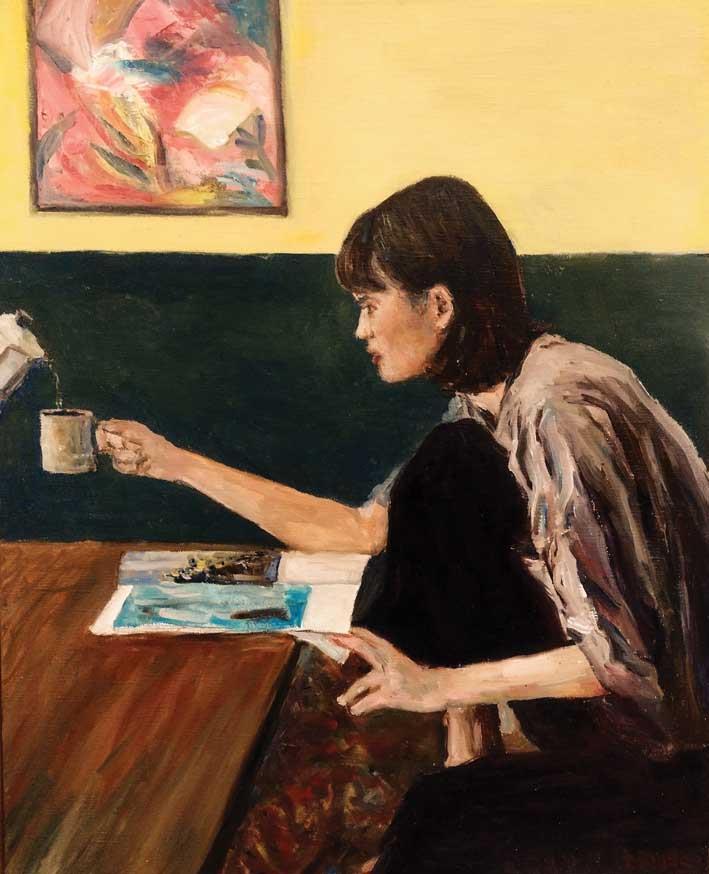
Probably many will wonder where Borg gets his ideas from - at least I did, and so I asked him. Putting it plainly, he explains that he is after portraying the point of view of a human being living in contemporary times. His ideas are an expression of experiences and the observations of his surroundings including contemporary visual media. Daniel takes it a step further however, deviating from pure realism for a more subjective approach and focusing on the expression of memories and feelings in his work. This approach has recently been termed Disrupted Realism. There is always something in each artwork that makes us look twice, makes us think and ponder, giving a different experience for each viewer.
The titles play an important role in these complex works. For Borg, these are "a tool to open up the narration of the image". The works are in fact presenting sub-themes, all telling many stories that are open to interpretation.
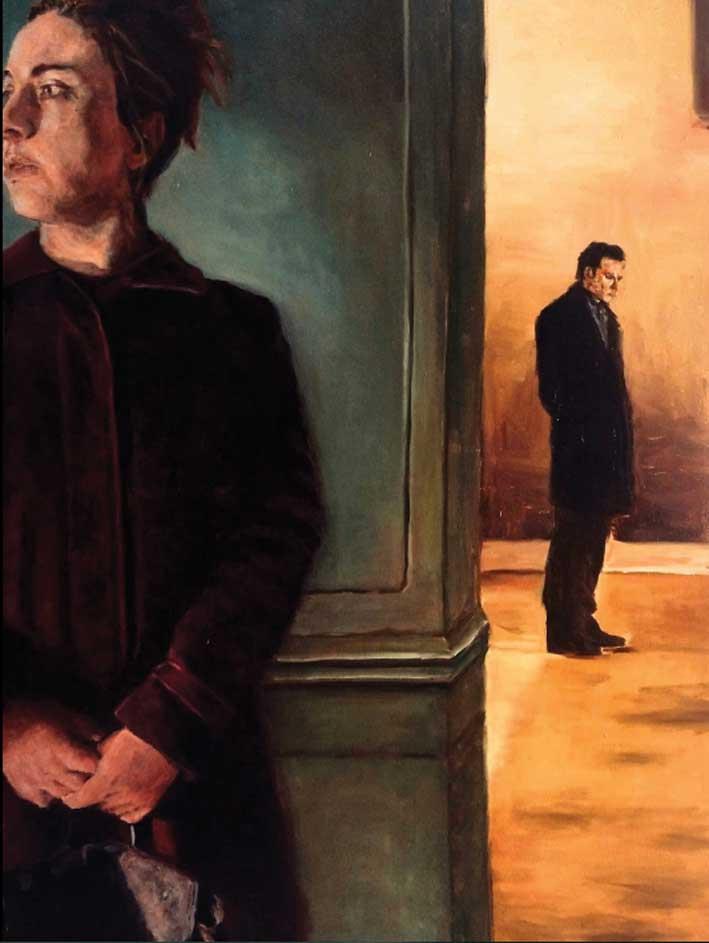
Two 'back portraits', titled I Need You I & II show a male and female portrayed from the back and even though we can't see their gaze, we can feel they are both looking at the same imaginary distant dot, which is virtually binding them in a non-existent diptych.
Inwerżaq ġo wiċċek boggles the mind in a number of ways. First, it takes me to a macabre version of Olympia by Edouard Manet. Here the protagonist is not a strong female in all her glory but what seems to be a dead body. The maid is not presenting a flower bouquet but is crying in desperation, while the blooming flowers are now just a planted pot in the background. It simultaneously transports me to The Death of the Virgin by Caravaggio, where il Dormitio of the Virgin Mary was depicted as an actual death.
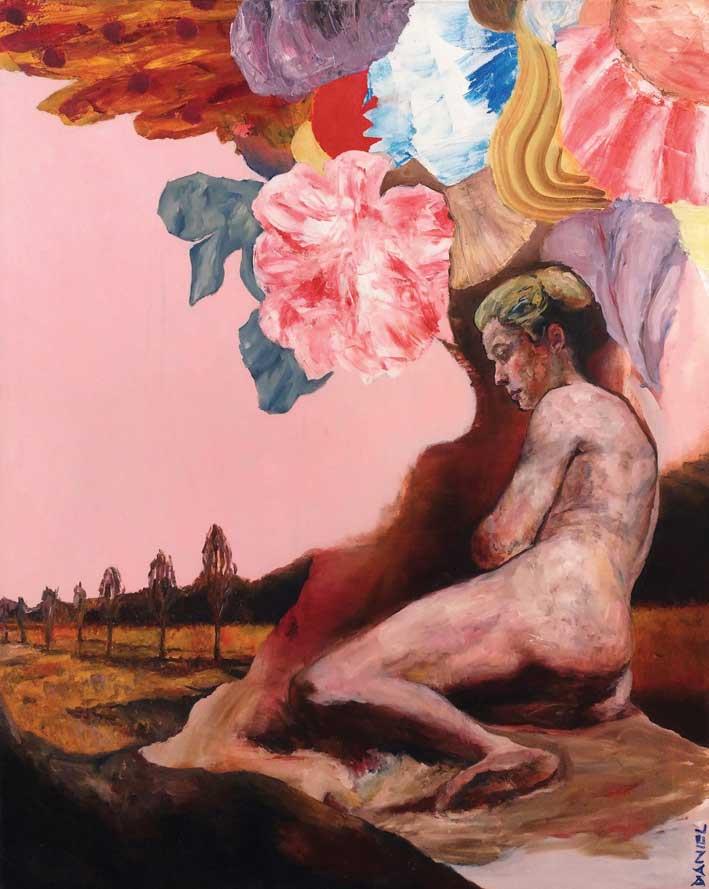
The Petals series is imbued with strong colours, and a disquieting interplay of plains. Petals II & IV show larger-than-life portraits, which seem to be jutting out of the picture frame. The composition is enclosed in a surreal frame made of humongous colourful flowers, encapsulating secrets that these characters will never share with the viewers. Petals I & III show nude figures lost in these strange scenarios. Re-interpretations of three works from this series are also available as silk scarves - a collaboration between Daniel Borg and Alexandra Aquilina - and can also be appreciated at the exhibition.
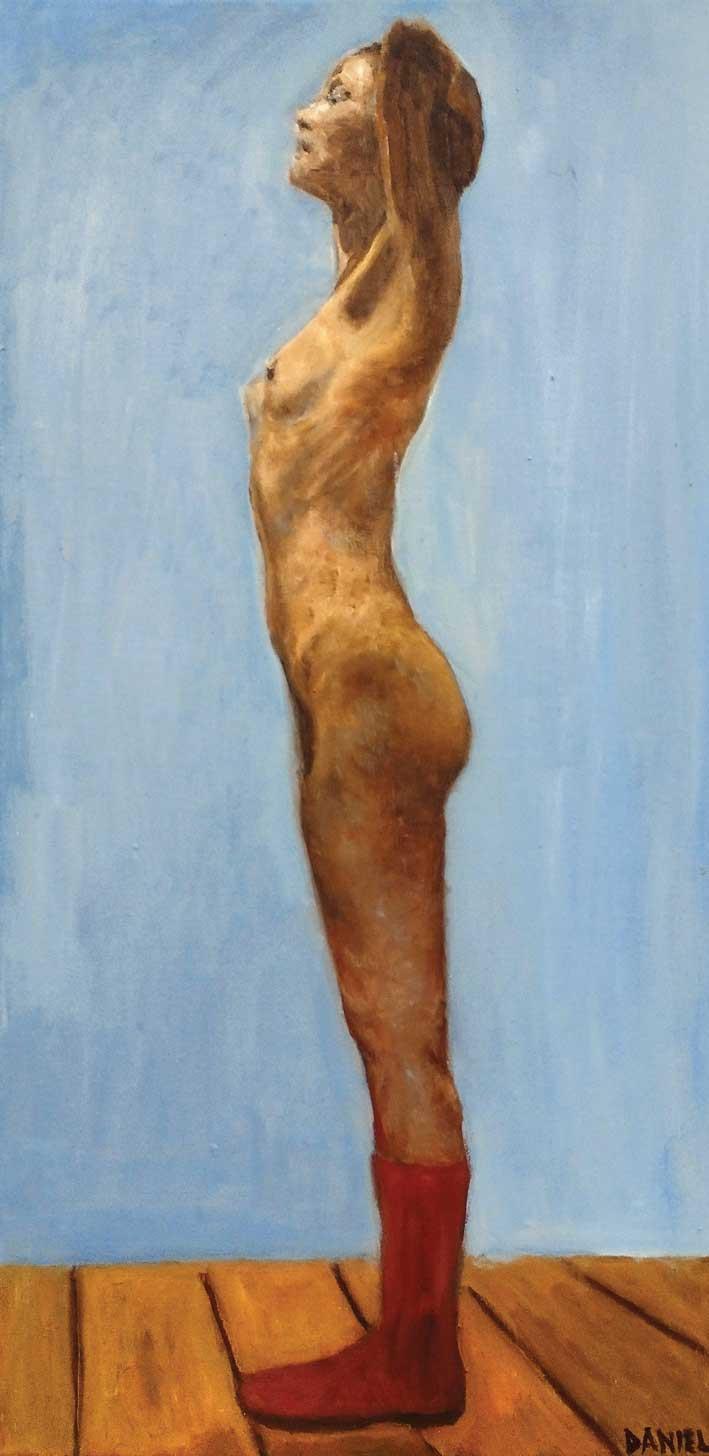
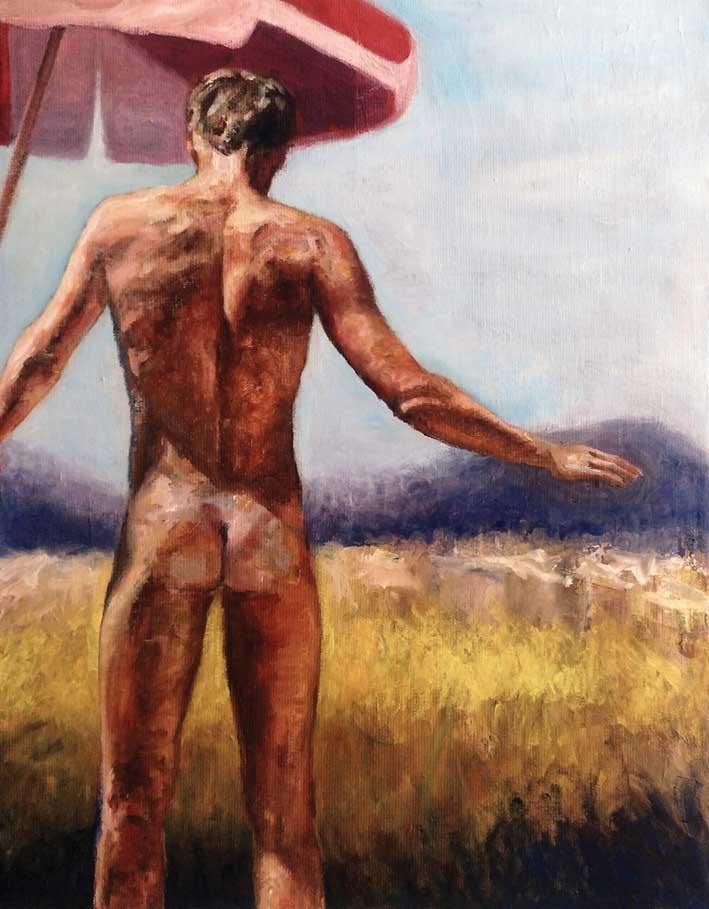
The collection features a number of nudes, all in either unexpectedly contorted positions or taking a less dominant role: almost becoming the prop of the prop. A painting titled "Wellies" diverts our focus to a pair of red wellingtons worn by a female nude. In "Sonnenschirm" the umbrella is not creating any shade for the nude male. And "Homme II" a black cat is not so thrilled to share the composition space with the contorted male nude.
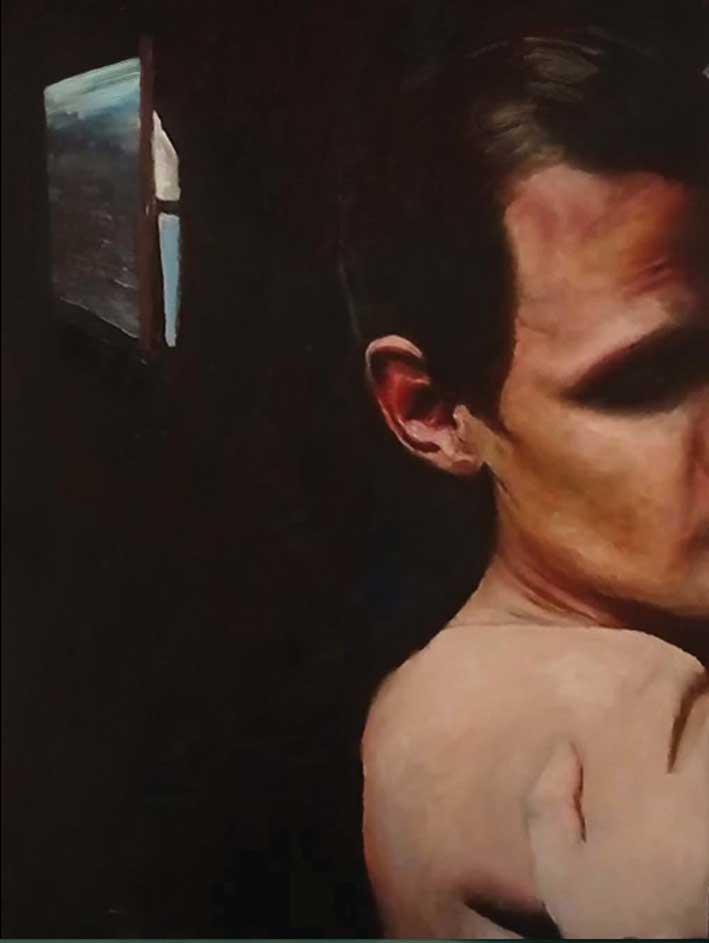
But the artwork that really haunts me is Widnet il-baħar - the only work executed in oil on paper within the exhibition oeuvres. A male figure, showing only part of the face and his right shoulder takes over the right-hand side of the composition, situated in total darkness, a darkness pierced only by a strange window full of light. I have no idea what the story is and why this title... maybe a morphing of the window's sea view and the ear of our guy in the foreground. Either way, I don't want to know the real story because I want to endure this haunting loop and aura of mystery.
The exhibition GO BLIND ERA is curated by Melanie Erixon and is being held at il-Kamra ta' Fuq from 13 October to 5 November.