Residents of Paola are raising urgent concerns to the Environment and Resource Authority (ERA) over what they say are "toxic emissions" and foul odours being emitted by the Thermal Treatment Facility in Marsa.
The Malta Independent on Sunday spoke with Paola resident Johann Gatt, after discovering that on Gatt's own initiative, he has been working to bring the issue to light on behalf of all the Paola residents.
In fact, he created a Google form, which he posted on Paola's residents' group on Facebook, on odour pollution in Paola.
Respondents are being invited to fill out the form anonymously indicating the date of when the odour was detected, as well as for the specific day of the week.
It also asks respondents to say for how long the odour persisted, giving them the option to choose between different times of the day.
Respondents are also urged to specify the area where they detect the odour, along with the name of the street. Areas in Paola such as Għajn Dwieli, Albert Town, Corradino Flats, Ta' Lourdes, and other areas in Paola, were given as options.
Finally, the form requests residents to describe the type of odour they are detecting, whether it's from burning animal carcasses, plastic, wood, oil or something else. Gatt said that after a meeting with ERA last month, officials revealed that only five formal reports had been filed regarding the plant.
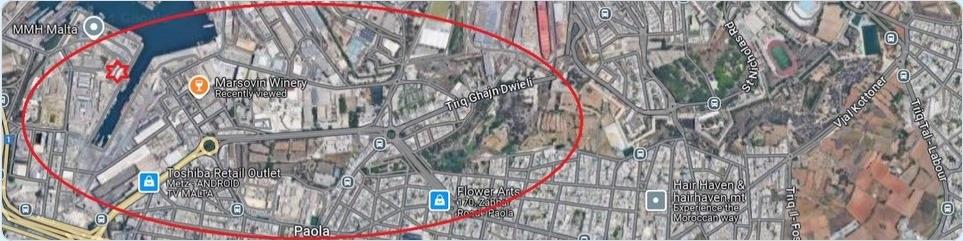
However, the Paola Local Council facilitated the process for residents, collaborating with Gatt and his Google form, and in just a month-and-a-half, 101 reports of unbearable odours were submitted on the form, with at least 35 residents calling ERA to report the issue.
"Despite the millions being spent on improvements at the Thermal Treatment Facility, which processes animal carcasses, medical waste and industrial liquid waste, locals, and those in the vicinity, say the unbearable stench lingers," Gatt said.
He added that residents are feeling frustrated and embarrassed by the stench, making them reluctant to invite guests over. They are forced to keep their windows closed to avoid the foul odour and often have to wash their clothes two or three times, Gatt said.
Real-time monitoring data on toxic gases has also been inconsistent or missing, he said.
Built in 2007, the Marsa incinerator has been the subject of complaints for years, and the Paola Local Council had opposed its establishment from the beginning, foreseeing its future effects.
Over the years, residents, former and current local councillors, and even MPs from both sides, wrote to and reported to ERA, WasteServ and other entities, such as the Environmental Health Directorate, about the unbearable stench that this plant continued to emit, Gatt said.
In 2016, an autoclave was installed to help extract animal fat and reduce the stench, and in 2021, a large enclosure was built to store carcasses before processing.
Furthermore, in a bid to stop the nauseating smell, WastServ installed advanced filters and ionizers at the end of 2022, costing the government €4m, Gatt said.
However, he mentioned that residents argue that these measures have failed, as the noxious odours still permeate neighbourhoods such as Ta' Lourdes, Albert Town, Għajn Dwieli, and parts of Paola.
In fact, the most affected area in Paola, according to the latest data derived from Gatt's Google form, shows that out of 101 responses, 39.6% detected the odour coming from the Ta' Lourdes area, followed by other areas in Paola (46.5%) and the Għajn Dwieli area (8.9%).
The odour was mostly detected on Sundays, with 50.5% respondents; 15.8% of respondents said that they detected the smell on Saturday, while 9.9% of respondents smelled the odour on Monday and Friday respectively, Gatt's data showed.
66.7% of 72 respondents said they smelled burning animal carcasses, followed by 9.7% who smelled burning plastic, Gatt's responses showed.
Predominantly, the smells are being detected late at night before midnight or in the early hours of the morning, with many people detecting the smells as early as 5am, up to as late as 10am, the data showed
Gatt told this newsroom that residents from Fgura and Tarxien also reached out to him through the form, as certain areas have also been affected.
"Adding to the frustration is the lack of transparency regarding toxic gas emissions. Real-time readings, which are supposed to be displayed every half hour on WasteServ's website, have not been updated since 16 July and when this was reported in the media, the nil readings were changed to a caption saying - Plant Maintenance Shutdown," Gatt said.
He said that the last available readings show zero levels for several pollutants, raising doubts among locals about their accuracy. Many readings are missing altogether, which has left residents fearful about what they are breathing into their lungs.
Gatt said that there are growing concerns about the incinerator's impact on residents' health, as in addition to carcasses, more than 100 types of toxic industrial liquid waste are being burned at the facility.
"Residents are asking for reassurances that these emissions are not reaching their lungs in dangerous quantities, and they demand that ERA and the Environmental Health Directorate provide proof that the gas levels from the incinerator are within legal limits," Gatt said.
Meanwhile, he said that plans to relocate the incinerator to Magħtab by 2026 have stalled after the Naxxar Local Council and nearby residents objected to the project. There is still no set date or location for the Maghtab incinerator, Gatt said.
"Although WasteServ announced the construction of a new state-of-the-art facility at Magħtab, objections have halted the process, and it is still unclear where or when the new plant will be built," he continued.
Gatt said that originally, the Marsa incinerator was supposed to be placed on "cold standby" once the new plant was operational. However, with no progress on the new facility, the timeline remains uncertain, leaving residents exposed to pollution from the existing plant.
The permit for Marsa's incinerator is set to expire on 31 May 2025, and the permit renewal was meant to be submitted nine months beforehand, Gatt said.
"Locals fear that if no new facility is completed, the permit may be renewed, extending their suffering. Many are questioning why the concerns of Magħtab residents were addressed when they protested, as they rightfully should have been, while those in Paola continue to be ignored despite enduring years of pollution exposure," Gatt said.
Questions have also been raised about the effectiveness of the plant's monitoring system.
According to the facility's permit (IP 0004/07/C), an established odour panel should include at least one representative from the Marsa Local Council.
However, Gatt said that there should be someone representing the Paola residents, given the impact the incinerator has had on their health and quality of life. Especially when there are northerly winds, Paola is heavily affected, he said.
Residents also questioned how many odour reports have been investigated, what factors contributed to the stench, and what measures the plant operator (WasteServ) has taken to prevent the situation from recurring.
Gatt also said that authorities must take action if it decides to stop operation at the Marsa incinerator, to absolve workers which may become redundant.
Residents are also questioning whether the waste processed at the Marsa plant could be exported and incinerated elsewhere temporarily, so the local facility could cease operations until the new plant is completed.
Gatt stated that they are also calling for a study to evaluate the health impact on residents living near the plant, due to concerns about air quality and prolonged exposure to toxic emissions.
Gatt ended by saying that waste should be treated according to the local Long Term Waste Management Plan 2021-2030, but never at the expense of human health as explained in the EU directive. The EU Waste Framework Directive "lays down measures to protect the environment and human health by preventing or reducing the adverse impacts of the generation and management of waste," Gatt said.