Many of you might have noticed a striking new addition to Jean de Valette Square in Valletta, a really large temporary public artwork that seems to have materialised out of the blue (and white). In this fun article, I'll be delving into how this 7.5-metre-high arch materialised itself. For the real long story, though, you'll have to wait for my book.
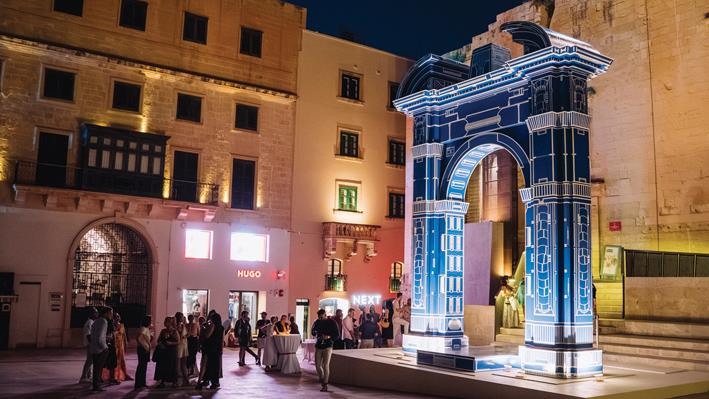
This public art installation is part of the 3D Blueprint Network: Malta Test Station by Justin Amrhein. Yes, the name should sound familiar if you've been reading my articles! This marks Amrhein's second exhibition in Malta this summer, following Dystopian Garden at Spazju Kreattiv. This time round, we've crossed the piazza and are being hosted by Muża. Both exhibitions form part of The Maltese Diptych, a project supported by Arts Council Malta.
One could say that Amrhein's practice revolves around two distinct yet interconnected signature styles. One is his series of mechanical plants and trees, where Amrhein creates speculative replacements for real flora lost or that might become extinct due to environmental collapse. The other, which I'll be focusing on today, is his 3D blueprints. These schematic sculptures depict fictitious machines designed to help save the planet from the climate crisis. The central message is clear: with all the technology we already have at our fingertips, instead of wasting it on war and other irrelevant pursuits, we should be directing our energy and intellect toward preserving the Earth.
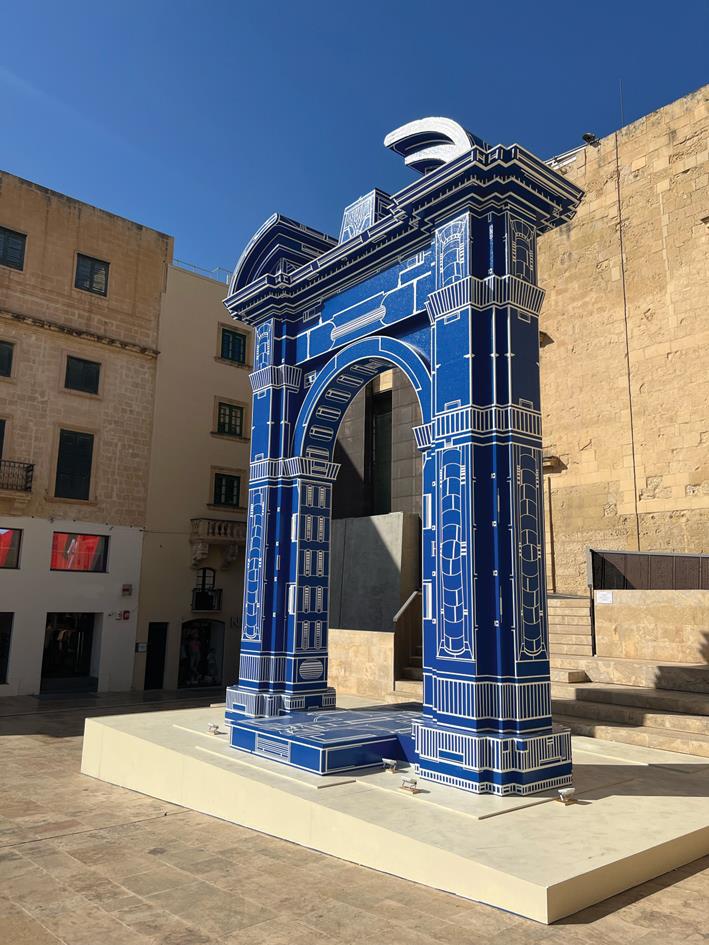
I'll start with a little "secret". That huge arch sculpture standing proudly in the square is actually a replica of the 18th century stone arch found in Muża's central courtyard. The secret? Justin's arch was originally meant to be installed just in front of the real one inside the courtyard, until about two weeks before the exhibition opened. Then, the unexpected happened: the opportunity arose to present it as a public artwork just outside the museum instead. And somehow, after a few spells, whispered prayers, and an overdose of potions in the form of Berrylicious smoothies, the stars aligned.
Justin, together with the incredible project manager Pacci Taub and a dream team of expert installers, consisting of Vincent, Dominic and Luzie, managed to adapt the entire installation plan in a matter of days. They worked with different equipment than originally intended and found solutions to deal with the sloping surface of the piazza.

What followed was a mad rush to find a cherry picker... which then became two cherry pickers... and eventually also a crane (with a lovely driver, Pierre, who ended up spending three whole nights with us outside the museum). Yes, the arch was built across three consecutive nights. A big shoutout here to the Muża security team, who patiently endured our nocturnal chaos.
The delivery of the arch pieces also happened during one very long night at Muża. The installation nights turned into a little pop-up factory for setting up other parts of the exhibition, with lots of painting happening too. I discovered I'm actually not bad at retouching detailed lines... but I definitely can't paint using a roller.
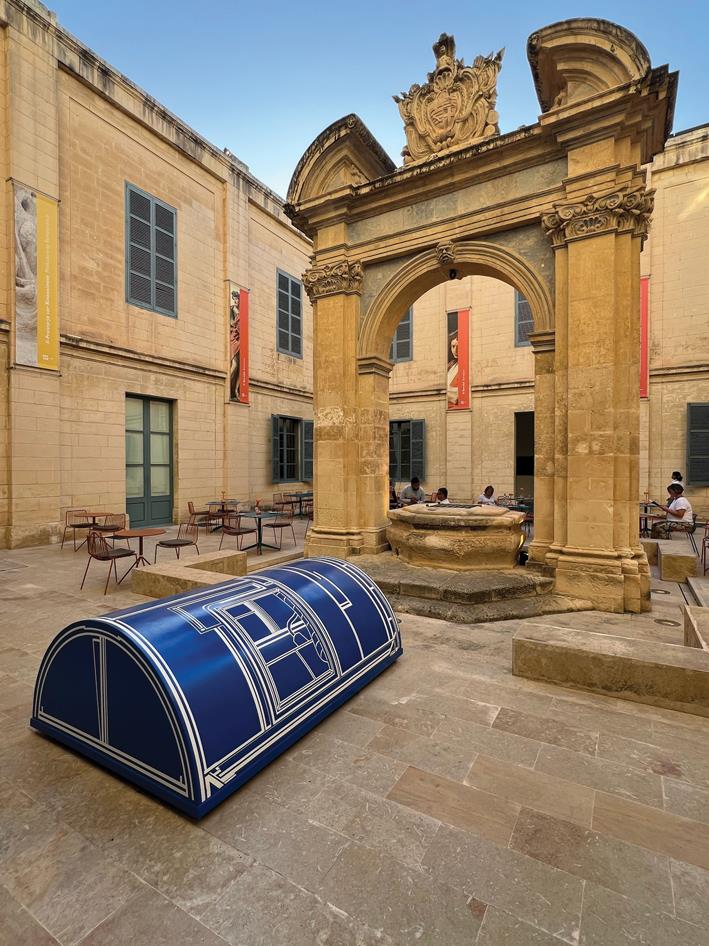
The exhibition, or rather, the Network, extends across the museum, occupying two other key areas. In the courtyard, a large semi-cylindrical sculpture lies flat on the ground, positioned just in front of the historic stone arch. This sculptural element, originally featured in Dystopian Garden, and now, recontextualised within Muża's courtyard, acts as a visual and conceptual link between the two exhibitions.
Echoing the semi-circular top of the adjacent Baroque triumphal arch, the structure reads like a fragment of a larger imagined machine, bridging historical architecture with Amrhein's futuristic blueprint language. At once a standalone artwork and a modular element within the broader 3D Blueprint Network, it deepens the artist's ongoing dialogue between past, present, and ecological possibility.
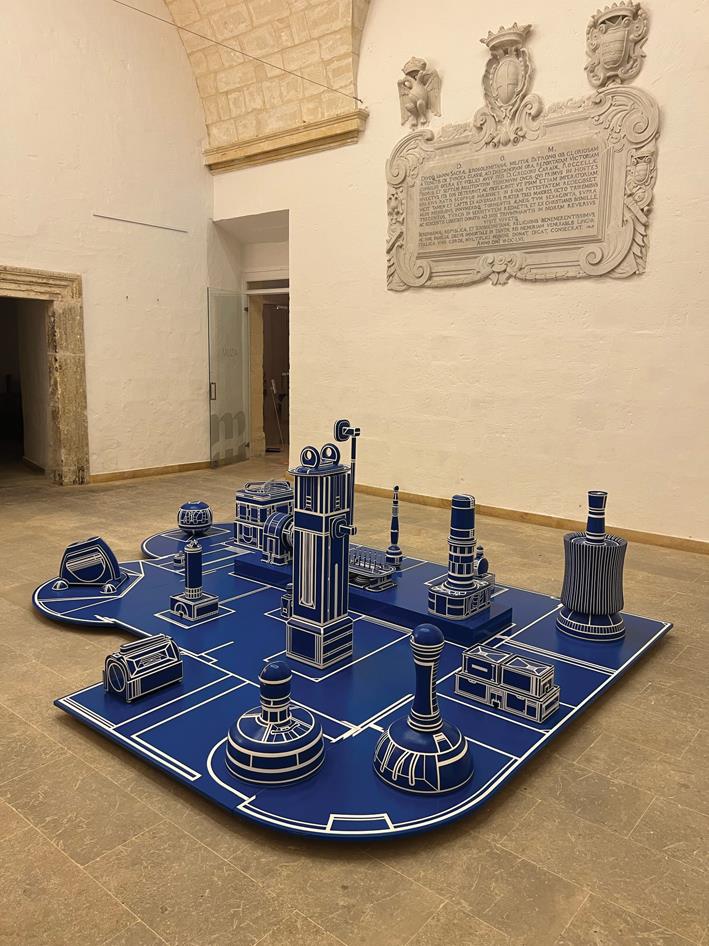
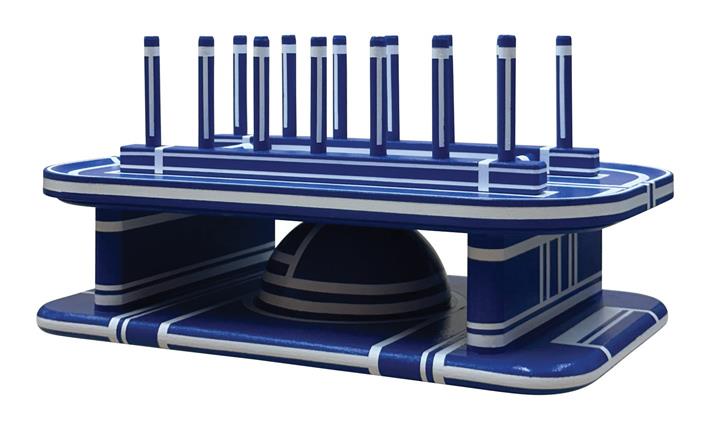
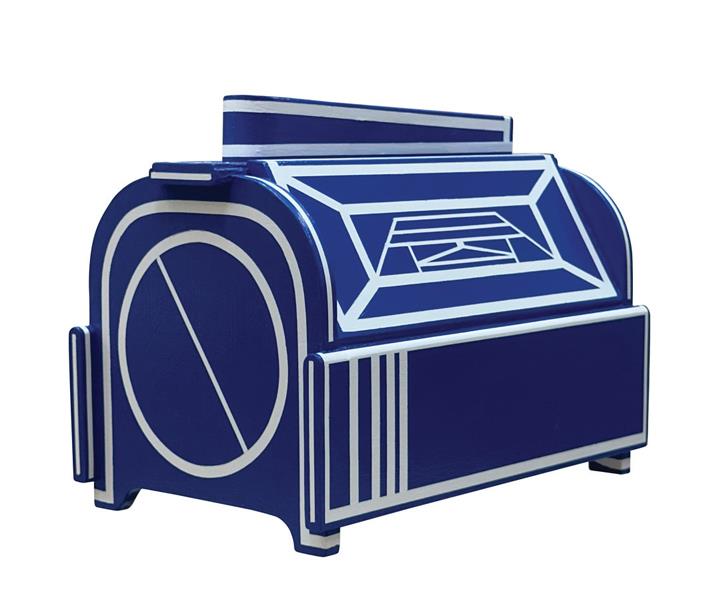
Moving on to the Community Space within Muża, we encounter a full "motherboard", painted in deep blue with white schematic lines. In this case, the traditional copper lines of a circuit board are replaced with white communication lines. The entire platform functions as a display for a number of 3D blueprints: sculptural prototypes for environmental healing machines.
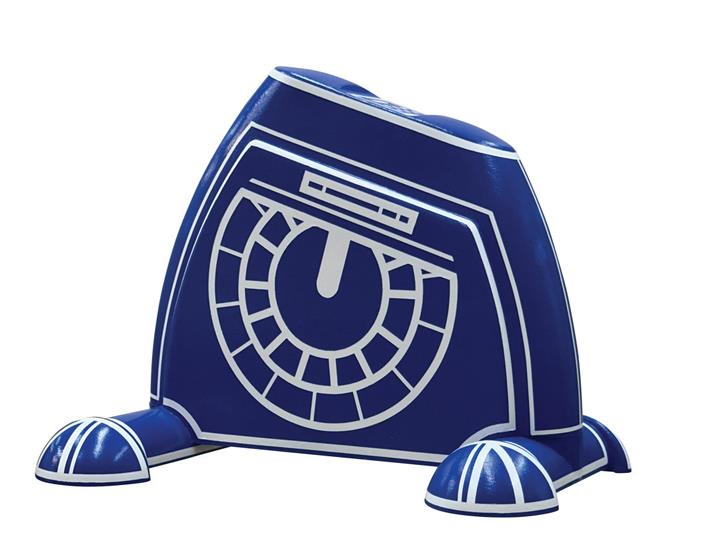
These works are constructed from repurposed and transformed found objects, as well as industrial remnants. Each mixed-media piece resembles a component of a larger speculative system. Though non-functional, the sculptures are meticulously crafted using a mechanical visual language that draws from blueprints, schematics and circuit boards. Together, they suggest the possibility of coordinated environmental repair, if only we choose to activate it.
Many visitors have remarked that the ensemble resembles a futuristic cityscape, with the individual sculptures taking on the appearance of avant-garde architectural structures. Needless to say, they are all rendered in Amrhein's signature palette of blue and white (in fact, at one point, Justin and Pacci had to travel all the way to Sicily just to find the exact shade of blue paint!)
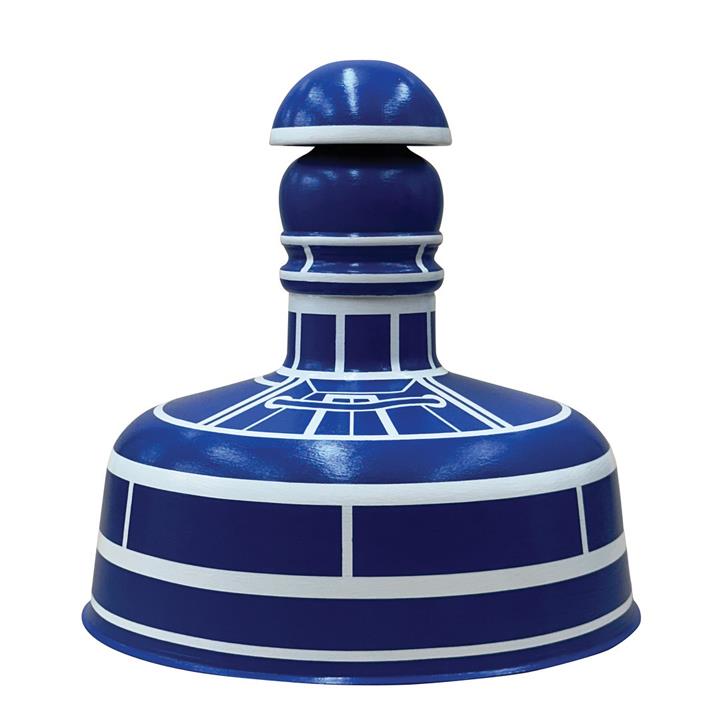
Quick side note: the inspiration for the blue-and-white aesthetic actually stems from traditional Portuguese tiles (azulejo). Justin developed this idea during a long stay in Portugal, where he was working on art projects, including another 3D Blueprint Network test station.
A video work accompanies the sculptural network, presented through stop-motion animations. Using images of the sculptures, the videos parody advertising aesthetics, promoting these fictitious machines as if they were mass-produced consumer products. This tongue-in-cheek approach raises questions about innovation, commodification, and the uneasy tension between imagined solutions and real-world inaction.
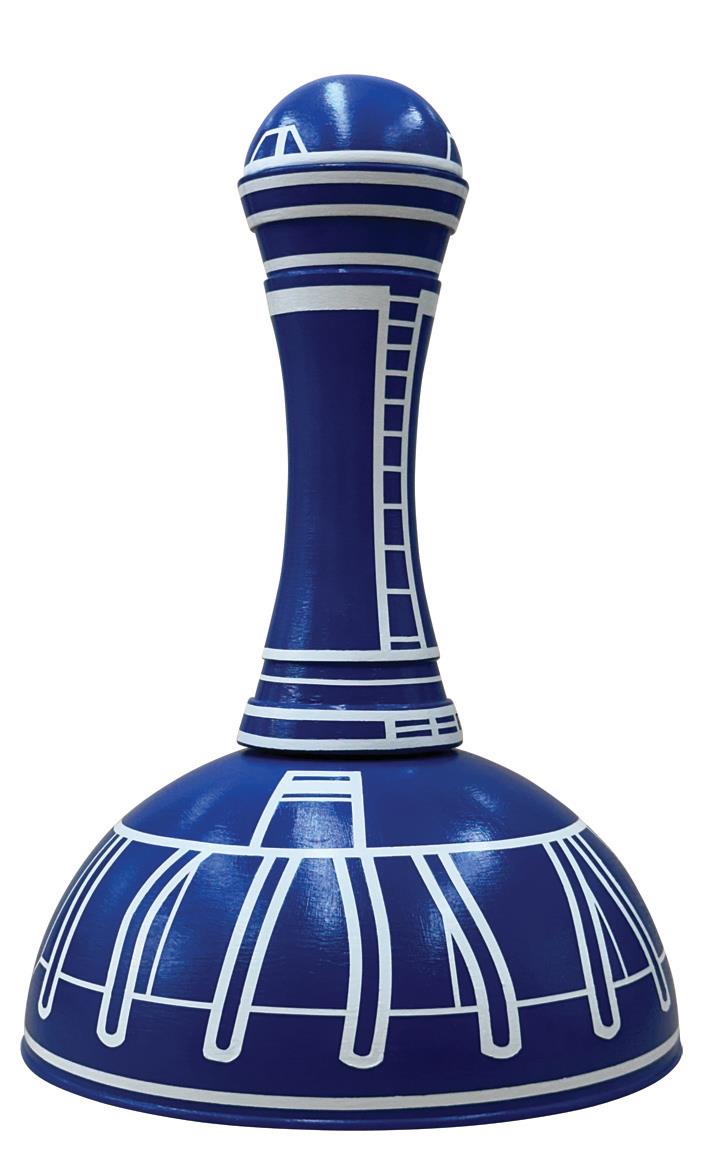
Also on display are two small-scale sculptural models of the courtyard's Baroque arch. One is an existing model from Muża's collection, the other a puzzle-like interpretation created by the artist. Together, they reference both the original historic structure and its newly-constructed counterpart outside the museum. Acting as a conceptual bridge between past and future, these models reinforce the exhibition's ongoing dialogue between architecture, transformation and ecological awareness.
Back to our arch, its full title is actually quite a mouthful: Atmospheric Water Generator - Humidity Portal. But the name isn't just for show. In every country where Amrhein develops his 3D Blueprint Networks, he imagines a fictitious machine that addresses a local issue. In Malta, he was particularly struck by the island's unusually high humidity levels, something that stood out to him compared to everywhere else he's been. So it felt only natural to create this towering Humidity Portal, as a sort of industrial-scale dehumidifier, imagined through his playful and speculative lens.
Through this network, Muża is reimagined not only as a site of preservation but also as a space of projection, where history, possibility, and urgent questions about our shared future come into dialogue. Amrhein's work suggests that the tools to combat climate change are already within reach. His sculptures merge technical insight, creative repurposing and ecological imagination, inviting us to envision a world where function follows intention.
Oh, and yes, you're absolutely allowed (and encouraged!) to walk through the arch, strike a pose, snap a photo, and don't forget to tag #3DblueprintNetwork.
The exhibition is curated by Melanie Erixon, project managed by Pacci Taub, and supported by Arts Council Malta.
You can experience this incredible network until 15 August
