In recent years, both internationally and in Malta, the art scene has witnessed a marked rise in the number of self-taught or informally trained individuals who turn to abstract painting or loosely structured sculpture. These works, often expressive and intuitive, dominate social media platforms and community art exhibitions. The question arises: why is abstraction such an appealing route for those who have not followed traditional academic pathways in the visual arts?
This article does not aim to dismiss the contributions of untrained artists, nor to claim that academic training is the only measure of artistic legitimacy. Rather, it critically explores the tension between intuition and discipline, expression and expertise, and asks how we might support artistic growth without romanticising the absence of skill or training.
The democratisation of art
One reason for this shift is the democratisation of art. Digital platforms such as Instagram, Facebook, and online marketplaces have removed the traditional gatekeepers, galleries, critics, and institutions, enabling artists to share and sell their work directly. While this has opened new spaces for creative voices, it has also blurred the line between professional and amateur art practice.
Many self-taught artists refer to abstraction as a means of personal or spiritual expression. Free from the pressures of realistic representation or formal critique, abstraction allows them to engage with paint or material instinctively. But abstraction is not simply a free space, it is a complex visual language, one that historically emerged from rigorous philosophical and artistic inquiry (Fineberg, 2000, Art Since 1940: Strategies of Being).
Why abstraction?
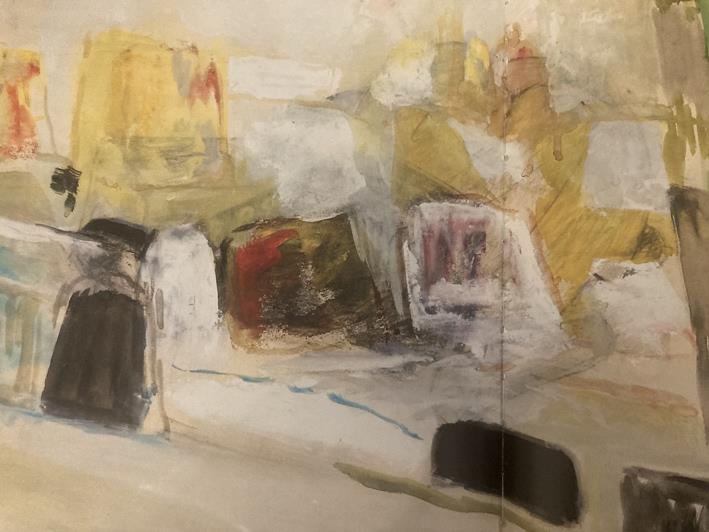
Abstraction is appealing because it appears liberating. It promises expressive freedom without the need to master perspective, anatomy or compositional rules. Yet this "freedom" is deceptive. In his book Why Art Cannot Be Taught: A Handbook for Art Students (2001), Elkins argues that while art education cannot teach creativity itself, it provides essential visual tools, like balance, contrast, rhythm and structure, which give form to expression. Without such knowledge, abstraction risks becoming generic, repetitive or emotionally vague.
The cultural capital attached to abstraction, particularly since modernism, also plays a role. Movements such as Abstract Expressionism and Minimalism have lent abstraction a kind of historical authority, even when detached from its original theoretical roots. The best example is Jackson Pollock, who found inspiration and aesthetic liberation from the Surrealists, but took his work in the opposite direction. He destroyed the last vestiges of traditional formal representation (Hagman, 2010, The Artist's Mind). Thus, some artists may adopt abstraction not because it reflects a personal visual language, but because it resembles "serious" or "high" art.
Discipline as a form of freedom
Contrary to the popular view, discipline in the arts is not antithetical to freedom, it enables it. Many of the most revered abstract artists were highly trained. Joan Mitchell studied at the Art Institute of Chicago; Gerhard Richter was classically trained in Dresden and also produced photorealist paintings. Even Jean-Michel Basquiat, who often presented himself as a raw talent, had significant exposure to art history and modernist traditions.
In the Maltese context, pioneers of modern art, artists like Emvin Cremona, Antoine Camilleri, Esprit Barthet, Karmenu Mangion, and other key figures, merged symbolic abstraction with deep personal and religious themes. Their work, though rough and expressive in appearance, was grounded in years of academic study and experimentation. One could also understand that such artists were being influenced by what was happening in art in Europe at the time. For example, Carmelo Mangion (1905-1997), one of the earliest artists to work with abstract themes, is considered an important figure in the development of Modernism in Malta. His retrospective exhibition is currently on display at Il-Ħaġar Museum in Victoria, Gozo, and will run until 8 September.
Currently on show at the Micas galleries, an art exhibition by six contemporary Maltese artists explores the theme The Space We Inhabit. Three of these artists are presenting abstract paintings. For example, Vince Briffa, an academically trained multimedia artist, is exhibiting large abstract canvases. One of the works, executed with synthetic polymer and charcoal on wood panels, is inspired by a line from the poem Do not go gentle into that good night by Dylan Thomas - specifically, "Rage, rage against the dying of the light" (Briffa, 2025). In this triptych, Briffa also gives importance to the materiality of painting, allowing the texture of the charcoal and the layering of synthetic polymer to evoke a primeval, almost tactile response. The gestural marks and tonal contrasts echo the poem's emotional intensity, translating the metaphysical struggle between light and darkness into a visual form. The abstract language Briffa employs invites viewers to contemplate not only the poetic reference but also the broader existential dimensions of the spaces we occupy, both physically and psychologically.
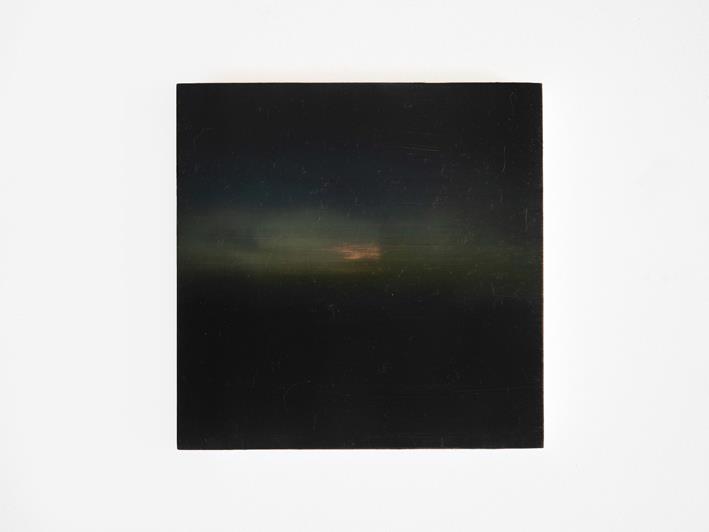
This existential dimension resonates with the work of Katie Sims, whose practice also engages with unseen, ineffable spaces, though through a quieter, more contemplative lens. Based in Gozo, Sims resists the binary of abstraction and figuration, instead using painting as a means of sustained looking, where meaning accrues through duration and depth. Her work Still, Deeper, titled after a poem written in response to her paintings, offers a counterpoint to Briffa's gestural urgency. While Briffa's brushstrokes fight against the dying light, Sims draws viewers into a quiet journey inward, facing the unknown with openness rather than resistance. Both artists connect their work to poetry, but in different ways: Briffa through rebellion, Sims through acceptance. Together, their paintings show us different ways of responding to the spaces around us and within us.
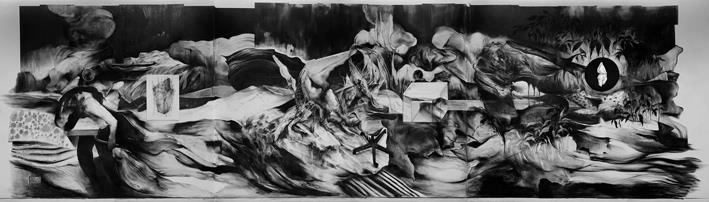
Gozitan artist Mario Abela produces visceral abstract drawings and paintings that evoke the textures and tones of human flesh, but beneath their biomorphic surfaces lie deeper narratives. His imagery is drawn from humankind's fraught relationships, with each other, with the environment, and with the looming spectre of conflict. Rooted in themes ranging from environmental degradation to personal entanglements, his work occupies the borderlands between the organic and the conceptual. In his monumental charcoal mural Shadows of a Wanderer, over nine metres in length, Abela channels his creative impulse into a transmutation of destruction into beauty. What emerges is not just an aesthetic spectacle, but an archaeological excavation of our collective condition, the Anthropocene, as he himself describes it: a probing of "the interweaving of man and nature in an age defined by radical contingency that sustains life" (Abela, 2025).
The myth of the naïve genius
There is a persistent romantic narrative in art culture that celebrates the untrained artist as a figure of raw authenticity. This idea gained traction with the promotion of Art Brut by Jean Dubuffet in the 1940s, who believed that artists free from institutional conditioning were purer in expression. While this may be true in some cases, the glorification of "naïveté" can also excuse mediocrity and discourage growth.
As French sociologist and public intellectual Pierre Bourdieu notes in his now-famous Cultural Capital Theory (2000), our judgements of taste are shaped by cultural structures. Today's art world often privileges individualism, intuition and emotion over skill and tradition. This has created an environment in which untrained abstraction is not only accepted but sometimes valorised over work that emerges from disciplined skills.
Supporting artistic growth
The question, then, is how to nurture artistic potential without enforcing rigid standards or discouraging experimentation. One possible way forward is to enhance opportunities for informal education. Community art centres, NGOs, and cultural institutions in Malta could offer short courses in composition, colour theory, and critical reflection, not to standardise art, but to empower artists with tools to refine their vision.
Curators, educators, and critics also have a role to play. They must foster critical discourse without elitism, helping both artists and audiences distinguish between abstraction as a serious visual language and abstraction as aesthetic fallback. True inclusivity in the arts does not mean lowering standards, it means broadening access to knowledge.
Conclusion
Rather than opposing "trained" and "untrained" or "academic" and "intuitive", we should ask more meaningful questions: What does the artwork communicate? Does it have structure, coherence and intention? Is it part of an evolving inquiry, or does it rely on abstraction as a shortcut?
Abstract art is not easy. When it is done well, it requires great discipline, sensitivity, and visual intelligence. For Malta's vibrant and expanding art scene to thrive, we must foster environments where artists, regardless of background, can explore both their intuition and their trained skills. The goal is not to reduce freedom, but to deepen it.

Prof. Louis Laganà PhD (Lough) is an academic, curator and practising artist