Poets have different relationships with poetry. How do you approach it and why is it necessary in your life?
For me, poetry offers a way to come to stillness, to look at the world around me with full attention. It is also the detour that gets me to myself - and thus to others - most quickly. And sometimes, just sometimes, it feels as if poetry grants me a glimpse behind the curtains of reality.
Above all, I love that poetry is such a vague concept. That vagueness gives me the freedom to keep redefining it, over and over again. I could happily spend a lifetime at it.
Your work often explores the intersection of language and identity - how do you negotiate this tension in your creative process?
I don't really feel like a European, or a Belgian, but above all like an inhabitant of my own language. And in that language, I sometimes feel limited, even trapped. That is why I'm fascinated by people who can switch effortlessly between languages - as if their identity shifts the moment they do.
Perhaps that also explains why there is such political tension between Dutch-speaking Flanders and French-speaking Wallonia: we can't seem to find each other, because we live in different languages.
When I was a city poet of Antwerp, I initiated many projects around multilingualism. One was a poem for the façade of a building where immigrants take language classes. In the poem, a few words (in neon) appear in other languages. I hope that, by recognising their mother tongue, visitors will feel instantly welcome - at home, even.
Your works expose vulnerability in your writing. How does it influence the connection you build with your audience?
I deeply believe in the power of vulnerability. By opening yourself - on the page and on stage - you challenge your audience to open themselves as well. Only when both sides do so can a genuine connection emerge. Sometimes even a kind of osmose. Nothing is more beautiful than creating a shared moment with an audience. You can recount it, you can film it, but you can never truly reproduce it. In French, the Dutch word nu (now) also means "naked". There is something pure and vulnerable in that shared nu. That is what I love to search for.
When you 'read' a poem, performance seems to be key. How do you move from the poem on the page to the poem on the stage? What unique elements does performance bring to your work that might be lost on the page?
I see stage and page as two different arenas, each with its own rules. What works on the page doesn't always work on stage and vice versa. Repetition, for instance, is almost always effective on stage - it carries the force of a refrain, but can sometimes feel tedious on the page. (Why write something you've already written?) Some of my texts therefore exist in two versions: one for the stage and one for the page. In any case, I see texts as living documents. I keep tinkering with them, even after they've been published.
What is your relationship with the audience? Do they play a part in your performance?
When I'm writing, I try not to think too much about the audience. Above all, I try not to be guided by the question: "Will they like this?" But the moment I bring a text to the stage, the audience becomes an essential part of it. Sometimes I invite explicit interaction, though I think it's important that people always feel completely free. You can participate by joining in, or just by quietly watching from the corner of the room. In truth, I see every text - even one that exists only on paper - as an outstretched hand.
When writing poetry, words are not the only essential elements. What is your relationship with silence and pauses within your poetry, both on the page and in performance?
What a beautiful question. Poetry only truly exists by the grace of white space - on the stage as well as on the page. White space is an essential concept in my work. Almost all my books have a white cover. My latest book, Tosca, was entirely white: leaf through it and you'd see only blank pages, with a poem here and there. Then, if you tore the pages open, you'd find the novel inside. (We used a Japanese binding.) I don't see white space as absence, but rather as the presence of a meaningful emptiness.
How do you see spoken word poetry contributing to social and political discourse?
Language has a treacherous power. With a single tweet, you can tilt the world in the wrong direction. It may sound strange, but as a poet I distrust language more than I love it. I don't necessarily see a poet as someone who glorifies language, but as someone who remains wary of it - someone who can point out its treacherous power to readers and listeners. Sometimes I struggle with militant spoken word poets who wag their finger. I am more interested in finding playful ways to disrupt myself, the audience, and language.
Reading or listening to poetry is an attempt to dive into someone else's language, no matter how foreign it is. It is about paying attention to detail, to nuance, to deeper layers of meaning. And yes, I do believe that reading or listening to poetry trains us to live in our multi-layered society. Poetry may take place in the margins of literature, but for me it beats right at the heart of society.
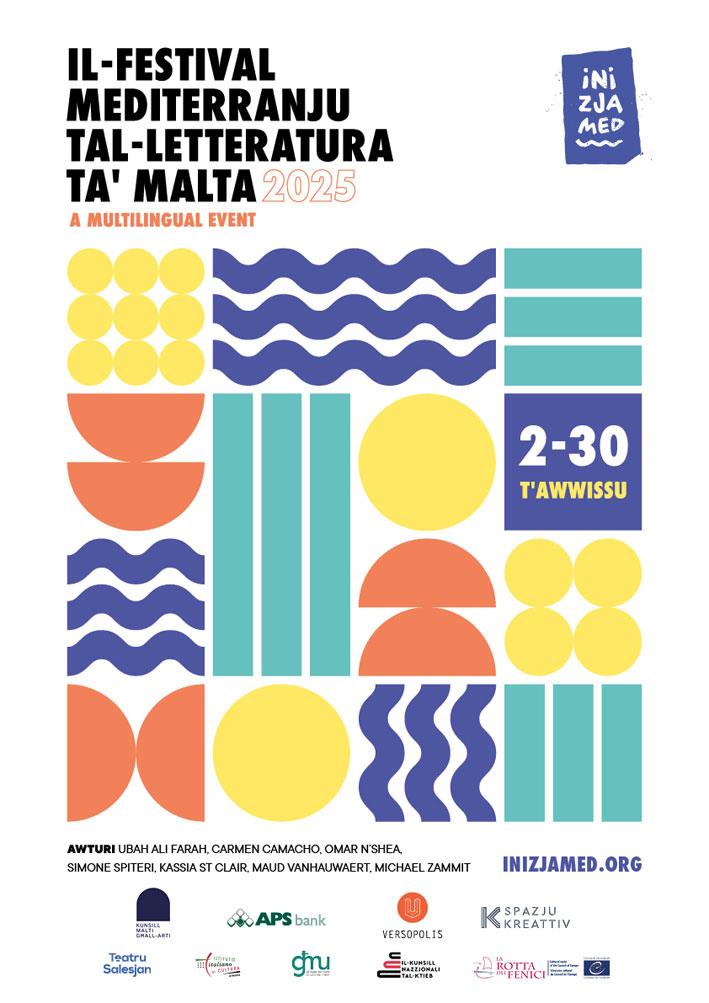
Maud Vanhauwaert will be a panellist at 'All the Wor(l)d's a Stage', joining Maltese actress and writer Simone Spiteri, with Keith Borg as host on 26 August at 8pm at Spazju Kreattiv in Valletta. She will also perform a reading of her poetry. Tickets are available at showshappening.com. Follow Inizjamed on Facebook and Instagram for more details about the Festival. Inizjamed, the organiser of the festival, is an NGO and can be found at www.inizjamed.org