Post-war Malta, especially the 1950s and 1960s, was characterised by new socio-economic realities which were weakening the power base of the Catholic Church in Malta. This led to growing secularisation and the declining influence of the Catholic Church.
Factors that contributed to this decline were the growing modernisation and industrialisation of Malta, the introduction of television and the struggle between the socialist party (Malta Labour Party or MLP) and the Catholic Church, which interfered in political matters.
Communism?
The Church in Malta always feared the socialist party in its apprehension that it would destroy the Church's influence and introduce communism to Malta. In 1961, this hostility grew to unprecedented heights with the direct campaigning by the Maltese Bishop, Mgr Gonzi against the MLP and its leader Dom Mintoff, for its defeat.
The MLP was also affiliated to the Afro-Asian Peoples' Solidarity Organization (AAPSO). This organisation was established in 1957 and headquartered in Cairo. It was the organisation that brought together anti-imperialist, socialist currents from 75 Asian and African nations and national liberation struggles. It was claimed that this organisation was dominated and financed by communists.
The 'Ġunta' and parties under the Church's protection
The 1961 electoral campaign was so harsh with the direct involvement of parish priests, provincials and the Ġunta Djoċesana or Ġunta (made up of Catholic lay organisations such as the Catholic Action, MUSEUM, Legion of Mary and the Young Christian Workers) that organised one mass rally after another in the run-up to the general election. The Ġunta was also known as the Central Committee of all Catholic Lay Organisations (CCCLO) which had its headquarters at the Catholic Institute in Floriana. The running theme of the Ġunta in its electoral campaign was to save Malta from communism and obtain a victory for Catholic Malta in the face of the socialist threat.
The Ġunta was very organised having published 170,000 specimen voting documents with the emblems of the five political parties loyal to the Church with the names of their candidates. These documents were distributed more than once by the Action leaders through door-to-door distribution. These documents proved very effective during voting.
The Ġunta encouraged voters to vote to any of those parties loyal to the Church. The Ġunta organised no less than 12 national and district rallies where it is estimated that 500,000 people attended to these spiritual crusades.
The MLP was disadvantaged in most respects in this election, considered by many as the most unfair one. Also, in May 1961, the Catholic organisations, encouraged by the Ġunta, opened a united front against the MLP, which was nicknamed "ta' taħt l-umbrella" (consisting of a five-political party umbrella front under the Church's protection).
Interdiction and other unorthodox sanctions
The Church also resorted to many unorthodox measures such as interdiction by refusing absolution to those who admitted voting for the MLP. Also, those who challenged the Church were denied a holy burial and were not allowed to marry except in the Church's sacristy.
Those who were active MLP supporters were not allowed to act as godparents in the bestowal of sacraments. The British stayed clear of taking sides in this election but implicitly and subtlety backed the Church, knowing very well that an MLP victory would mean that their presence in Malta would be prejudiced and their days counted if the independence movement continued to take deeper root and become stronger. All these factors naturally profited the Partit Nazzjonalista (PN).
Vatican Council II
When Pope John XXIII and Pope Paul VI summoned Vatican Council II between 1962-65 with the intention to adapt the teachings of the Catholic Church in modern times, many of the arguments advanced by the Maltese Church against the MLP had lost their validity. Catholics could now vote socialist without carrying any reprobation. Pope John XXIII for the first time made a distinction between socialist and communist ideology.
Election results
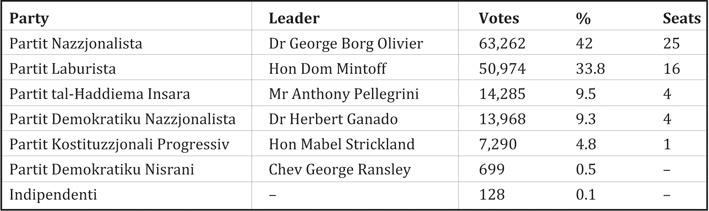
Despite the hurdles faced by the MLP, and although the election was won by the PN, the results show that over 51,000 voters (33.8% of the electorate) had defied the Interdict and voted for the MLP. This reflected the implications of the Vatican II Council, which had their effects in the declining influence of the Church and the voting tendencies of the population.
The following were the results of the political parties under the Church's protection and the MLP and their respective leaders:
The conflict between the Church and the MLP continued until December 1968 when Archbishop Gonzi removed all remaining religious sanctions against the MLP. In April 1969, it was officially announced that both parties had reached an agreement and that the quarrel had been finally settled in what became known as the Truce of 1969, which provided the MLP the key to power in the 1971 general elections.