What usually sparks the beginning of a new abstract piece for you?
It is sparked by a need of self-expression. The drive within me to create and express with colours "things" that I can't express in another way. It cannot be explained in words. At times the spark can simply be the urge to create, other times an abstract starts as a response to a transient emotion or even a particular state of mind.
How do you decide when an abstract painting is 'finished'?
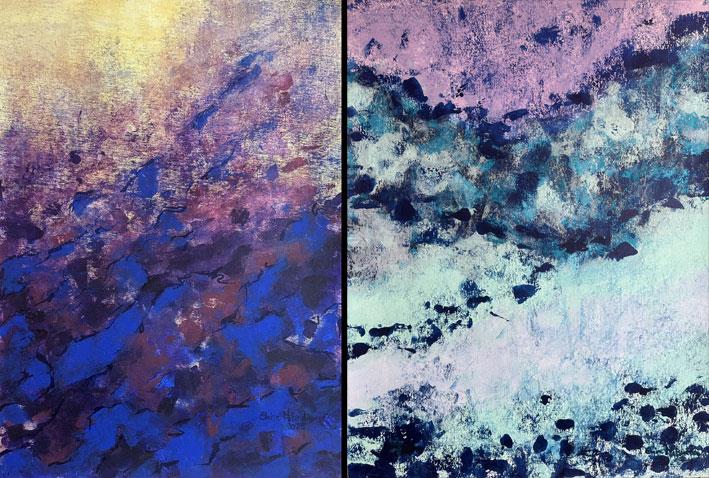
It is a combination of various aspects that lead me to decide that I have worked enough on an abstract. My academic background in art certainly helps. First of all I work in layers, therefore the "finished" piece has to have a build-up of various layers. Texture is also important, I try to bring out texture in various ways even through the application of paint itself, using varying tools and pressure. Colour contrast and colour harmony are also two other aspects I look out for. Most of the time I finish off an abstract with some markings which for me is like leaving my most personal mark to a work, this adds more expression to the finished look.
Do your paintings carry specific meanings, or are they open to interpretation?
They are open to interpretation. What I may be expressing in a piece can be understood and experienced in varying ways by others. Some pieces carry a very deep title to them. This, together with the use of a particular colour combination, may affect the viewer emotionally, they might feel the message I am trying to convey and make that moment their own.
Although the pieces I create carry meaning for me, they may not resonate with others. My aim when creating art is not for it to be understood, as my end goal is self-expression. However when my art leaves a therapeutic and positive effect on the individual, I can't be happier.
How do you feel about viewers assigning their own narratives to your work?
Overall I feel positive about it, as for me it means that the work stirred a reaction. They have been touched by it in some way or another, they aren't only looking at it, but experiencing it in its totality.
At times some of my viewers point out what they are seeing in the work, the first thing which comes to their mind. I get comments alluding to something representational, a particular object that they are seeing in it which wasn't what I had in mind when creating it. This has a humorous aspect to it as well. Others sometimes also remark that my works are "dreamy" or "captivating".
Is abstraction a way for you to escape reality or confront it?
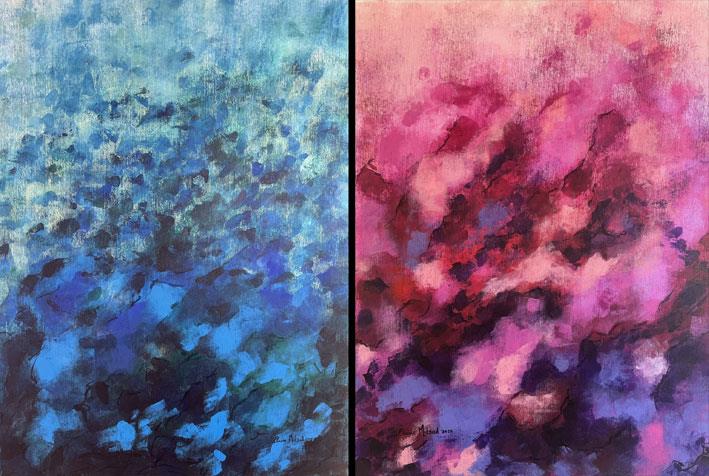
Both! Abstraction turned out to have massive expressive power for me. This is something which I did not feel as strong, when doing representational art. When creating work from life, I used to be focused on the subject in front of me and not on my emotions or state or mind. Abstraction proved to be an introspective process for me. It has become a way of expressing my emotions, to confront them and transfer them through the use of colours on the canvas.
At the same time, abstraction for me is a form of escapism, since each time I am working on an abstract piece, I detach myself from reality and enter into an almost meditative state; I go into my own world of imagination and colours, and this is simply beautiful.
What emotions do you most often channel into your work?
A mixture. Emotions of peace and tranquillity; positive energy, through the use of vibrant colours which I certainly do not shy away from; emotions of reminiscence, as at times I paint with a nostalgic memory in my mind; emotions driven by the intensity of colours and the dialogue I sense through their use; emotions of vulnerability, of disclosing my inner feelings or point of view; emotions guided by philosophical or existential notions such as the search for meaning, or truth.
Do you ever paint when you're feeling emotionally neutral - or is emotion essential?
Yes I do, I can't live without creating, without expressing myself. For me expressing myself through colour is as vital as the air I breathe.
So yes, even when I am emotionally neutral, I paint, maybe my colours will be a bit toned down and not so highly saturated.
How do you translate intangible feelings into visual forms?
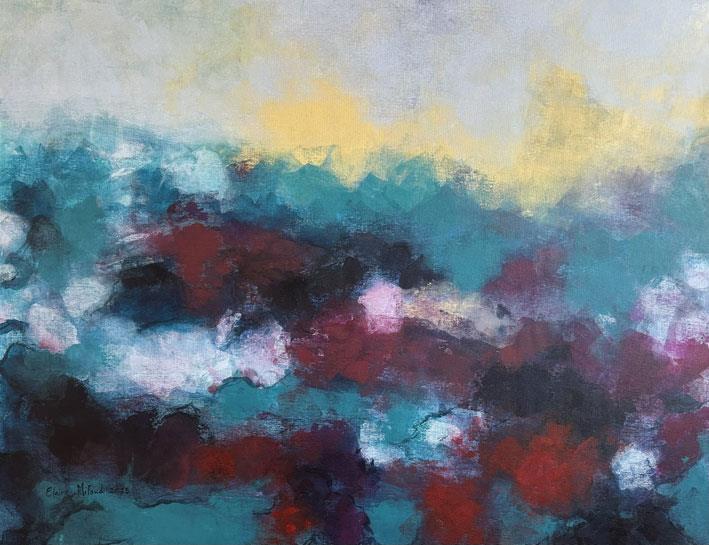
Colour for me is a form of language. I often choose the colours which suit that particular moment I'm in while painting. The higher the intensity of emotions the more vibrant my work is, the busier it is.
Colour is for me as notes are for a musician. It enables me to fully express myself in unbound ways.
Do you have favourite tools or materials that shape your style?
Switching from representational to abstract saw me put my small brushes aside... small brushes are of no use for me now, especially when working on a large canvas. I have resorted to big brushes and mark-making tools. These help me build up my layers. I love to use the palette knife too, especially in the final stages as it adds to the vibe with thicker dashes of colour here and there.
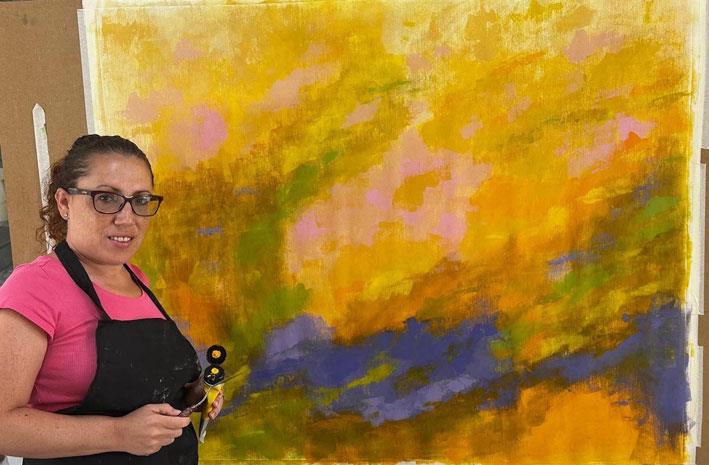
Regarding materials, I often like to work on a primed canvas which I cut and stretch to the desired shape I need. Lately I prefer to work on large pieces of canvas as that gives me a greater sense of freedom and it feels so liberating to let the colours flow on a larger area.
How do texture and layering play into your compositions?
These two factors are really important in order to obtain a better composition, and make it feel more unique and complete.
The first layer of paint helps me determine roughly the particular placing of the colour combination I will be using, as well as getting rid of the white canvas.
A composition is best worked by tending to all areas at the same time and not in isolation. So building layer after layer is very important. This helps in creating a more balanced work.
Texture is really important to create interest in the work; to add depth and an element of mystery as well. Texture for me is what draws me to really observe closely every inch of the canvas whenever I stand before a finished work.
Do you experiment with unconventional techniques or mixed media?
The transition to abstraction saw me switch from oils to acrylics, as these paints dry fast and enable me to work layers more comfortably. So yes, I had to experiment with a medium which wasn't that familiar to me. I do use mixed media as well as sometimes I work over a textured surface, I also love making marks at the end with acrylic inks over the painted surface.
What kind of reactions do you hope to evoke in viewers?
With my work, especially with what I am presenting in my debut exhibition, I seek to take the viewer to another world, another space and dimension, a world full of "colour!" I hope that my work evokes a sense of otherworldliness and positivity, as well as stir inner emotions. I invite the viewers to make a personal experience out of it, and disconnect from the chaos of the real world, to experience the r e a l m s that I visit each time I am immersed in my own world of colours.
Have you ever been surprised by how someone interpreted your work?
Yes, once someone bought a particular work, as in it this individual saw a path to a better place. This person who was at the time going through a rough patch, interpreted my work as a ray of hope and a promise of better times ahead.
Do you think abstract art has a unique power compared to representational art?
Without any doubt. Abstract art might not be for everyone, but once you immerse yourself into it, you start feeling its powers and it won't leave you unchanged. It has unique expressive qualities, it is loaded with meaning. Through abstraction the artist can convey a message and touch the viewer in unprecedented ways.
Abstract art has a narrative of its own, it can tap upon notions which go beyond the mundane. It can transmit a whole wave of emotions which can take the viewer into another dimension.
What drew you to abstraction rather than figurative or realistic styles?
The transition to abstraction came about as a response to a statement my curator, artist Fabio Borg presented me with... he told me "Everyone knows that a tree is green and the sky is blue". With this in mind, I set on a journey of exploration, of learning to see the world as never before, of pushing myself out of my comfort zone, and embracing change. Throughout these two years I was constantly producing new works in prolific ways, some of which are being presented in my debut solo.
Has your style evolved over time? If so, how?
Definitely! When I initially set out on creating abstract compositions, it was a very big challenge for me and I did not know exactly where it would take me... I was very conscious of the process and used to rely on sketching a lot. As time went by, I became more confident in my self-expression, and started noticing common elements which were appearing in my work, such as the use of vibrant colours. I started taking bolder decisions such as working on larger canvases, as well as adding markings on my work with acrylic inks which is something I discovered through experimenting with different media. I also explored soft pastels, which turned out to be one of my favourite mediums for creating vibrant and soft compositions.
Realms of Colour is my first solo exhibition, in which I bring out my passion and insatiable drive to express myself with colour.
Elaine Mifsud's solo exhibition Into the Realms of Colour is at present open at Gemelli Art Gallery until 24 September
About the artist
Elaine Mifsud was born on 31 August 1981 and hails from Qormi. Mum, artist and teacher in the Secondary Sector. Art is her passion and colour her obsession.
Her formal art tuition started in 2007 at the Malta Society of Arts in Valletta, after which she started attending the Malta School of Arts. She completed the Foundation programme, and then proceeded with the course of Diploma in Fine Arts (2010-2014) under the tuition of Tony Sciberras. In June 2015 she was awarded a Diploma in Fine Arts in Painting.
She regularly attends various workshops both locally and online. Some important workshops were Capturing the Essence. Abstraction and Notan in July 2023 with British Artist Prasad Beaven; Chasing light in floral pastels with Australian artist Stephie Clark; Allaprima in floral still life with the British artist Alex Kelly and recently in July 2024 and August, a workshop and demos on still life and portraits from life with the renowned Russian artist Regina Lyubovnaya organised at the Malta School of Art. She occasionally loves working from direct observation, in fact she does plein air painting sessions from time to time. She took part in several collective exhibitions, with the recent one being Collectively Solo IV at Gallery 23 in April.