Mater Dei Hospital's A&E Department had 140,150 patients walk in for its emergency services in 2024. This total is mostly on par with years prior since 2016, barring the pandemic years.
A month following the news that the tender to expand Mater Dei Hospital's emergency services and construct new mental health wards was cancelled after the sole bid of €135.7 million went well over the government's budgeted €80 million, the works to bolster the public health sector's emergency services have gone back to square one before even taking off.
Through this context, The Malta Independent analysed the numbers related to MDH's A&E Department and provide some insight to a growing national concern that has semi-permanently become etched into the back of our minds: how badly do we need to bolster Mater Dei Hospital's emergency services?
Malta's health sector has been a sensitive subject for years. A continuously increasing population, the failure of the "fraudulent" Vitals-Steward deal and the pressure on Malta's only public hospital have resulted in the Maltese islands crying for the health sector to be better supported. In addition, experiences at the national hospital's A&E Department are categorised by very long waiting times as hospital staff try to keep up with frequently large influxes of patients seeking immediate care.
It is unsurprising that Prime Minister Robert Abela said earlier this July that the €80 million tender to extend Mater Dei's emergency services and construct new mental health wards will be given "absolute priority until the end of this legislature". This hospital extension was "designed to meet the hospital's demands for the next 10-20 years", according to the tender's documents.
The Ministry for Health had defended the decision to cancel the tender for being too expensive, well over the planned €80 million, according to Times of Malta. The way forward remains unclear for the time being, though it is assumed that the government will try to reinvigorate these plans.
Emergency services and supporting infrastructure are vital to care for sudden injuries or the rapid health decline of our loved ones, though how busy have health workers been at Mater Dei's A&E Department over the years?
140,000 emergency attendances per year, annual increases noted post-pandemic
In 2024, Mater Dei Hospital registered a total of 140,150 A&E attendances - averaging roughly 384 daily patients throughout the year in this department alone.
In the previous two years since the Covid-19 pandemic, total attendances of 135,167 and 137,991 were respectively recorded in 2022 and 2023.
Throughout this article, "A&E attendances" refers to patients visiting Mater Dei's Accident and Emergency Department. Cases may vary greatly between minor walk-ins to life-threatening injuries. Attendances are triaged according to their severity and are seen by appropriate departments, depending on the case. Such visits may either result in admission to hospital wards or discharge, the Health Ministry told this newsroom.
Earlier this May, this newsroom reported that in 2024, patient admissions into Mater Dei Hospital exceeded 100,000 for a calendar year for the very first time. This was mainly attributed to the country's continuously increasing population, which is increasing through the importation of foreign labour, not through the births of Maltese newborns - Malta's fertility rate is as low as ever at 1.06 live births per woman [lowest mark in the EU (2023)].
2024's A&E attendances figure was not a record-high for Malta's main emergency department, though it wasn't far off.
This newsroom gained access to the annual A&E attendance numbers between 2013-2024 to check out this data.
Mater Dei Hospital opened in June 2007 and hence had its first full operational year in 2008. The Ministry for Health did not provide this newsroom with this data pertaining to the years 2008-2012. However, if one had to observe general MDH admissions trends and population trends, it is incredibly unlikely that a record-high in annual A&E attendances was registered within MDH's first five years in operation given that the population of Malta began booming in 2013 and that general hospital admission rates were also significantly lower back then.
The most A&E attendances recorded in a single calendar year at Mater Dei Hospital was noted in 2018, with 142,519 in total - just 2,369 more attendances than in 2024.
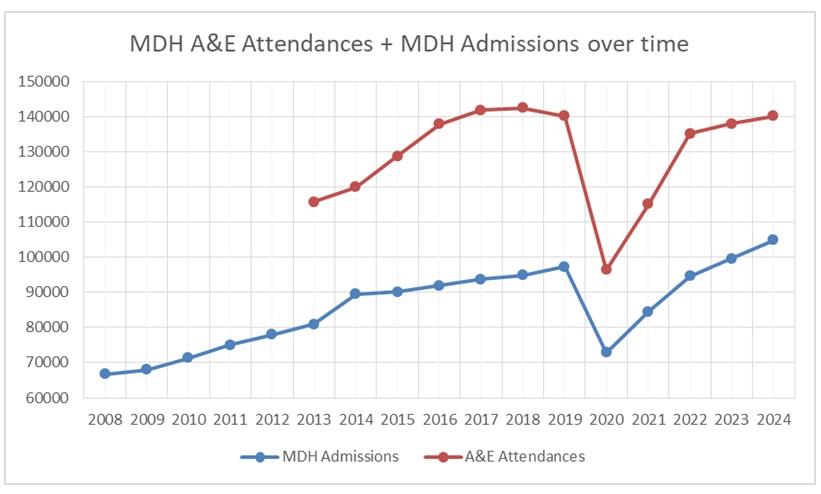
Between 2013 and 2024, the number of A&E attendances per year increased by 21.1% - from 115,706 attendances in 2013 to 140,150 last year.
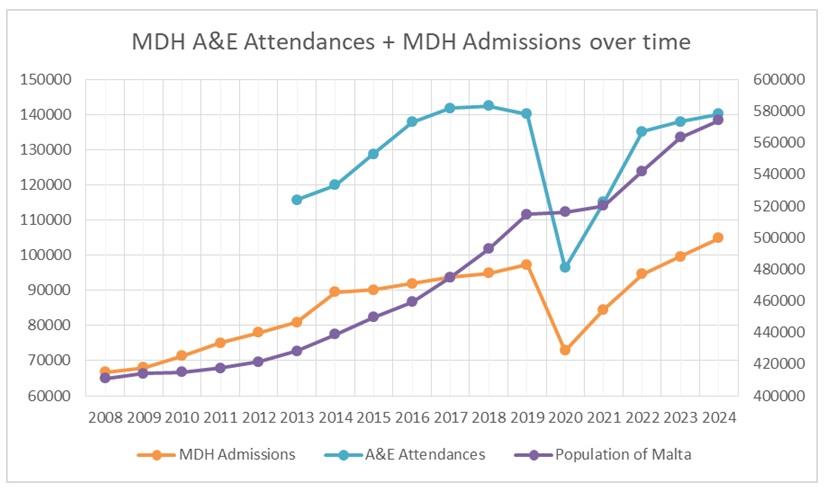
During this same timeframe, overall general admissions into Mater Dei Hospital went up by 29.6%, from a total of 80,931 admissions in 2013 to 104,886 in 2024. Simultaneously, the population of the Maltese islands rose by a third (34.1%) over the past 11 years, from 428,156 people to 574,250 persons.
The annual number of A&E attendances has stood pretty stable since 2016, though these figures had initially skyrocketed during this time from years previous - 115,706 A&E attendances were observed in 2013. This was followed by 119,941 attendances in 2014 and 128,747 attendances in 2015, followed by another spike in 2016 to 137,852 attendances and much less significant growth afterwards.
After the annual A&E attendance figures grew by nearly 18,000 in just two years between 2014 and 2016, with the exception of the principal Covid-19 years of 2020 and 2021, these numbers have since remained pretty stable.
141,758 A&E attendances were recorded in 2017, followed by 142,519 in 2018, 140,209 in 2019, and then a sudden drop in attendances ensued due to the societal and hospital restrictions imposed by the pandemic.
In 2020, Mater Dei's A&E Department witnessed some 44,000 less attendances than the previous year - just 96,382 throughout its 12 months. In 2021, just 115,068 attendances were noted; despite being significantly lesser than attendance numbers in recent years, this mark was only a few hundred attendances less than what was observed in 2013.
2024's total actually ranks fourth throughout this 12-year period, only narrowly eclipsed by the totals accumulated in 2018 (142,519), 2017 (141,758) and 2019 (140,209). According to the available data, this three-year stretch (2017-2019) was the most demanding three-year period for Mater Dei's A&E Department. During this stretch, the MDH A&E Department saw 424,486 patients; between 2022-2024, 413,308 patients visited the hospital for immediate care. From 2017 to 2024, the population of the Maltese islands increased by 100,000 people, from 474,837 people to 574,250 people.
Throughout 2024, according to Parliament data, a total of 1,309,300 patients utilised the services of government health centres, which are a separate yet relevant component of Malta's emergency health infrastructure.
Less of total population visiting MDH A&E Department overall
Since emerging from the Covid-19 pandemic's worst years, the ratio between the annual A&E attendance totals and the population of the Maltese islands has decreased.
Prior to Covid-19, annual attendance figures varied between numbers that represented 27-30% of the total population between 2013-2019. From 2022 onwards, this ratio has decreased to just under 25% and has remained stable. Essentially, this means that as the country's population has continued to increase, comparatively less of the overall population is visiting MDH's main emergency centre, resulting in similar annual totals since 2016, barring pandemic years.
Prior to Covid-19, health workers could expect to receive up to three-tenths of the whole population in total terms. Since the pandemic subsided, this has gone down to just under 25%.
In the first four months of this year, between January and April, MDH's A&E Department saw to the needs of 46,513 patients. January was the busiest month from the first third of the year, with 12,129 patients.
What does the future forecast?
Throughout Jo Etienne Abela's tenure as the Minister for Health, since succeeding Chris Fearne, the Maltese government's strategy to support emergency health services has been pretty clear.
Aside from the ambition to expand on Mater Dei's A&E department, earlier this year, Minister Abela announced a programme to outsource some uncomplicated emergencies to private hospitals. The 1400 national helpline was also launched to deter people from visiting the A&E Department with non-emergencies.
While the discussed A&E attendance figures may not highlight a worsening situation, the reality is that the A&E Department has been struggling to keep up with demand for years. In 2017, when A&E attendances were already reaching 140,000 annually, reports were emerging on people at the Emergency Department being forced into 12-hour waiting times to be admitted into a ward - a situation that the then Mater Dei CEO, Ivan Falzon, had labelled an anomaly.
With government optimising Mater Dei's operational strategies, intent to increase its bed stock by 600 beds, and (albeit temporarily cancelled) plans to extend its A&E Department to meet demand for the next 10-20 years, the health sector is clearly lined up to expand public infrastructure amid its sustained high demand.
The hope is that these strategies will address the elephant in the room highlighted by Finance Minister Clyde Caruana: Malta's population is projected to grow by a quarter of a million over the next 15 years."
If healthcare workers are struggling today, one can only hope that this vital sector is not brought to its knees once 800,000 people are living in the Maltese islands in 2040, as per Caruana's estimates.