 What a remarkable legacy - you are entering the 31st year of cultural storytelling. No small feat! What first drew you to cultural broadcasting and how did the programme begin?
Way back in the early nineties, when I was already working on television, presenting live Saturday night shows and educational programmes for children, I decided to follow a course in scriptwriting at MTADA with Gorg Peresso as tutor. Writing has always been my first love, indeed a part of me, must be in my blood seeing that both my uncles on my late father's side were writers and poets, namely the well-known poet and novelist Guzé Chetcuti, and Gorg Chetcuti, a poet and literary editor of newspapers il-Bajda u l-Hamra and The Maltese Herald in Australia, where he had emigrated with his family in 1965 and where he was also the literary editor of Il-Bajda u l-Hamra, newspaper of the cultural society of the same name and editor of The Maltese Herald, a newspaper of the Maltese community in New South Wales. But I deviate. I consider the script writing course with Gorg Peresso as the turning point of my television career. I remember I had paid 5 Maltese liri as fee to follow the course, and I still consider that fiver as the best fiver I had ever spent. Apart from Gorg Peresso's tutoring which had further stimulated my love of writing, Gorg who was then acting programmes manager at TVM, asked me to start presenting the cultural television programme Spektrum with Tony Barbaro Sant. Two years later, the then chairman of PBS, Roland Flamini and Gorg Peresso proposed the production of a new cultural programme. Meander, with me as producer and presenter. Meander aired for the very first time on 12th October 1994. On Thursday, 2nd October 2025 we will, God willing, start the 31st year of Meander, with what must be roughly the 1200 programme.
I generally like asking women this question because we know how difficult it is to work while bringing up children. Your children were small then. How did you manage?
My daughters, Krista and Berta were very young when I was entrusted with the production of Meander, what's more it was an entirely new experience for me, a job which entailed a lot of time, a mental and physical challenge really. I remember there were times when I panicked and even considered giving up, but both my husband Geoff and Gorg Peresso whom I consider as my mentor and whose professional advice I respected, continuously supported me and urged me to continue.
The girls, even though so young, somehow understood Mama's new commitment and life style they co operated and Meander became an integral part of our family life.
Do you remember the very first episode? What was its theme, and how did it feel stepping into that role? You were very young then.
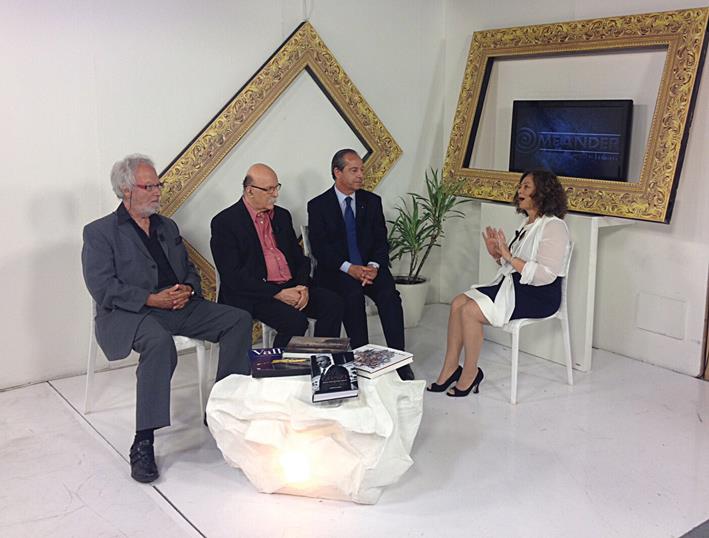
I remember the first episode very well indeed. We filmed the intro to the new series at the Domus Romana, at that time known simply as the Roman Villa, by the mosaics decorated with the spiral of the continuation of life, the Meander, and basically I explained why we had chosen Meander as the name for the new series of cultural programmes. We also filmed at Tarxien Temples, which had just been accepted as a World Heritage Site by Unesco, and where there are also stones carved with the meander symbols. My uncle, already mentioned above, poet and novelist Guzé Chetcuti was featured together with actors who played some of the characters in his novel asking him questions about a particular character. Albert Storace, the music critic, interviewed violinist Carmine Lauri, then at the beginning of his career and now a virtuoso in his own right. The first programme also included interviews with various Maltese artists, now all among the most established artists in the local scene, who were participating in an art exhibition organised by AZAD. The pace for Meander was set in the very first programme. Who would have told me at that time that Meander would last through 31 years of continuous broadcasting?
What was the cultural landscape like when you started, and how has it evolved over the decades?
When I first began to produce Meander in 1994 the cultural landscape was one in which, at least that is how it seemed to me at the time, only the elite few were included. By elite few I mean, a few select artists and art critics a couple of prominent composers, poets, writers and actors who were the main protagonists in various fields of the arts. The general public whilst participating wholeheartedly in traditional cultural activities like Carnival and village festas, felt that it did not belong, it had no place in what was considered 'high' culture.
Throughout the years various factors contributed to a change in this line of thought. When the Art Unit was set up at the University of Malta, on the initiative of Professor Mario Buhagiar, it made History of Art and Art accessible to students, paving the way for academically qualified art historians, who through their valid contribution in various museums and art institutions and publications gave local art meaning in the context of the wider art scene. As did other departments at University. Art in all its forms became attainable and was given recognition.
The opening of St. James Cavalier, the Knights of St. John war machine so brilliantly transformed by architect and artist Richard England to a creative centre for the arts, Malta's Millenium project, further contributed to bringing the arts to the general public.
Throughout these last thirty years, through the production of Meander I had first hand experience of the development of the local cultural scene. Thanks to Meander televiewers felt that they, too, could partake of the beauty of art.
How has the programme changed over time - visually, thematically, or in tone?
Meander has inevitably developed throughout the years. A firm believer in 'never change a good formula' I have always adhered to our modus operandi. Of course technically and visually Meander has moved with the times, but as regards themes and concept these have remained practically the same as day one.
Are there particular episodes or interviews that stand out as turning points or personal favourites?
I have met and interviewed many local and foreign artists, musicians, composers, writers, poets, actors, dancers and singers, theatre directors, film makers. I have hosted architects, art critics and art historians, famous people, politicians, presidents and prime ministers, really and truly every encounter, every interview, every work of art has throughout the years left a mark on me. I am grateful and I deeply treasure every moment I experienced on Meander. I have dedicated the best years of my life to Meander, for which, thankfully, I have no regrets.
How do you balance showcasing tradition with exploring contemporary or experimental culture?
The content of each programme is normally made up of five to six features about different themes. These may include cultural activities happening currently, mainly art exhibitions and theatrical productions; features about new publications; features about historical events and architectural sites; interviews with personalities hailing from various roles in society and the cultural scene. This combination of topics and the juxtaposition of traditional and contemporary, classical and modern gives Meander a fresh and innovative air, week after week.
Have you ever featured something that surprised you or shifted your own perspective?
Many a time, I am pleasantly surprised to realise that Meander has throughout the years become a part of the lives of so many people. I meet artists today who tell me that watching it when they were young instilled in them their first awareness of art. Meander has made me appreciate people and respect the great need of human beings to express themselves and their inner feelings through art. Certainly not every human being is an artist but every artist is a human being worthy of respect and to be held in high esteem. On Meander I never under estimate anyone, but I always endeavour to identify that je ne sais quoi many a time hidden in the delicate sensitivity sometimes eccentricity of each particular individual.
What kind of feedback have you received from viewers over the years? Any moments that deeply moved you?
Meander's televiewers over the years have been the backbone of my personal support system. Feedback has been constant, coming from people from all walks of life. My face is familiar and my voice seems to be even more so. Many a time I am stopped in the streets, sometimes by the most unlikely persons, and spoken to like an old friend. When I feel the sincerity of these people, I must admit, I am touched.
How do you see your role - as presenter, curator, storyteller, or something else?
Professionally I am the producer, presenter and script writer of Meander. As an art historian, I write about art and artists, I am an art critic and also a curator. First and foremost however I consider myself to be a writer and a novelist.
What has this journey taught you about Maltese identity, creativity, and resilience?
As Maltese people, we certainly are a resilient race. No doubt about that. Through sheer hard work and dedication as a people we are able to overcome most of the difficulties that come our way. Often the limitations of having been born on such a minute island, a rock in the Mediterranean sea hinders our performance in all we do, but our innate impulsion to prove ourselves, to be as good, if not better than our European counterparts, spurs us to make huge efforts to succeed.
Meander has throughout the years repeatedly exposed and demonstrated the creativity within us as Maltese people.
How has your own relationship with culture deepened or changed through this work?
Yes. Inevitably. I have through the years fully understood that art and culture are a reflection of our inner self, our thoughts, our beliefs, the circumstances we encounter through our experience of everyday life. Art and culture reflect our past, our island's history, our ancestors' way of life even. They also reflect our country, our beloved Malta, the political and economic situation we face throughout the years. Art and culture are a reflection of all this and I have learnt to appreciate artistic expression, above all I have grown to respect whoever contributes in one way or another to the holistic sense of well-being and the beauty that art and culture convey, giving sense and meaning to our lives.
If you could whisper a message to your younger self at the start of this journey, what would it be?
I would tell Mariella, a young wife and mother then, so excited and enthusiastic but so anxious to be venturing on such a challenging television production, to enjoy and treasure every moment of this Meander journey, a journey which turned out to be so exciting, so fruitful, so meaningful to me, because time really does fly fast and as the Maltese saying goes, 'iz-zmien ma' jistenna' lil hadd.'
What are your hopes for the future of cultural programming in Malta?
I sincerely hope that art and culture, the backbone of society, in the future always be given due importance, raised high on a pedestal on the social platform.
I know you have written at least one book. Can you tell us about it. Do you intend writing another?
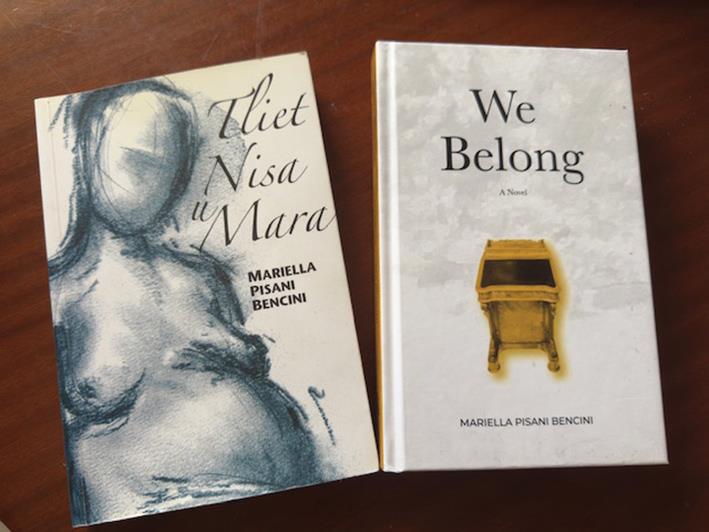
In 2004, Klabb Kotba Maltin published my first novel, Tliet Nisa u Mara, described by the late Professor Oliver Friggieri, in the foreword as ' l-istil minimalista jhaffel il-qari u jishaq fuq il-fatti, minghajr ma jinsa' lill-karattri u l-bqija. Il-grajjiet isegwu lil xulxin b'mod li l-qarrej ikollu jissokta' jaqra sa l-ahhar'. Tliet Nisa u Mara, won the first prize in the literary prose category of the National Literary Prize in 2004.
My second novel, We Belong, written in English, was published by Kite Group in 2018. In the foreword, Gorg Peresso, wrote: 'A novel in English? Indeed, but the flavour and the smell are typically Mediterranean. Reading this novel is like eating an oven-fresh Maltese loaf of bread with olive oil and tomatoes, garnished with refreshing herbs. And with every bite, the poignancy of the imagination comes to life like relived shadows of past seasons'.
For the past years I have been working on my third novel, this time in Maltese, a novel to which I have not yet given a title, but which I sincerely hope to publish in due course.
What legacy would you like to leave behind - not just for the programme, but for the cultural community?
I would wish my legacy to be one where the hundreds of television programmes in the Meander series, would be a fitting tribute to so many local artists from all fields of the arts, highlighting and documenting their art and their valid contribution to the local scene of art and culture. Through the interviews, through the footage recorded I hope that through Meander their memory will live on forever.
Let's get to know you a little better...
What is your idea of perfect happiness?
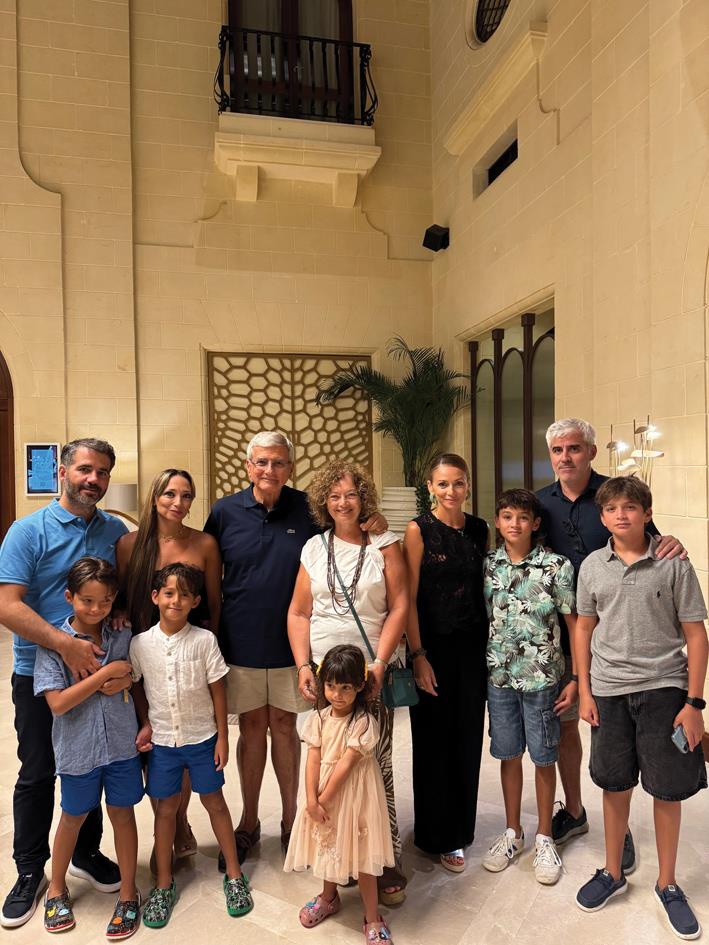
Perfect happiness is time spent with my daughters Krista and Berta, and my five grandchildren, my four grandsons Max, Roger, Giorgio and Paolo and my four- year-old granddaughter, Bettina Zazà. My heart fills with joy, when I see the beautiful family my husband Geoff and I have been blessed with. The laughs, the arguments which cannot be helped since both my daughters and my two sons-in-law, Antonio and Paul, are lawyers, the love which we share is the greatest blessing of my life.
What is your greatest fear?
My greatest fear is illness. Illness on any member of my family. I fear illness and I fear old age. Yes, I dread looking in the mirror one day and seeing an old lady looking back at me, but then, as my husband Geoff tells me, not to grow old means to die young. So...
What is your greatest regret so far?
Regrets I've had a few, but then again, too few to mention, as Frank Sinatra's song goes. Perhaps I would have liked to publish more novels, but since I pertain to the philosophical thought of 'what will be will be' I suppose that is how it was meant to be, for the time being at least.
What is your greatest extravagance?
I am not an extravagant person by nature. I appreciate beauty in all that is simple and natural. I sincerely relate to the words of Antoine de Saint Exupery, when he says in The Little Prince, that: 'It is only with the heart that one can see rightly; what is essential is invisible to the eye'.
As Meander continues its graceful journey, Mariella Pisani Bencini remains at its helm - curating, presenting, and preserving Malta's cultural soul with unwavering passion. Her work is a living archive, a testament to the enduring power of storytelling, and a reminder that beauty, when nurtured, never retires.
Until last season Meander was transmitted on a Monday, but as from this October it will show on Thursdays, then repeated on Mondays at 10pm and on Saturdays at 14:15. Arti u Kultura NET TV Thursdays 9:35pm
