It's finally happening! Ebru Çınar Erdoğan's debut solo show is here, and I have the privilege of curating this thought-provoking exhibition. Titled Unwritten Rules: Conformity, Identity, and Freedom, the exhibition is being held at Bizzilla Art Space in Floriana and runs until the 30th of October.
I'll start with a quick background check before sharing how I fell in love with Ebru's work. Born in Turkey in 1988, Ebru Çınar Erdoğan has been based in Malta since 2020, following a period of time living in Poland. She is an artist whose practice reflects lessons inherited from her mother, woven into her work through the medium of thread, while reinterpreting them in a contemporary context.
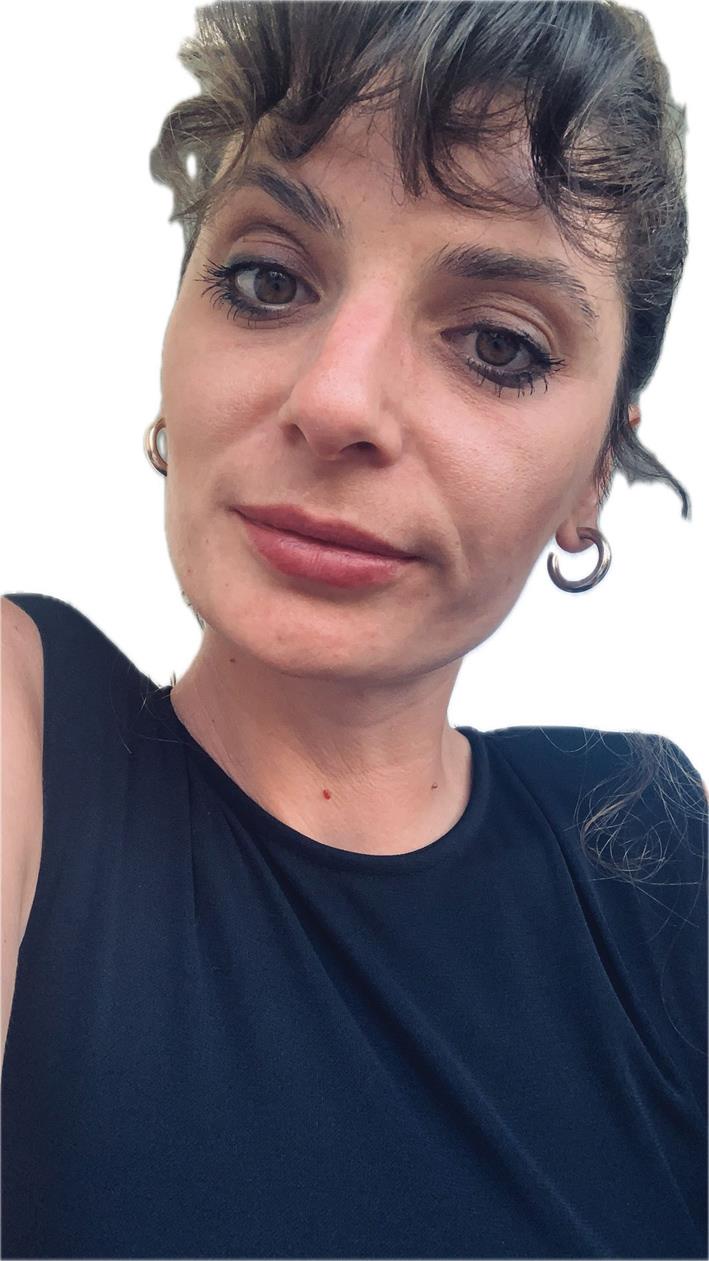
In 2016, she founded her brand byebrucinar, transforming what began as a hobby into a meaningful artistic practice. Each stitch became an act of patience, care, and creativity, evolving into a language through which she could question tradition while embracing new forms of expression. Since then, she has exhibited both locally and internationally. Her oeuvre spans embroidery, embroidery on paper, textile printing, acrylic painting, and mixed media.
It was during Covid-19, on one fine but boring early morning, that while wasting a casual 15 minutes scrolling on Instagram, I stumbled upon an artwork that completely captivated me. It was a photo of a woman's face, beautifully reinterpreted and given a whimsical twist through embroidery. I had to own it. I didn't know the artist at the time, so I started digging through the profile and what a great surprise to discover that Ebru was living in Malta! Needless to say, just a few minutes later, I was already in touch and ordered not one, but two artworks.
After that, it was just a matter of finding ways to collaborate with her. And we did! Ebru was part of a collective exhibition at il-Kamra ta' Fuq, which explored the artistic possibilities of thread.
The following year, we teamed up again for the major exhibition But I See Beauty and Wonder... at Spazju Kreattiv. As part of the ŻiguŻajg Festival, Ebru led a workshop for children, once again using thread as her creative tool. So, of course, I was absolutely thrilled when she asked me to curate her very first solo show!
And my excitement grew even more when I read her exhibition concept proposal. It's such a strong and important project, one that resonates deeply with women not only in Malta but across so many different countries.
The exhibition explores the invisible yet powerful restrictions placed on women through societal expectations. At its centre is the notion of Elalem-literally translated as "what people will say", an unwritten authority that dictates behaviour and enforces conformity in silence.
Growing up in Turkey, Çınar Erdoğan witnessed how shame and prohibition shaped the daily lives of young girls. Ordinary acts such as going out at night, smoking, drinking, or having male friends were deemed unacceptable for women, yet entirely permissible for men. Instead, women were expected to remain at home, seated beside their mothers, under the quiet but constant surveillance of Elalem. These experiences became the foundation of her artistic engagement with questions of gender, identity, and freedom.
Over time, and especially after moving abroad, Çınar Erdoğan came to realise that these unwritten rules were not unique to her own cultural context. Conversations with women from different countries, including Malta, revealed similar pressures that cut across cultural and religious boundaries. From this, a sharper understanding emerged: these restrictions are less about faith or tradition and more about the systemic control of women's autonomy.
This exhibition raises many uncomfortable questions. Why must women adhere to these strange "rules" that are more ingrained in tradition than rooted in any real logic? And, perhaps most importantly, why do we continue passing them on to our daughters?
I still remember my Paceville days, when my brother, five years younger than me, was allowed to stay out later than I was! What logic is there in that? The reasoning always came back to what the neighbours would say: if the daughter's skirt was too short, if she came home at 3 a.m.... But really, why should that matter? Does it matter?
This kind of upbringing leaves its mark. For some, it works in keeping them "in line." For others, it backfires, fueling a constant need to prove they can do everything men can do, and even more.
The tagline of the exhibition, (Elalem - Dak li se jgħidu n-nies), points directly to this core issue: the weight of "what people will say."
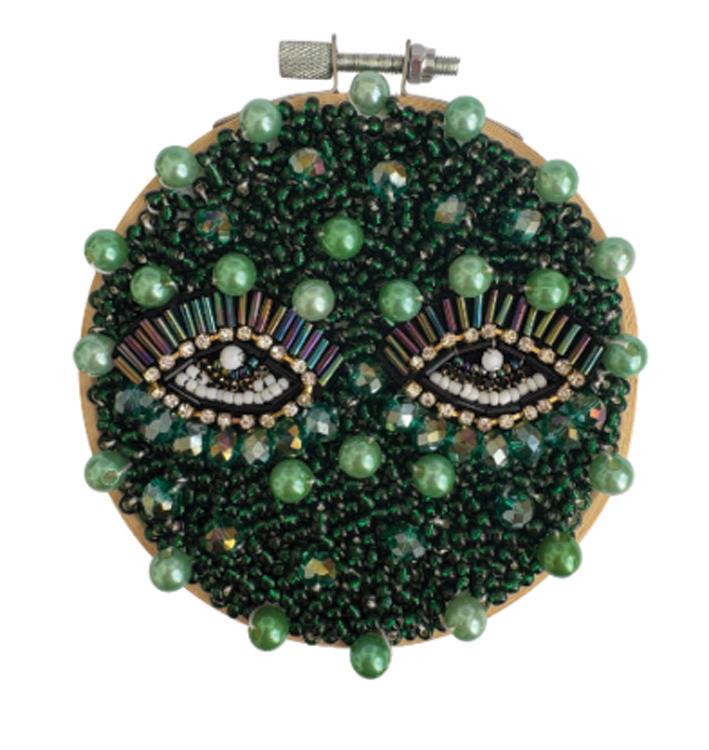
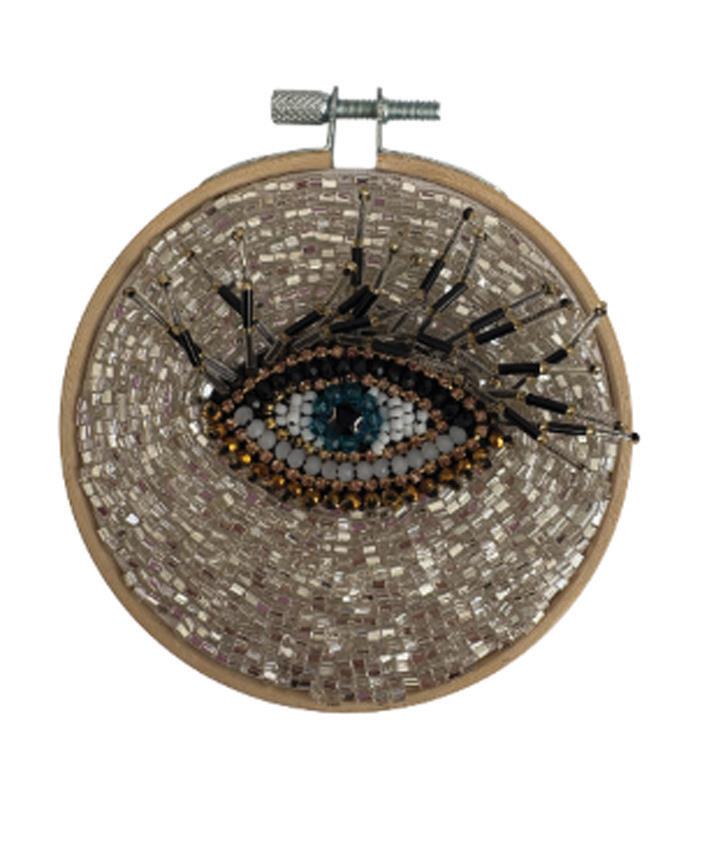
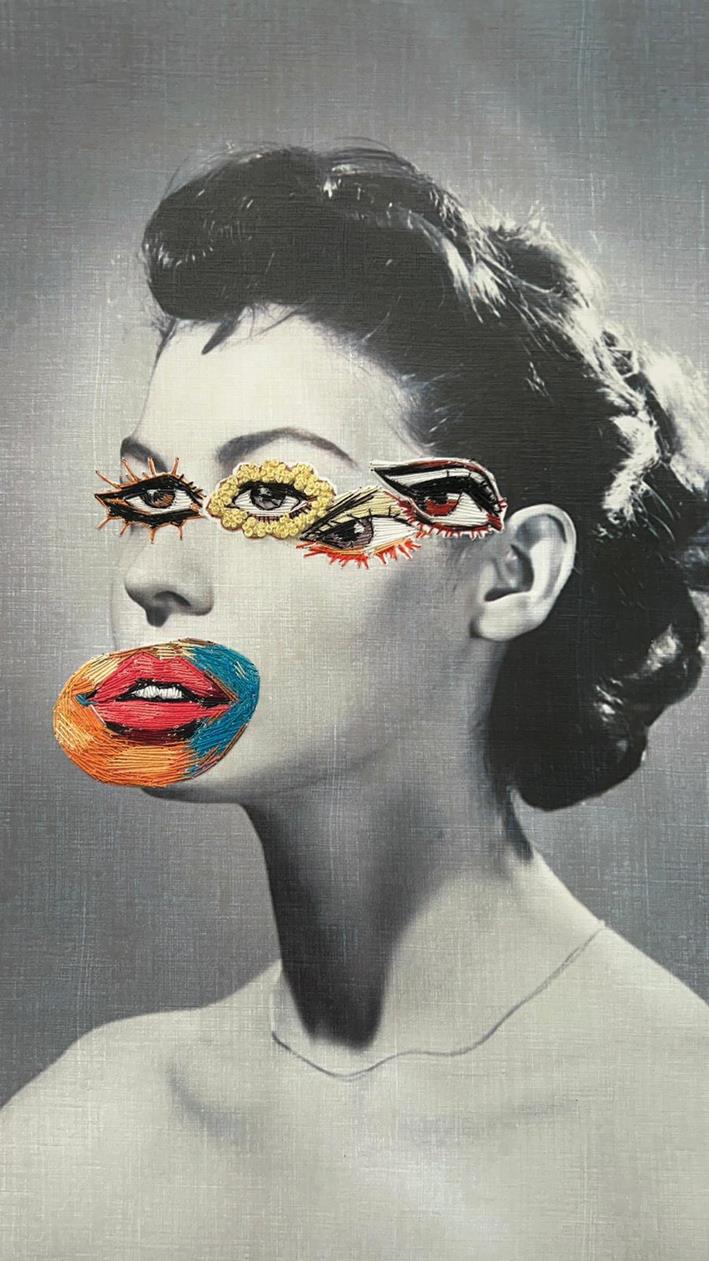
The artist tackles these themes in different ways throughout her work. The "spying and controlling eyes" of Elalem are playfully represented in a set of six small beaded roundels titled El-alem. This motif is also strikingly evident in the piece Many Eyes, which presents a beautiful portrait covered in embroidered eyes and a large mouth, ready to tell the world your every move. The eyes stare fixatedly at the viewer, almost judging, echoing the constant surveillance of society.
Another work, Molded Alike, executed on a roundel, features numerous female figures with long hair braided into plaits, all intertwined into a web of hair. This imagery reflects how, deep down, women often find themselves bound by these unnecessary conformities.
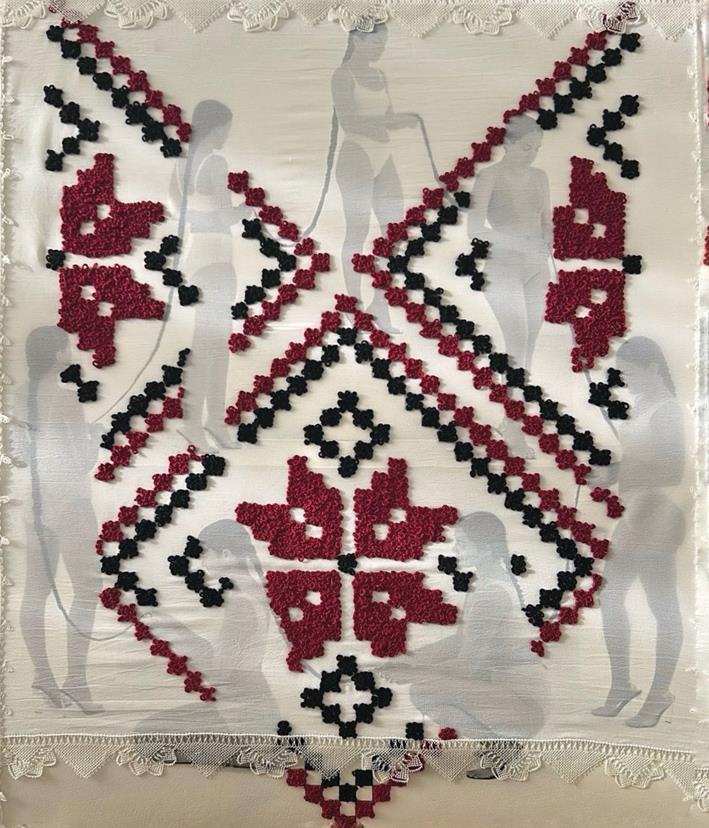
The same point is revisited in Traditional Embroidery as Imposed Social Norms. Here, female figures again appear with long plaited hair, but this time they are dressed in underwear and high heels, hinting at an atmosphere of rebellion. The act of holding each other's braids becomes a symbol of solidarity rather than oppression. Yet, Çınar Erdoğan partially conceals this image beneath a semi-transparent fabric embroidered with a traditional motif. The result is a powerful tension: even when the desire to break free is present, societal rules still linger, imposed upon freedom.
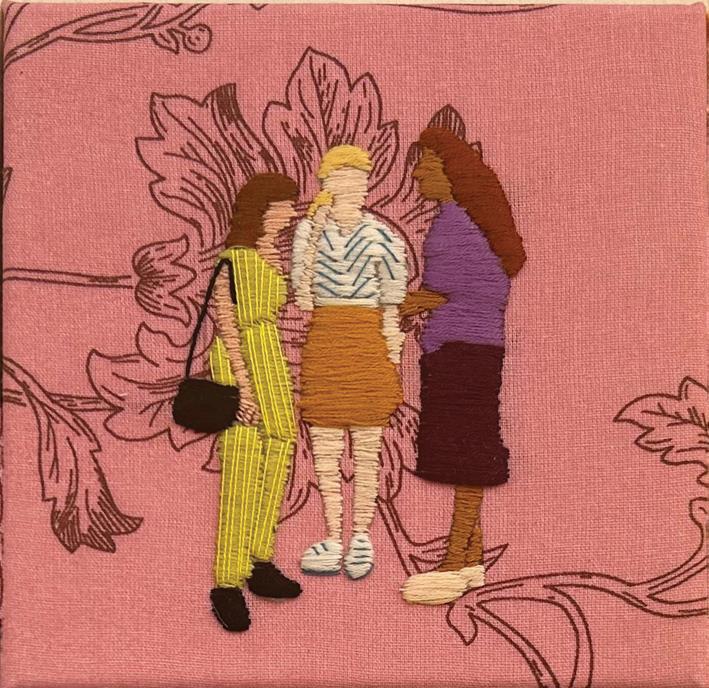
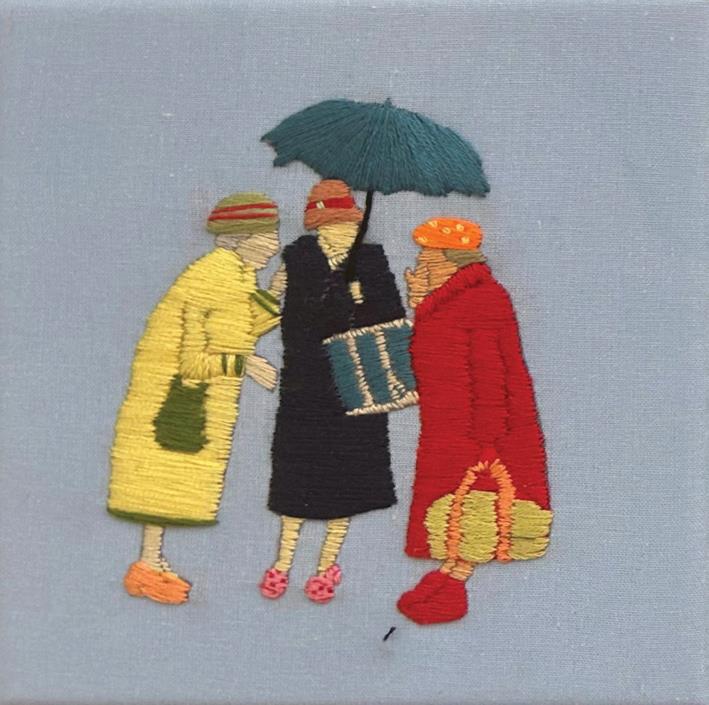
Seven small, squarish works with vibrant pop-inspired backgrounds depict fully embroidered figures of different ages and genders, all caught gossiping, peeking, eavesdropping, and surveilling. With a wink of sarcasm, the artist fittingly titles this series Networking.
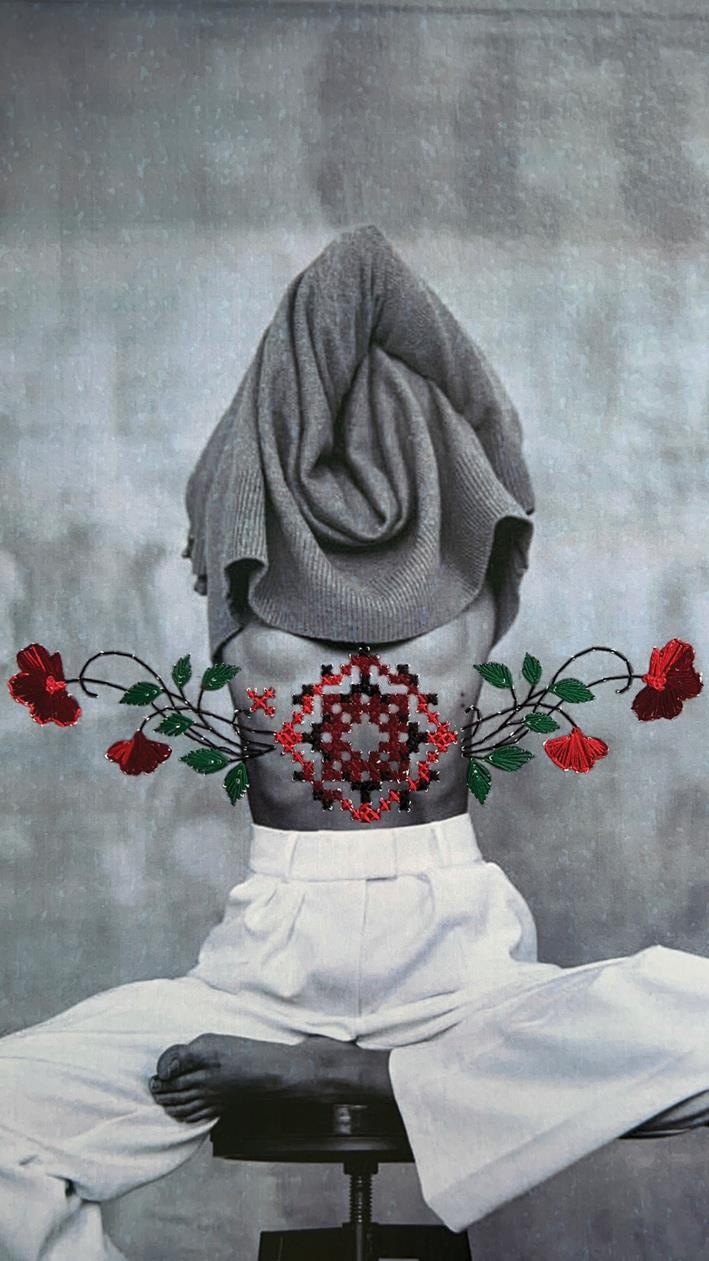
The striking piece is Embroidery Souls. Here, a female figure sits confidently on a revolving stool, dressed in white trousers and posed with undeniable authority. She is in the act of undressing her woollen top, revealing part of her nude torso. Her face and arms are hidden, suggesting that she could represent any woman revolting against imposed rules. Yet while the desire to break free is present, a sense of fear still lingers. Çınar Erdoğan embellishes the image with a traditional motif starting from the stomach, which then blossoms into red roses on each side, a metaphor for a woman's evolution, moving away from traditions that have long been rooted within her.
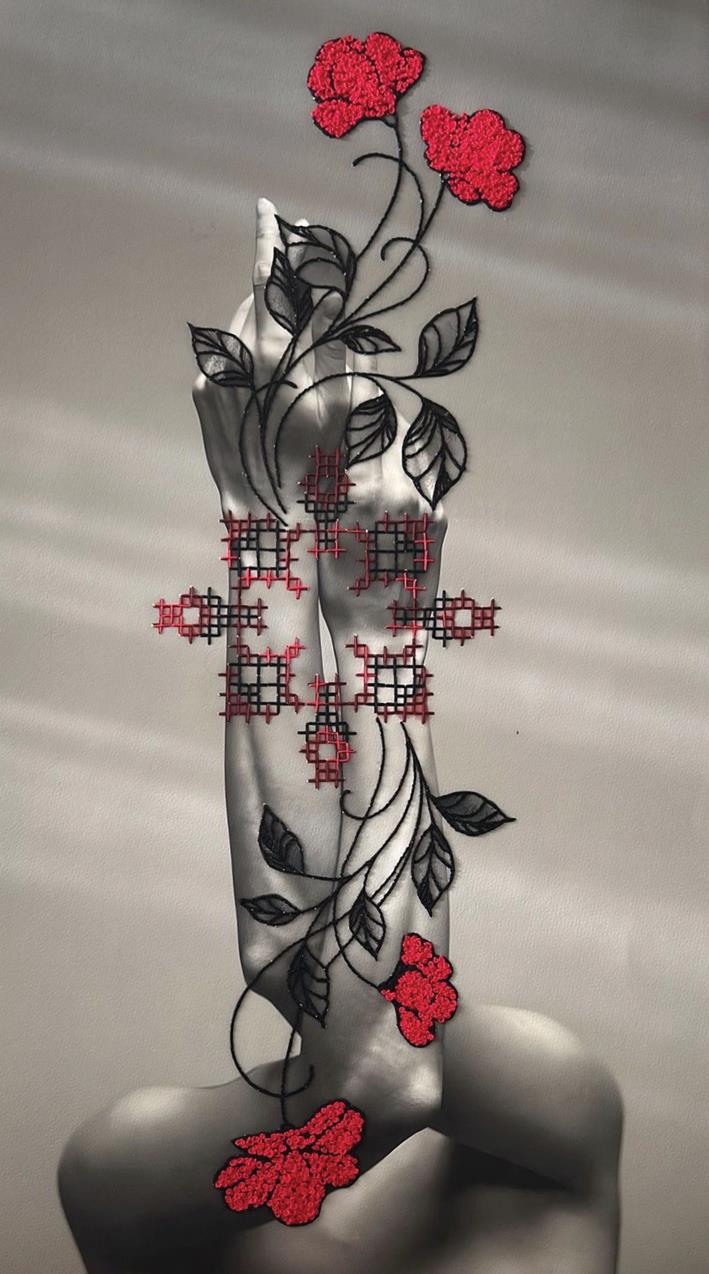
This motif of intertwined flowers reappears in Rebirth and First Steps Towards Self Love, where we see two sensual arms interlaced and stretched upwards. The head is absent, preserving anonymity once again, as if to say this could be every woman, taking tentative yet powerful steps towards liberation and self-acceptance.
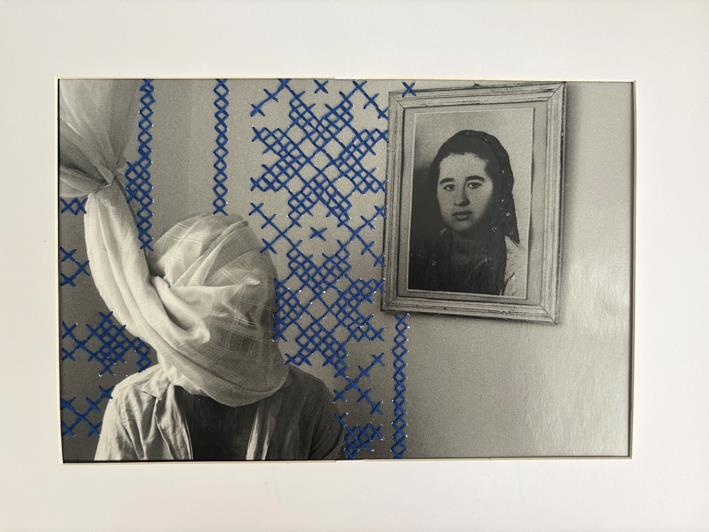
Last but not least, a truly unique piece is Bound Silence, a collaboration with Imren Rahbay. This film photograph presents the very first portrait of the artist's grandmother, taken when she was sixteen. The development and printing were carried out in the workshop of the late Zvezdan Reljić, a master of the craft whose legacy continues to inspire. Çınar Erdoğan adds her signature touch with a blue embroidered motif, creating a trompe l'oeil effect that transforms part of the photographed room into what feels like a patterned wallpaper, blurring the boundaries between photography, embroidery, and environment.
As both an artist and a mother, Çınar Erdoğan questions how these inherited patterns continue to pass silently from one generation to the next. Through the traditional medium of embroidery, a craft itself passed down through generations, she transforms a symbol of patience and repetition into an act of resistance. Each stitch recalls the restrictions women are taught to accept, yet in reworking the thread, she reclaims the narrative, restitching possibilities of love, self-confidence, and liberation.
Each work in Unwritten Rules ultimately asks whether future generations can be freed from these inherited expectations, and instead grow up in environments shaped by freedom, self-expression, and choice.
The exhibition runs until 30th October at Bizzilla Art Space in Floriana. It is open Monday to Friday, 9 a.m. to 5 p.m., excluding public holidays.
