In Joyful Moments, Maria Cassar invites us into a world of sunlight, laughter, and memory, a series of seaside scenes where childhood is preserved in paint, luminous and alive. These oil-on-canvas works are more than depictions of children playing at the shore; they are meditations on time, tenderness, and the eternal dance between light and life.
Cassar's artistic sensibility lies at the intersection of Impressionism and Expressionism. Her paintings radiate the immediacy of the Impressionists' fascination with light and colour, while her brushwork and emotional charge reflect an inner response to what she sees, the hallmark of Expressionism. The result is a body of work that feels both observed and felt, analytical yet deeply human.
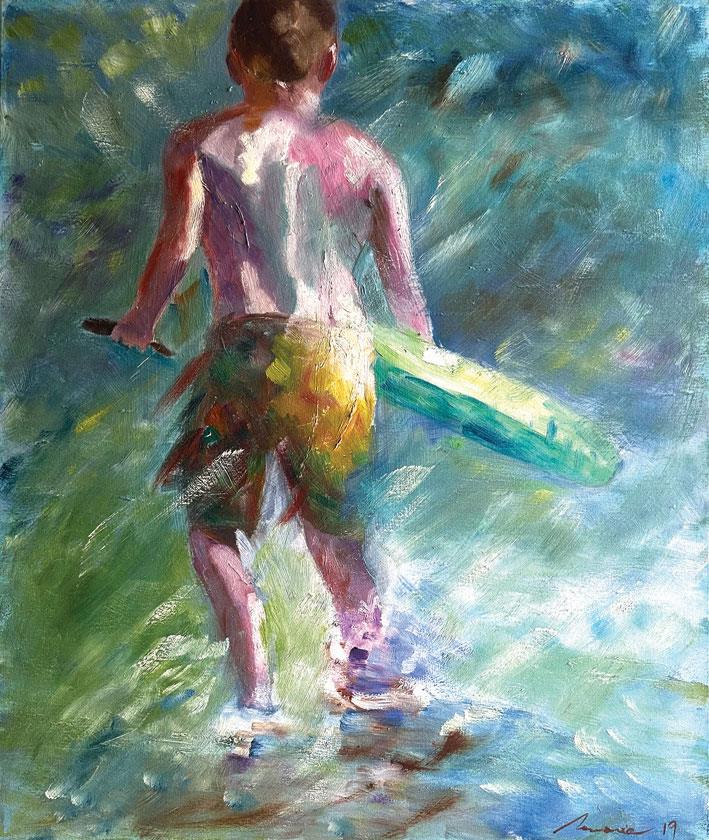
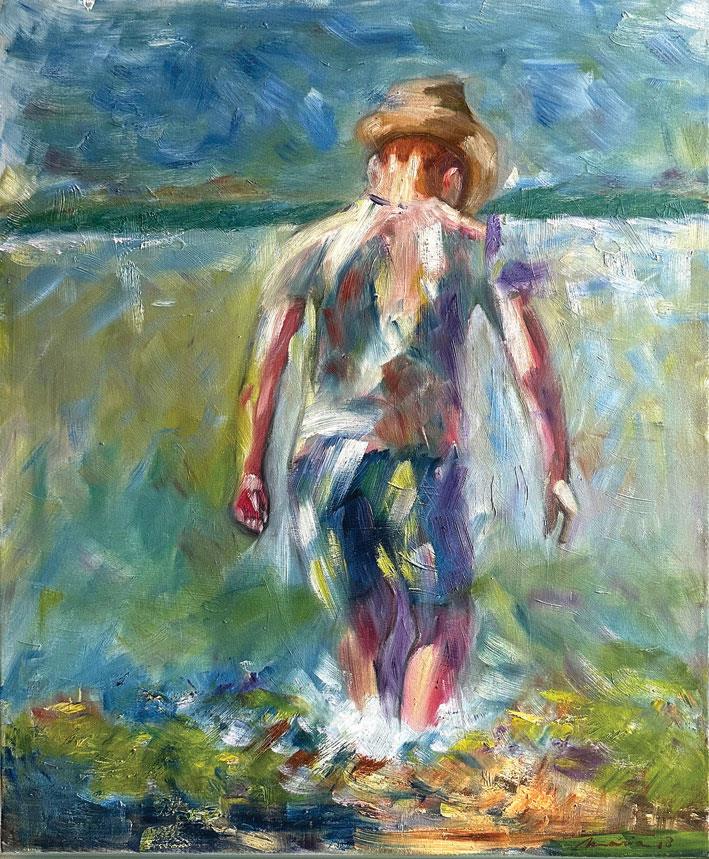
In Before the Plunge (2019), a young boy is portrayed from behind, stepping into the shallow sea with quiet determination. The composition draws the eye from the sunlit shoulders, rendered in warm pinks and mauves, down to the translucent ripples of turquoise and green at his feet. The painting vibrates with the anticipation of movement, that instant before immersion, before the cool sea meets the skin. Cassar captures that moment not through photographic detail but through sensation; her brushstrokes convey the tactile shimmer of light and the innocence of curiosity. The scene could be anywhere and anyone, yet it remains deeply personal, drawn from the artist's intimate observation of her grandchildren at play.
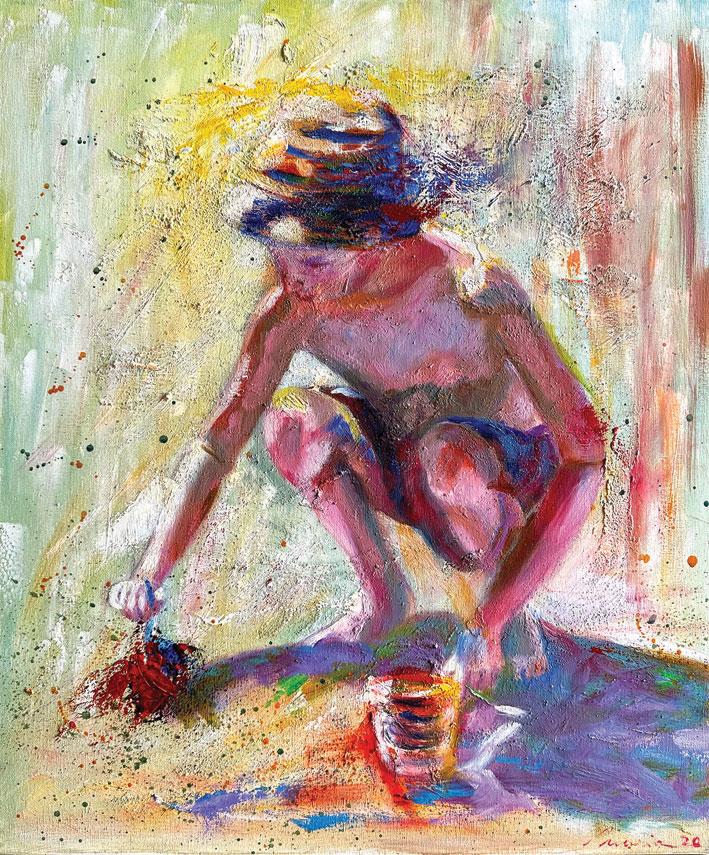
In most of the works within this intimate collection depicting children at the seaside, Cassar chooses to portray her figures from behind, immersed in their play. This perspective invites the viewer to share in the children's world rather than observe it from afar. In Sea Urchin (2020), the artist explores another facet of childhood energy, one of quiet concentration and discovery. A child crouches close to the sand, absorbed in the simple act of digging or unearthing hidden treasures. The surface of the painting vibrates with texture and vitality: splashes of vermilion, cobalt, and gold animate the canvas, while thick, strokes evoke both sunlight and heat. Here, colour becomes more than a descriptive tool; it emerges as an emotional force. The child's straw hat glows like a halo, infusing the scene with radiance, while the surrounding hues seem to pulse with joy as though the pigments themselves were celebrating the beauty of play.
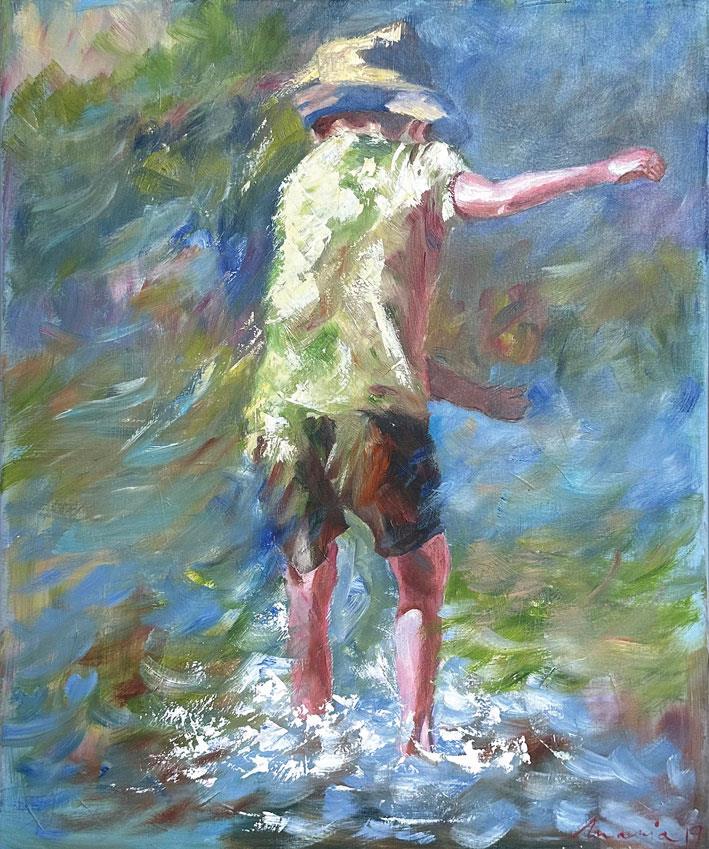
This celebration of colour and life stems from Cassar's own artistic formation. Having studied under Pitre and later under the distinguished Maltese artist Harry Alden, she acquired both technical discipline and artistic discernment. Alden's influence is particularly evident in her sensitivity to chromatic harmony and in her understanding that colour is never merely decorative but structural, a language that conveys emotion as much as form. Under his mentorship, Cassar learned to look closely, to paint not only what is visible but what is felt: the pulse of light, the atmosphere of a moment, the subtle dialogue between object and observer.
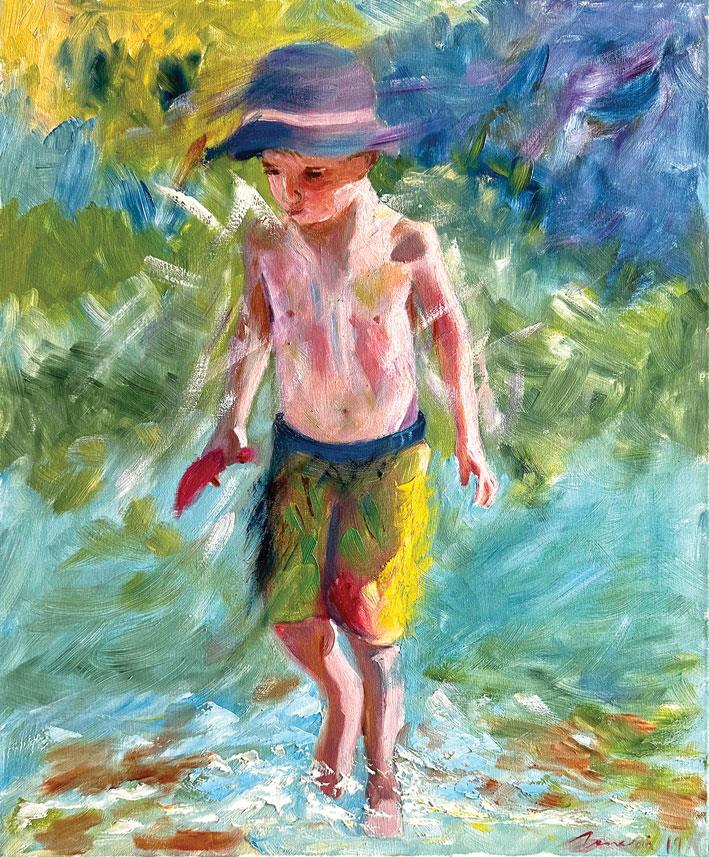
It was during this formative period that Cassar began to focus on painting children, particularly her grandchildren, as they played by the sea in Xlendi. This choice of subject became her signature; a fusion of maternal affection, artistic observation, and universal nostalgia. "I aimed to depict them naturally," she has said, "often capturing their spontaneous gestures when they were unaware of being watched." The result is a collection that feels intimate without being sentimental, personal yet universally resonant.
The seaside setting carries a symbolic charge beyond its visual beauty. In Cassar's work, the Maltese coast, with its fluctuating light, translucent water, and golden sand, becomes a metaphor for the transient nature of life itself. The sea, ever-changing and eternal, mirrors the fleetingness of childhood and the persistence of memory. Her "joyful moments" are not simply picturesque; they are acts of preservation, efforts to hold on to what is vanishing.
Cassar's painterly technique furthers this sense of ephemerality. Her brushwork is vigorous and fluid, suggesting motion rather than defining contours. The figures appear to dissolve into light, their forms merging with the surrounding air and water. This approach recalls the Impressionists' desire to capture the "instantaneous", yet her palette, rich in Mediterranean warmth, situates her firmly within the local landscape and tradition. The radiant interplay of yellows, blues, and purples in her paintings evokes the Maltese sun at its zenith, a light that defines both the physical and emotional tone of her work.
Ultimately, Joyful Moments is a hymn to childhood and to painting itself, to the capacity of art to arrest time and translate experience into radiance. Cassar's children, absorbed in their games, remind us of the purity of seeing the world without expectation or fear. Her canvases call on us to return, if only momentarily, to that state of wonder.
Cassar's exhibition reaffirms her position within the Maltese figurative tradition, while also marking her as an artist who bridges the observational and the expressive. Her joyful moments are luminous affirmations of the enduring connection between love, memory, and art, a reminder that joy, like light, is best captured when it is fleeting.
The exhibition runs at Art..e Gallery, Victoria, Gozo until 28 November.
Professor Louis Laganà PhD (Lough) is an academic, curator and practising artist