In the Absence of Words, the title of your exhibition, suggests a deliberate retreat from language. What prompted this shift toward silence and colour as your primary communicators?
When I paint, I do so in silence, alone in my personal space. Silence gives me the freedom to think, feel, and express my emotions on canvas. I enjoy writing too, but I find that words can be manipulated - especially today. When reading, you often question whether something is true or false. Colour, on the other hand, is immediate and unchangeable. Its connection to memory is powerful and enduring. I believe colour can be just as impactful as imagery or words, but unlike words, it cannot be twisted. Its emotional resonance remains intact.
So you see colour as a more honest or primal form of expression than words.
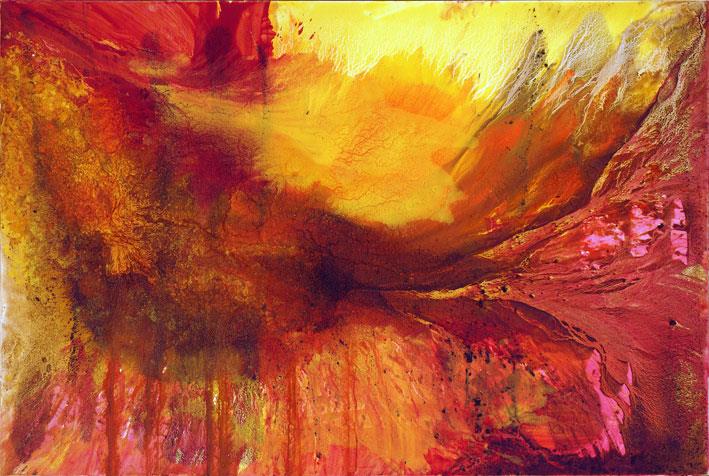
We are exposed to colour very early in life, and we develop preferences - likes and dislikes - based on it. I remember having a strong aversion to yellow as a child, to the point of finding it nauseating. Just as certain sounds can disturb us when linked to unpleasant memories, colours can evoke visceral reactions.
Words fall short because those who are skilled with language can distort the truth. Colour, by contrast, is subjective and immediate - you either respond to it or you don't.
How do you hope viewers will engage with your work - should they interpret, feel, or simply be present?
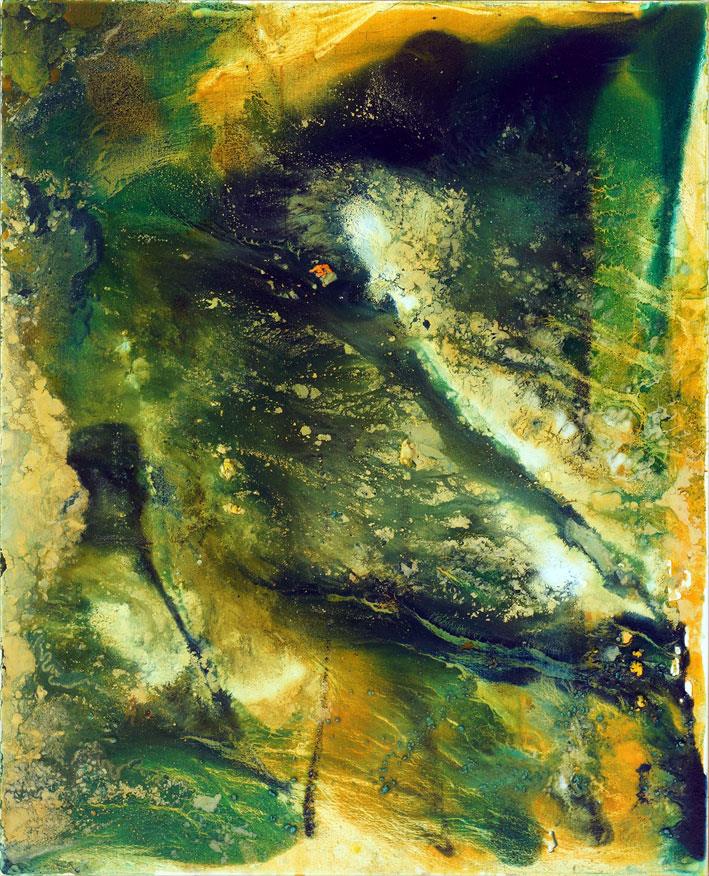
First and foremost, they should be present. The works are highly textured and need to be seen up close. Photographs don't do them justice, as texture is lost. Then, they should feel. I've been told these works strike a chord - different people have different reactions and interpretations. That's intentional. I've deliberately chosen not to attach a narrative to most of the pieces. This allows viewers the freedom to experience the work without the imposition of a constructed vision.
How do you choose colours - intuitively or conceptually? Can you speak of your relationship with colour? Do certain hues carry personal memories or emotional weight for you?
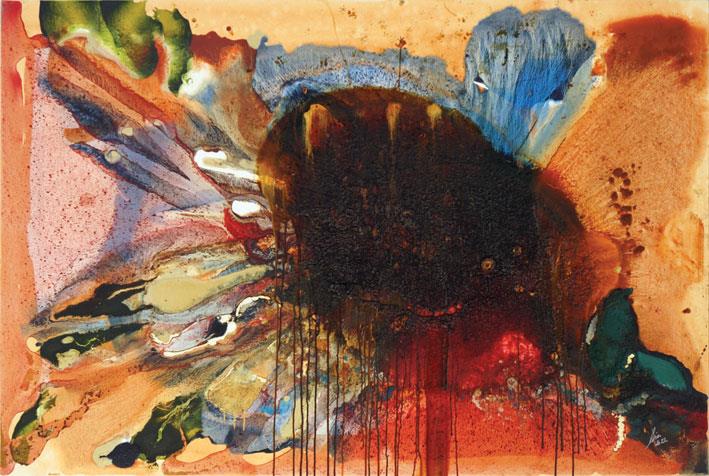
Interestingly, some works feature colours I wouldn't say are my favourites. I'm not fond of yellow or green - I wouldn't wear them - but on canvas, they find a harmonious balance. One painting, Life and Death, uses black, crimson, and gold. Crimson represents the primal colour of birth, black evokes the end of life, and gold - rich and precious - is my personal symbol of rebirth. Gold has long been associated with value, perhaps as precious as life itself.
Is there a palette that recurs in your work, and if so, what does it signify?
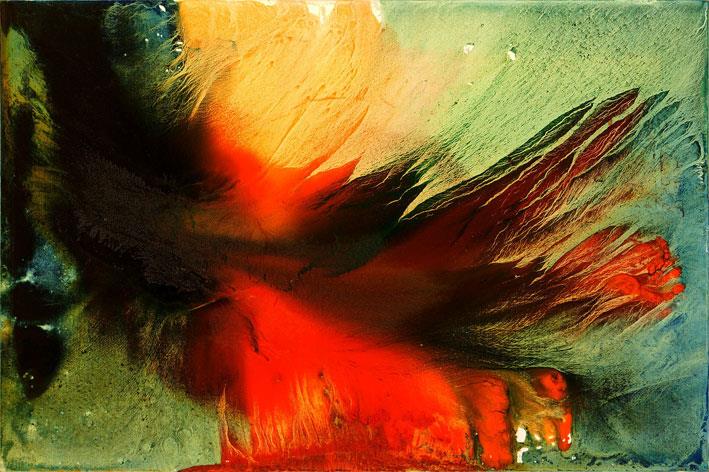
Crimson is probably my favourite colour. I feel I can express my emotions most deeply through it. It recurs often in my work, and I also like to wear it. It's bold, elegant, and emotionally complex - beautiful and painful at once. Red is typically associated with danger, but crimson, to me, is complete and refined.
I choose colours intuitively. There's no deliberate concept behind them, though I do have preferred combinations. My choices are guided more by emotion and mood than by theory.
You mention that these works were painted in silence. What role does silence play in your creative process?
One of my works is entitled Chaos - a swirling mixture of colours converging at the centre of the canvas. It's a signature piece that invites contemplation. Silence is essential to my process. It allows me to pour emotion onto the canvas without distraction. Noise, by contrast, is disturbing and disruptive. Silence is a spiritual state, and I believe these works carry a sense of spirituality. I often think of Mark Rothko's chapel, which, despite its lack of vivid colour, offers a sacred space where colour becomes spiritual. Similarly, light and colour in my work evoke a quiet sanctity - without needing representation.
Do you listen to anything while painting?
Fortunately, I have the ability to paint in silence.
How do texture and tactility help you translate emotion onto canvas?
Texture is part of the abstract anatomy of my paintings. I like to feel it - it's integral to the work. Art should stimulate the senses, and for me, the appreciation of colour combined with tactile engagement reflects the true nature of my practice.
This particular piece evokes a radiant explosion-almost cosmic or volcanic. Can you tell me about its creation and emotional genesis?
Life and Death is a pentimento - a painting layered over another that carried great emotional pain. The earlier work had become a burden, and I needed to let go of those difficult emotions. It took me over a decade to realise how heavy it had become. I avoided looking at it. Now, having released it, I find myself drawn to the symbolic colours and the new painting that emerged. It feels perfect.
My concern in the painting is purely colour. There's no intention to represent anything specific. However, viewers often see images in my work. That's what I love about abstract art - it invites interpretation, connection, or even rejection. It's open.
Was this work created early in the series, or did it emerge later as a culmination?
It was created midway through the series, but to me, it's the most significant of all.
You invite viewers to experience the work in silence. How do you envision that moment of encounter - what might they feel or discover?
I can't say what they might feel - but I'd like to know. I'm sharing works that I usually enjoy in solitude, and I'm curious to see how others respond. I've often been told that people are drawn to them, and I'd love to understand why. I'm drawn to the colours and the final result, but of course, that's my own bias.
Do you hope the exhibition offers a kind of refuge from verbal noise - a space for emotional clarity?
Yes. Choosing Bizilla Art Space was intentional - it's a quiet, contemplative environment where emotional clarity can emerge through colour. I feel we live in a very fake world, where words are manipulated to suit narratives. Words can be used to attack, to hurt, and to construct false truths. I want to create a space away - a space where silence and colour speak instead.
How do you feel about viewers bringing their own interpretations, even if they differ from your intent?
That's one of the strengths of abstract art - it
welcomes pluralism. I've rarely met people who don't understand or appreciate it, and that's perfectly fine. We're not all wired the same way. But I've also met people who were sceptical of abstraction until something clicked. I hope my work might strike that chord in some of them too.
What can visitors expect from the full series - are there shifts in mood, palette, or intensity across the works?
Yes, the collection shifts in mood. The choice of colour is personal and reflects the moment of creation. The series is very colourful, and the works are quite large by conventional standards.
Is this exhibition a turning point in your practice, or part of a longer evolution?
I have two main styles and bodies of work. In the Absence of Words represents my evolving abstract style. Another series, Duality, explores the paradigm of silence and noise through photorealistic works. My abstract style continues to evolve, but my intention remains constant - colour.
What's next for you creatively - do you see yourself continuing to explore silence and abstraction?
I've started a series of larger works and my style is evolving again. This new series already has a space in mind, and I hope it will be the next step in my abstract journey."
In the Absence of Words is more than an exhibition - it is a refuge from the noise of constructed truths, a place where viewers are invited to feel rather than interpret, to be present rather than persuaded. Through silence, texture, and a palette rich in emotional memory, the paintings offer a deeply personal yet open-ended encounter. The artist hopes is not to be understood, but to be felt - and perhaps, in that shared silence, something honest and transformative will emerge.
In the absence of words is a series of abstract paintings at Bizzilla art Gallery. The works will be available for viewing between 7-27 November 2025 at Bizzilla Art Gallery, Triq il-Mall, Floriana, Monday-Thursday 9am-5pm; Friday 9am-3pm.
www.lisa-art.com