Yes, finally, I managed to collaborate on a solo exhibition with Alison Agius. And yes, for all those who have been nudging us to work together - okay, you managed. It's show time!
I've known Alison for the past couple of years, and I've watched her work evolve at a fast pace. She came out of nowhere, and suddenly she was on everyone's radar. It all started with a discussion. Alison is extremely meticulous; her first priority is technique; mine is concept. Needless to say, the end result is rather fantastic.
I still remember my very first studio visit at her home, where we met to discuss ideas for her solo exhibition. She brought out the very first (and only one, at that time) of these works on tiles. Obviously, we agreed immediately that this would be the exhibition at il-Kamra ta' Fuq. (Till I arrived home, she had already messaged me to say I'd left two very long black hairs on her immaculate white floors. Needless to say, I'm extra careful now. She has all the material she needs for my voodoo doll.)
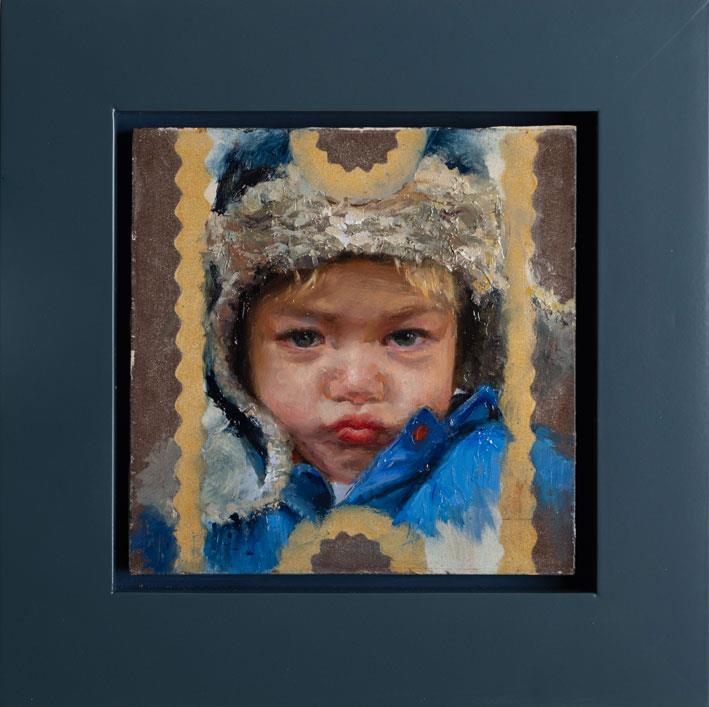
The works are all executed on old, traditional patterned Maltese tiles, using Alison's favourite medium: oil. We've seen the Maltese tile reappear quite often lately, in an attempt to raise awareness about its beauty and the loss it faces amid the over-construction fever infecting the island, as old townhouses are demolished to make way for a concrete jungle. Artists have been paying tribute to these tiles in various ways - including them within their paintings, hanging the actual tiles on walls as art objects, or incorporating their patterns into jewellery, among others. But Alison took things further, merging her art with the tile into a single work of art.
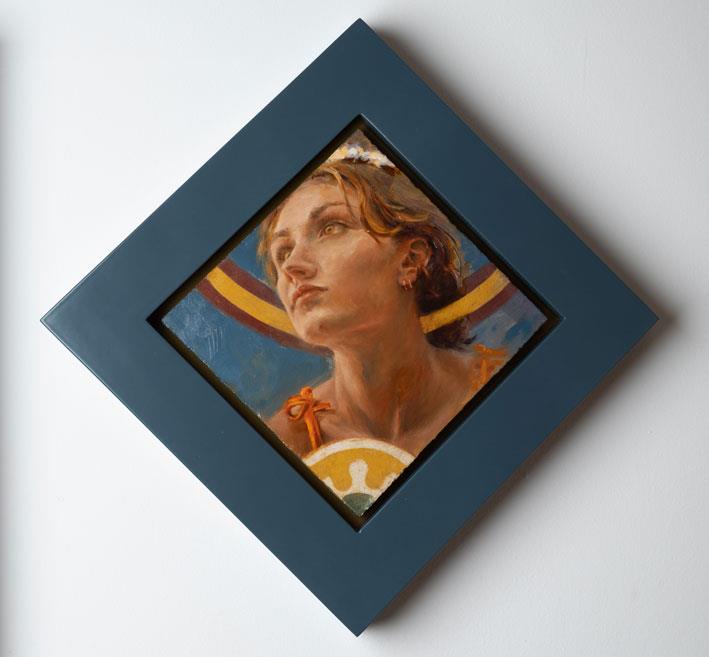
She has been scouring Malta and Gozo in search of old tiles, all of which were destined for disposal, giving them a new life and a new raison d'être. During her research, she discovered over 300 different patterns. Of course, not all of them suited the works she envisioned; even the same design can vary from one manufacturer to another. Alison's approach merges her signature portraiture style with the geometry of the tile itself. It becomes a sort of "hide and seek," where faces emerge from the patterns, and the patterns in turn dissolve back into the faces.
All the works are titled Maduma and numbered, and this is for a reason. The exhibition features twenty-one pieces, forming a closed series; meaning these will be the only works Alison will ever produce using this technique of painting directly on old traditional Maltese tiles.
Each Maduma portrays a distinct expression. Some faces belong to family or friends, others emerge from Alison's imagination or sources of inspiration around her. The portraits are not meant as direct representations, but as studies of emotion and expression. The characters seem like souls embedded in the tile, waiting for someone to draw them out. For Alison, finding the right tile pattern to match the right emotion was crucial. Even the age and mood of each face had to harmonise with the geometry and rhythm of the design. Some tile patterns were omitted simply because they didn't work out with what Agius had in mind, but when the connection clicked, the result was magical. The tile's pattern guides us toward the face, while meticulous care determines which parts of the design remain visible in all their splendour, and which are softened or concealed, creating a delicate balance between revelation and mystery.
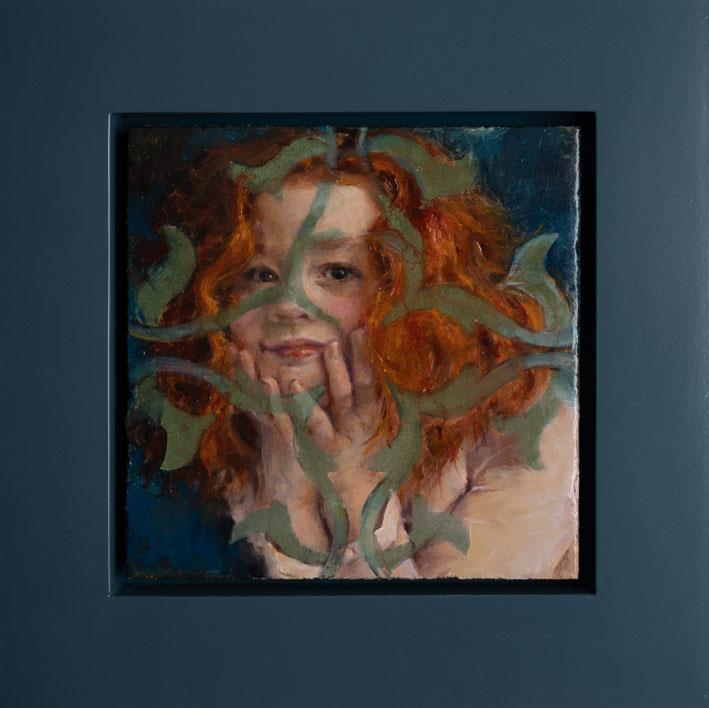
Most of the works are painted on a single tile, though a few pieces take things further. In some, Alison used sets of four tiles, skilfully aligning the seams to follow the contours of a face, the folds of clothing, or the flow of a narrative.
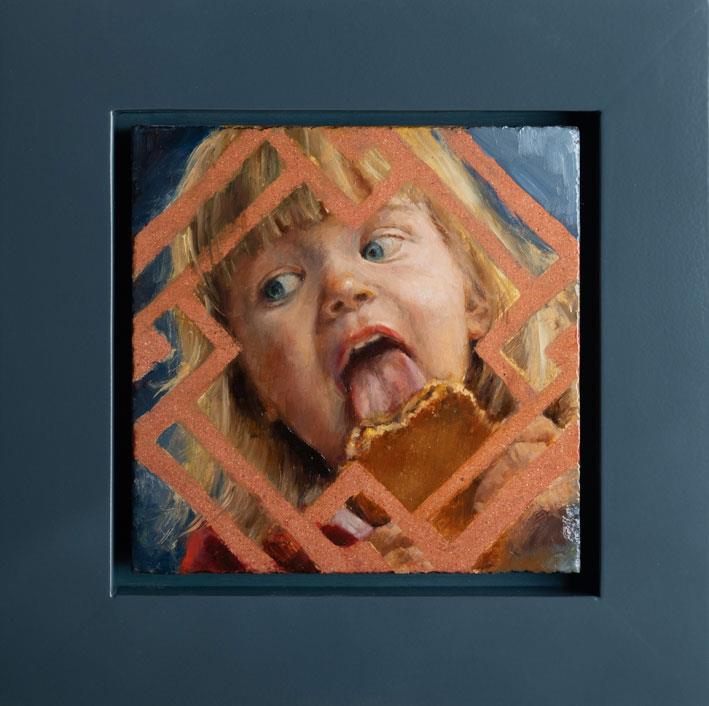
For example, in Maduma No. 14, we see this beautiful girl, pensively smiling behind a green floral pattern that becomes almost like an iron gate through which she playfully tries to catch our attention. A similar moment unfolds in Maduma No. 13, where the little girl, this time with a prop that looks like an ice-cream sandwich, tongue out, completely ignores us as her attention drifts to the right. She's placed behind what seems like a peach-coloured metal grid, and the result is irresistibly charming.
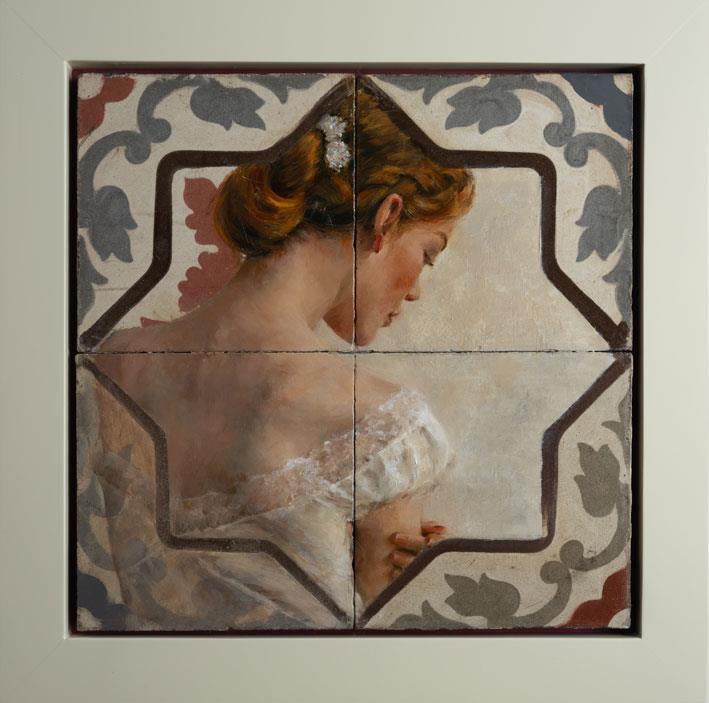
Several visitors have commented on Alison's choice to portray mostly children. (Only three of the works depict adults.) The answer is simple: she loves children. As a teacher and a mother, it comes naturally for Agius to portray them.
Speaking of the adult figures, the hero image of the show, Maduma No. 15, displays remarkable mastery in combining four patterned tiles into one harmonious composition. The subject, a serene woman in profile, dressed in soft white fabric, affectionately nicknamed "The Bride", is truly a standout. And of course, I'm allowed to have my favourite: Maduma No. 12. It was love at first sight. The tile is used in a diamond orientation, and the woman's face is cleverly juxtaposed with the design so that part of the pattern becomes a kind of halo around her head, a witty and poetic touch that feels "divinely" intentional.
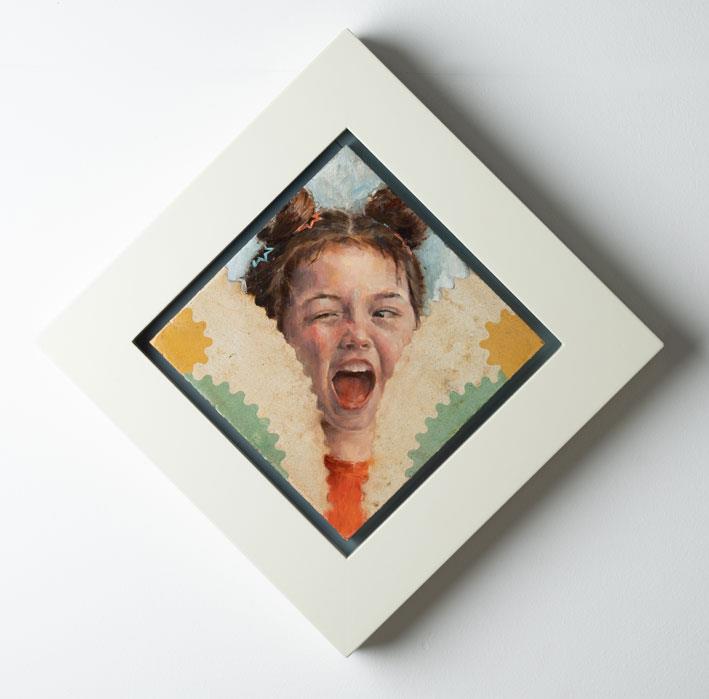
Two other tiles in the series are also positioned in a diamond shape, where the pattern becomes like two partitions, and from the narrow gap in the middle, we see the same girl popping out. In one, she appears quietly smiling, while in the other, she's unmistakably mischievous.
Maduma No. 1 was the very first in the series, where a young female face emerges from the tile's design, as if she has replaced a flower within the pattern itself.
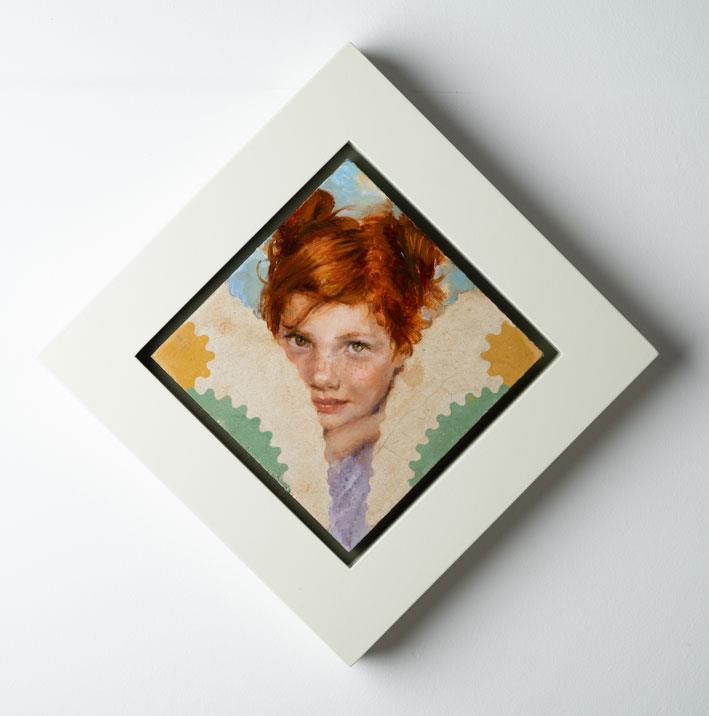
The amount of work that goes into creating these little treasures is quite phenomenal. So far, I've mentioned the careful search for the right face to match the right tile and pattern, but that's only part of the story. Once the tiles are selected, Alison spends countless hours cleaning and preparing them before she can even begin to paint. Then comes the framing. Each piece is custom-framed (special thanks goes to the artist's husband here), designed to support the weight of the tile with stainless-steel bolts embedded at the back for reinforcement.
The frames are made slightly larger than the tiles, deliberately exposing the edges to emphasise the beauty of the original surfaces, and to make it clear that yes, these are actually painted on tiles (which, believe me, is hard to believe at first glance!). And of course, Alison being Alison, she couldn't stop there. Each frame is painted in a colour that complements the tile's design perfectly, which is a process that required finding the exact tonal balance for every single work, resulting in an exquisitely harmonious finish.
And as always, to conclude, a quick background check on our artist.
Alison Agius' practice captures fleeting gestures, moods, and character, moving beyond mere likeness to convey an intimate connection with her sitters. As she explains: "If a portrait lacks soul, it isn't a true masterpiece; it's merely a collection of colour pigments assembled to create an image." Agius is the co-founder and coordinator of BILD (Bred in Life Drawing), an art group that organises weekly sessions for fellow artists. She is also the driving force behind International Workshops, designed to bring together like-minded practitioners and enrich the local art scene. Her works have been exhibited in museums and castles overseas and form part of both private and public collections in Malta and abroad.
Agius considers il-Maduma a silent protest against the destruction of our architectural heritage, reminding us of the importance of treasuring elements that form part of our identity. Through her art, she elevates the humble tiles, from objects we might walk past (or even on) every day, to a status worthy of admiration.
For more information, follow us on social media: il-Kamra ta' Fuq & il-Maduma.