Tomoko Fait's mandala-based abstractions reveal a profound dialogue between East and West: a meditation on unity, colour, and the depths of the human psyche.
In an age saturated with visual noise and digital distraction, Tomoko Fait's paintings emerge like meditative pauses, portals to a more centred, interior world. Her art is a journey inward, where abstraction becomes a spiritual act and the circular form of the mandala evolves into a living, breathing language of the self. In her paintings, the viewer encounters not mere geometry but the rhythmic pulse of consciousness itself: a visual dialogue between intuition and transcendence.
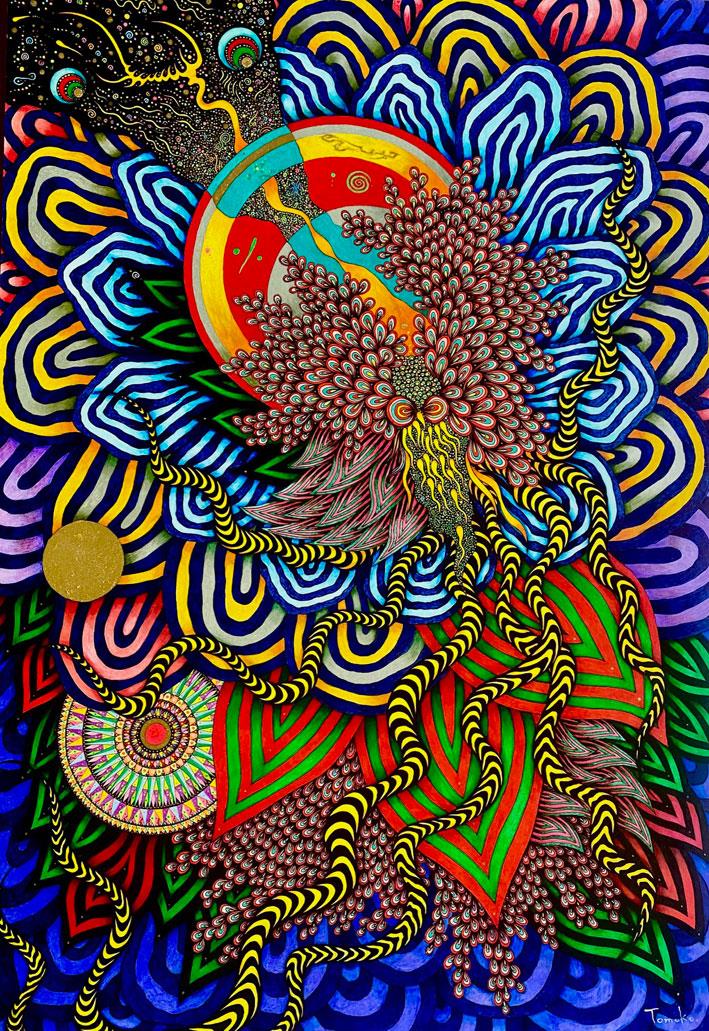
Born in Japan and based in Rome for more than 25 years, Fait embodies the delicate balance between East and West, tradition and reinvention. Although she has not returned to her birthplace for over two decades, the memory of her cultural roots lives deeply within her art, not as nostalgia, but as an invisible rhythm guiding her creative flow. In Italy she has developed a distinctive artistic language that unites Japanese sensibility with the expressive freedom of Western abstraction.
At the heart of her art lies the mandala, a circular symbol found in many cultures, signifying unity, totality, and the structure of the cosmos. In Hindu and Buddhist traditions, the mandala is a sacred diagram of the universe; in Jungian psychology, it represents the archetype of the self; the centre of wholeness within the psyche. Carl Jung himself drew hundreds of mandalas during his own process of inner exploration, noting how the form arises spontaneously in moments of psychic integration. For Jung, the circle was not decoration but revelation: the visual expression of the psyche's instinct toward order and balance.
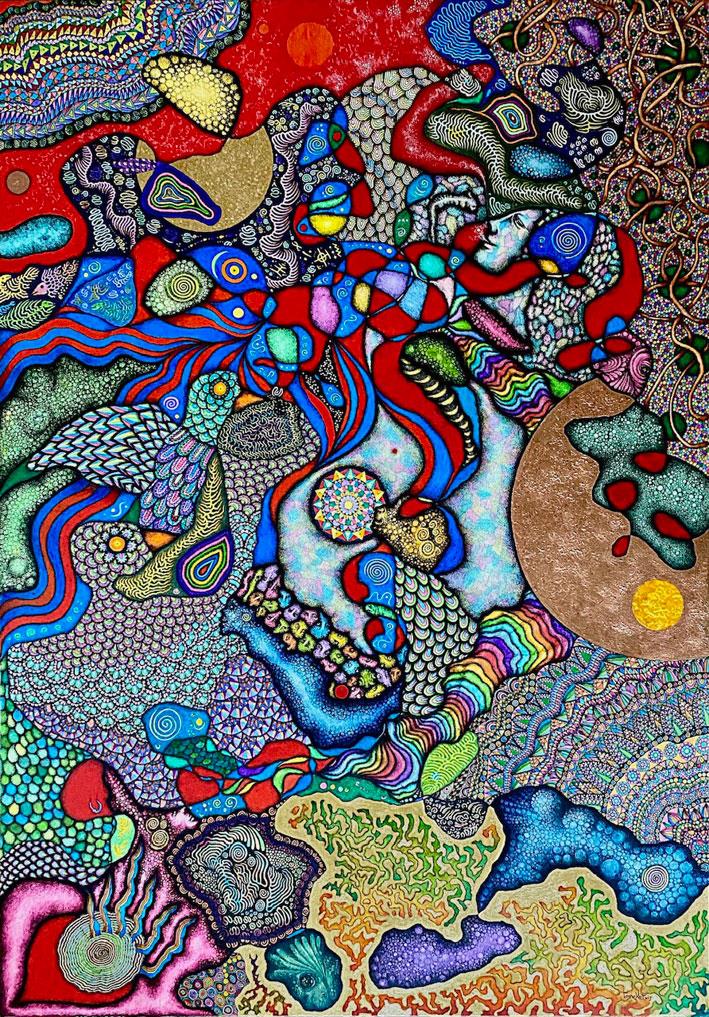
In Fait's paintings, this same archetypal force seems to be at work. Her mandalas are never static or mechanically symmetrical; rather, they unfold in waves of colour, motion, and light. She paints intuitively, without premeditated design, allowing the forms to grow from her inner state, a process of surrender rather than control. The resulting images radiate a sense of calm energy, as if the artist were capturing the vibration of thought itself. Each painting becomes an act of meditation translated into pigment, a visual mantra that both grounds and uplifts.
The colour palette she employs is often delicate pastels punctuated by vibrant hues that reveals her refined sensitivity to emotional resonance. Her lines and shapes are fluid, circular, and organic, suggesting breath, expansion, and transformation. Fait's abstraction thus resists the cold rationality sometimes associated with geometric art. Her mandalas are instead alive with feeling, an expression of the psyche's invisible currents. They are as much emotional as they are spiritual, embodying the spontaneous dialogue between consciousness and the unconscious.
In this sense, Fait's paintings reflect what Jung called the process of individuation, the journey toward psychic wholeness. Her art arises from an intuitive centre, embodying what the psychologist described as "the striving of the self toward unity". Each mandala seems to map an interior landscape, where opposites like chaos and order, matter and spirit, inner and outer, find temporary harmony. The circle, for Fait, is not a frame but a threshold: an entry point into the subtle dimensions of being.
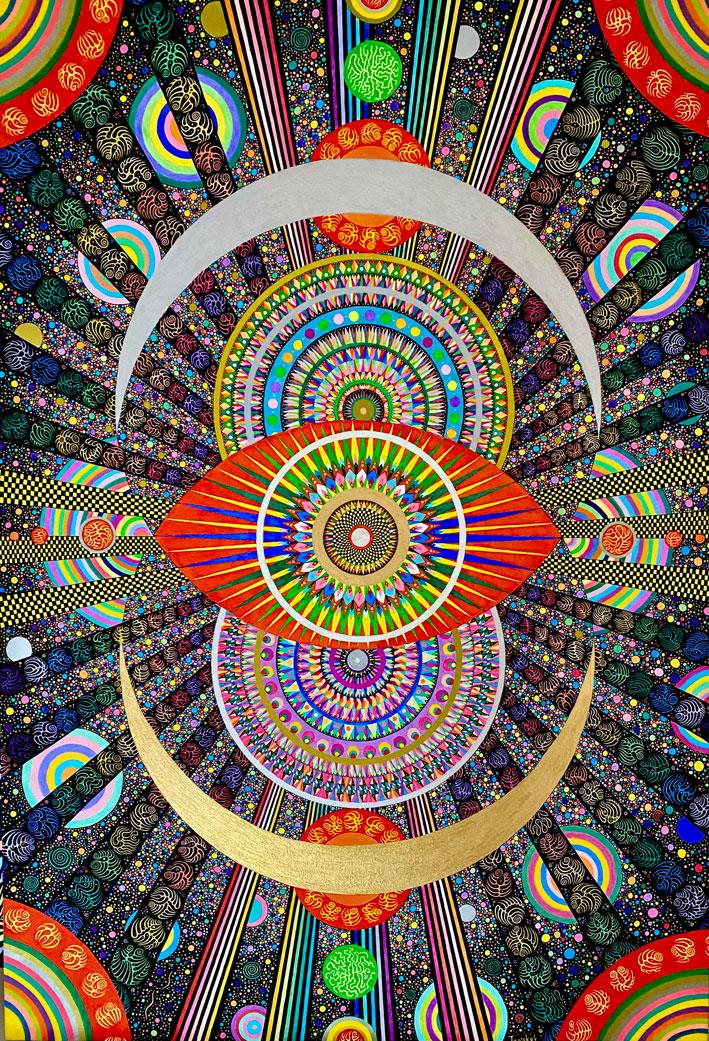
Her approach to abstraction distinguishes her from the formalism of Western modernism. While artists such as Malevich and Mondrian sought purity of form and reduction to essence, Fait's abstraction remains organic, sensuous, and spiritually resonant. She does not seek to construct a perfect order but to reveal the living movement toward order, the pulse of the creative psyche itself. This gives her art a unique sense of spontaneity, a breathing rhythm that invites contemplation rather than analysis.
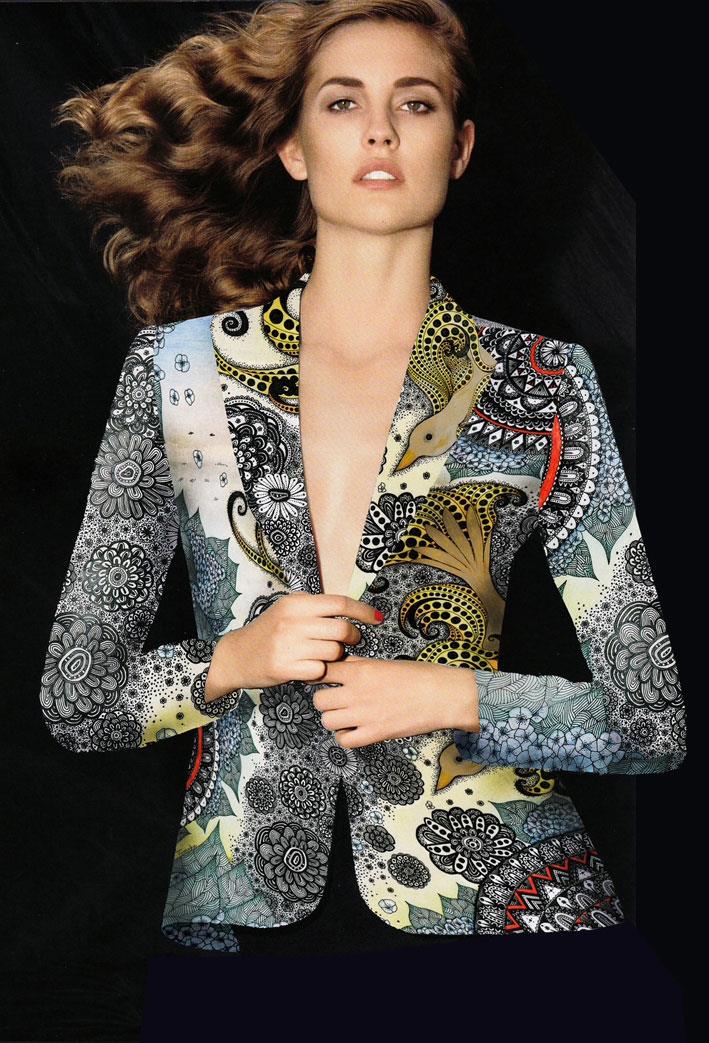
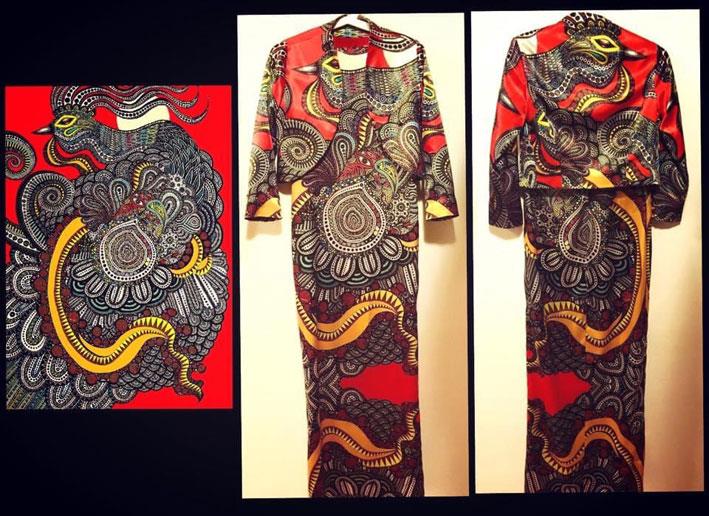
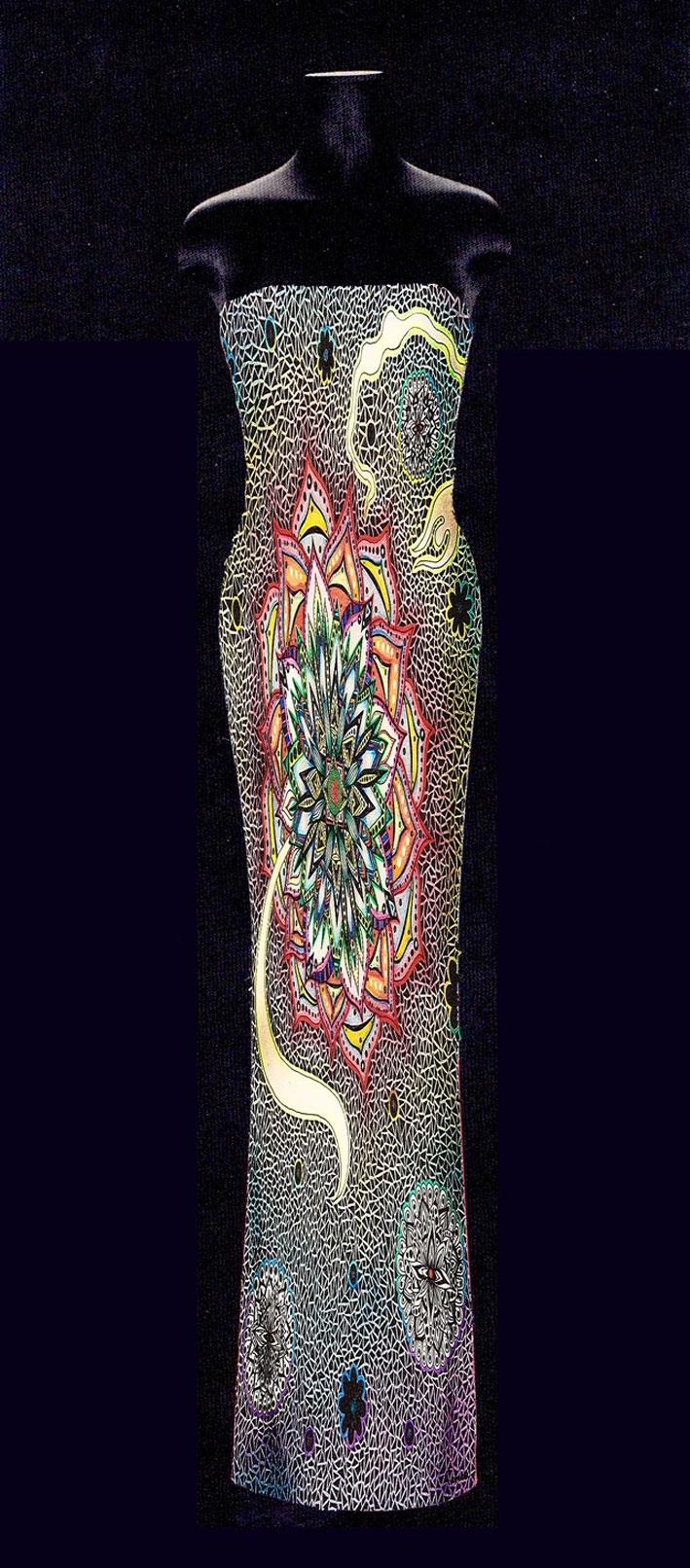
Fait's creative vision also extends beyond painting. Many of her abstract mandala designs and other motifs have been translated into fabric, flowing patterns that transform her inner imagery into wearable art. These textile works reveal the versatility of her language of forms and colours, proving that the mandala can inhabit not only canvas but also the living body. It would be both timely and visionary to introduce her designs during Malta Fashion Week, where art, texture, and identity converge in creative dialogue. Such a collaboration would bridge visual art and fashion, highlighting how Fait's spiritual geometry resonates across disciplines.
The influence of her Japanese aesthetic heritage is evident in her restraint, balance, and sensitivity to emptiness, that vital space in which energy flows. Yet her paintings transcend cultural categories. They speak to a universal longing for stillness in the midst of fragmentation, for the re-emergence of meaning through colour and form. In their layered transparency and subtle textures, one perceives an awareness of impermanence and renewal, much like the cyclical rhythm of nature itself.
As I prepare to curate Fait's forthcoming exhibition in Malta and Gozo, I am convinced that her art will find profound resonance here. The Maltese public, increasingly open to the intersection of art, spirituality, and wellbeing, will discover in her paintings an experience both intimate and transcendent. Her work offers not escape but reconnection - a reawakening of the inner eye that perceives harmony in the midst of chaos.
In bringing her art to Malta, the intention is not merely to showcase a body of work but to create a space of reflection, an oasis for the soul. In a world increasingly dominated by spectacle, Fait reminds us of art's sacred function: to restore contact with the self, to heal the divided psyche, to offer wholeness through beauty.
Fait's paintings are not to be deciphered but experienced. They invite the viewer to enter the circle within, to listen to the quiet voice of the unconscious, and to rediscover the luminous order that underlies existence. In their stillness lies motion; in their silence, a music of becoming.
In the end, what her art reveals is timeless: that the journey toward the self is the true path of creation. Through her mandalas of light and spirit, Tomoko Fait speaks a language older than words: the language of the circle, the language of the soul.
About the artist
Tomoko Fait is a Japanese-born artist who has lived and worked in Rome for more than 25 years. Her abstract paintings, based on mandalas and other symbolical motifs, explore the intersection of spirituality, colour, and inner transformation. Many of her designs have also been developed into fabrics for fashion. Her personal art exhibitions will be curated by Prof. Louis Laganà.
Professor Louis Laganà PhD (Lough) is an academic, curator and practising artist