It is a known fact that the suburban town of Floriana is in a demographic crisis which seems to be irreversible. As of 2023, Floriana is estimated to have around 2,072 residents according to citypopulation.de. From these 2,072 residents, a whopping 1,198 are between the ages of 40 and 90+, making it around 57% of the whole population. Those between the ages of 0 and 17 account for only 221 of all residents, or roughly 10%. This means that if a population pyramid were drawn for Floriana, it would appear inverted, showing a significantly larger proportion of elderly residents compared to younger individuals. It is also good to note that 17.5% of the population holds a foreign citizenship.
In 1931 the population of Floriana was as high as 6,200 residents. Almost a century later, that number has plummeted by some 66%. An exodus of people began during the post-war years due to lack of housing, and the trend continued. As new families formed, they eventually moved out of the area in search of more adequate housing as opposed to the ones found in Floriana which were tenant housings. This, combined with the recent exponential increase of property prices in the area have only continued to add to the demographic issue. Very soon, Floriana will become a ghost town; home to only office workers and boutique hotel entities.
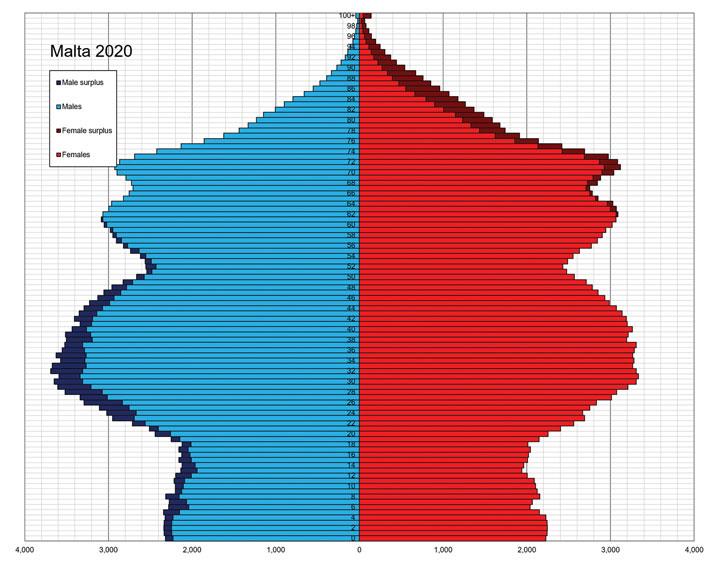
The situation of Floriana is not one which the Local Council can solve on its own. Indeed, many elected local councils since the inception of the Local Council itself have been or have had to deal with this elephant in the room issue plaguing the suburban town. Although their efforts must be commended, this is not an issue which can be isolated from a similar issue being faced by the nation in its entirety. Since the 1960s, Malta's fertility rate has been in steady decline, going from 3.62 births per woman in 1960 to just 1.06 in 2023. This reality, obviously, is most felt in those areas where the residential population is already very low and of a very advanced age.
Another major issue that must be addressed is the so-called quick-fix solution adopted by successive governments over the past 15 years - replacing the island's ageing population with foreign workers, primarily third-country nationals. This is not to say that immigration cannot be beneficial when done right and under strict conditions, but what we have experienced in just a little over a decade is an unsustainable influx of foreign workers who have already begun changing the demographic faces of a number of villages across Malta, not to mention contributing to increased traffic congestion, soaring housing prices, the emergence of no-go areas, and stagnant wages relative to rising living costs.
Here I must commend the Finance Minister, Dr Clyde Caruana for his open comments regarding the demographic issues of Malta and our low fertility rate, and I must also commend him for the budget proposal regarding tax breaks for families with two or more children. This is a good incentive indeed, similar to those implemented by Hungary and Poland, however one must ask if in the long run this approach will ultimately benefit foreign residents, who are generally more likely to have children, over the local ethnic Maltese population. It all boils down to the economic model being utilised in its entirety. It is not enough to tackle the symptoms of this model; the point should be to overhaul the system in its entirety, focusing on economic nationalism and creating the conditions for families to be able to sustain the nation while reducing dependency on foreign workers. In this sense, a cultural shift must also occur in the way we view sex and the family. Rather than as a burden or form of institutionalised oppression as some political extremists, mainly from the Left, want to paint it as, the family should be seen as the cornerstone of any society, nation and civilisation.
As mentioned, the demographic realities of Malta are strongly felt in already aging towns with a very low population. However, if the current demographic trends across the country continue, the issues faced by Floriana and the entire Harbour region will also be faced by other areas which up until now have had relatively healthy populations.
The main point is that attracting new generations to the area is futile if the country itself is failing to produce its own new generation. That is not to say that a reversal in fertility rates will necessarily regenerate the area, adequate housing and price affordability are still necessary, however the broader national demographic crisis must be addressed before smaller, localised issues can be effectively resolved.