What drew you to the incunabula as a source of inspiration for this body of work?
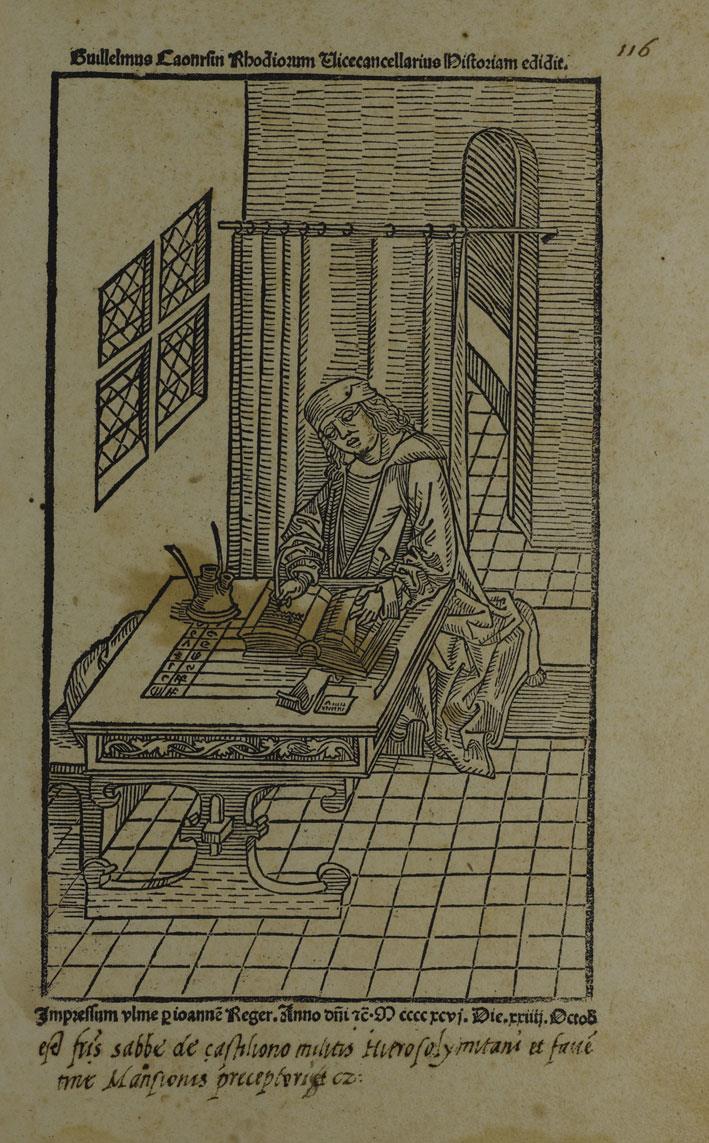
I had long known of this special collection of 15th century books, from the earliest phase of printing in Europe, in the Biblioteka collection but had never actually seen them. At the onset of this project I wanted to revisit my experiments in 3d printing and see how far I could stretch that medium and technique. Knowing that the Biblioteka had a collection which was defined by the fact that they were the earliest printed books made sense to create this dialogue across centuries.
How do you interpret the relationship between the historical texts and your sculptural forms?
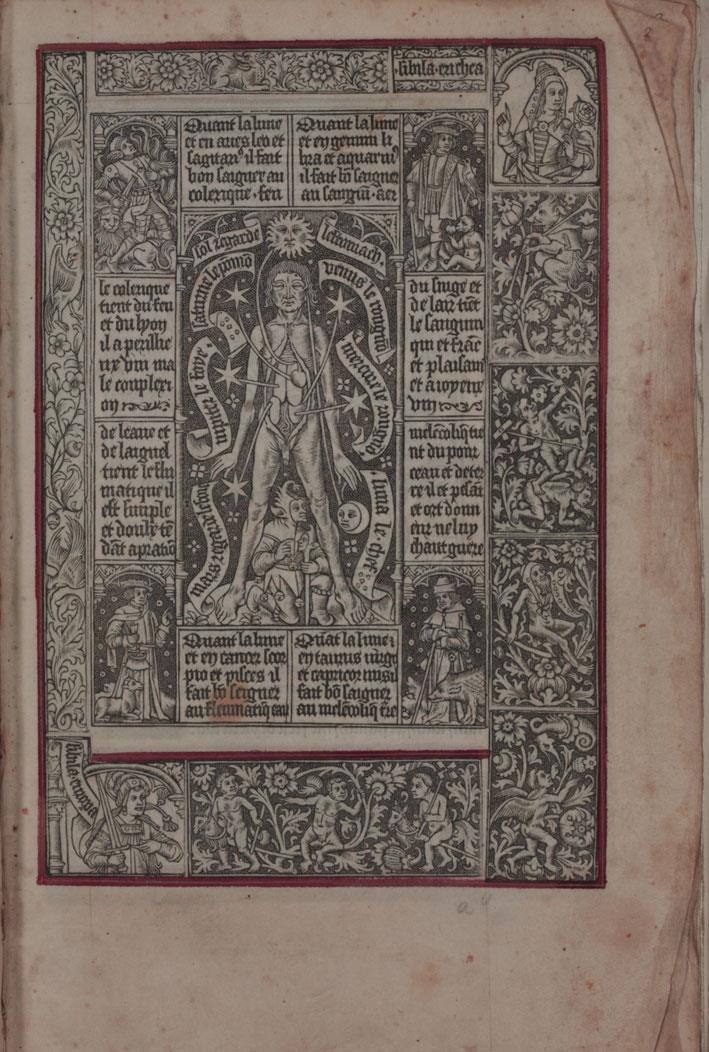
My work is always figurative and I focus on the face mostly. I therefore needed to seek out characters from the incunabula to depict in sculptural form. The first step in this project was to research and handle the actual incunabula to find these characters. Justine Balzan Demajo, the curator of the exhibition, and I spent many sessions at Biblioteka going through every single incunabulum in the collection (there are over 60). From there I was able to draw up a list of potential subjects whether these were authors, subjects of the books, illustrations within the books, the printers, or even previous owners of these books.
Can you describe the emotional or intellectual journey you experienced while reshaping the 3D printed busts?
The way I work is always intuitive. I literally dialogue with my clay, I allow it to suggest forms and I keep my process fluid and open to change. Although I always start out with a clear idea what I wish to depict, I try not to be too rigid and to allow space for change and for spontaneity. More than emotion, it is the ability to slip into a state of mind that allows for this flow. Some call it 'being in the zone' and it is hard to describe - any artist reading this will know what I'm talking about. It is a special state of mind and we are blessed to be able to make it happen on demand. Sometimes it is elusive and the magic doesn't happen - in that case it's best to stop.
Your work explores the tension between the digital and the handmade. Do you see this as a commentary on our current cultural moment?
Absolutely, yes! What I am doing is effectively overwriting the digital print with the hand. We are at the point of Singularity: the moment when artificial intelligence surpasses human intelligence. It is a scary moment for humanity, full of potential but equally worrying. We just don't know if we've created the instrument that will control us or if it will improve our lives immeasurably. What I am saying with this overwrite is that for now the human hand, like the human mind, is still in control. We literally have the upper hand. But possibly not for much longer.
In what ways do you think the human touch "overpowers the machine," as your exhibition suggests?
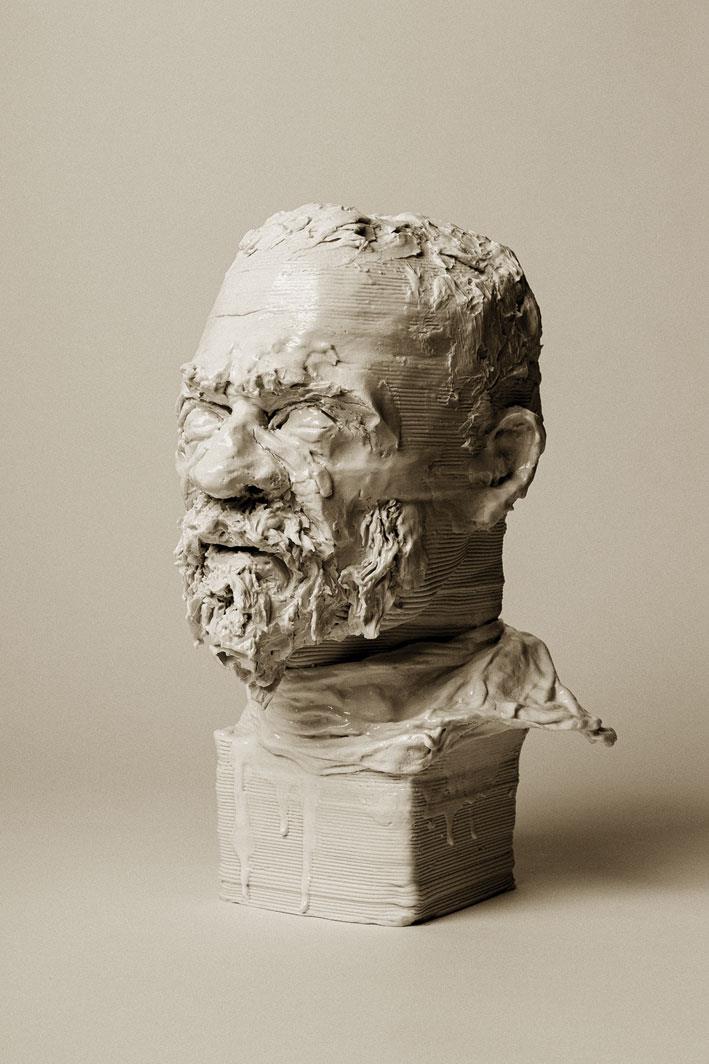
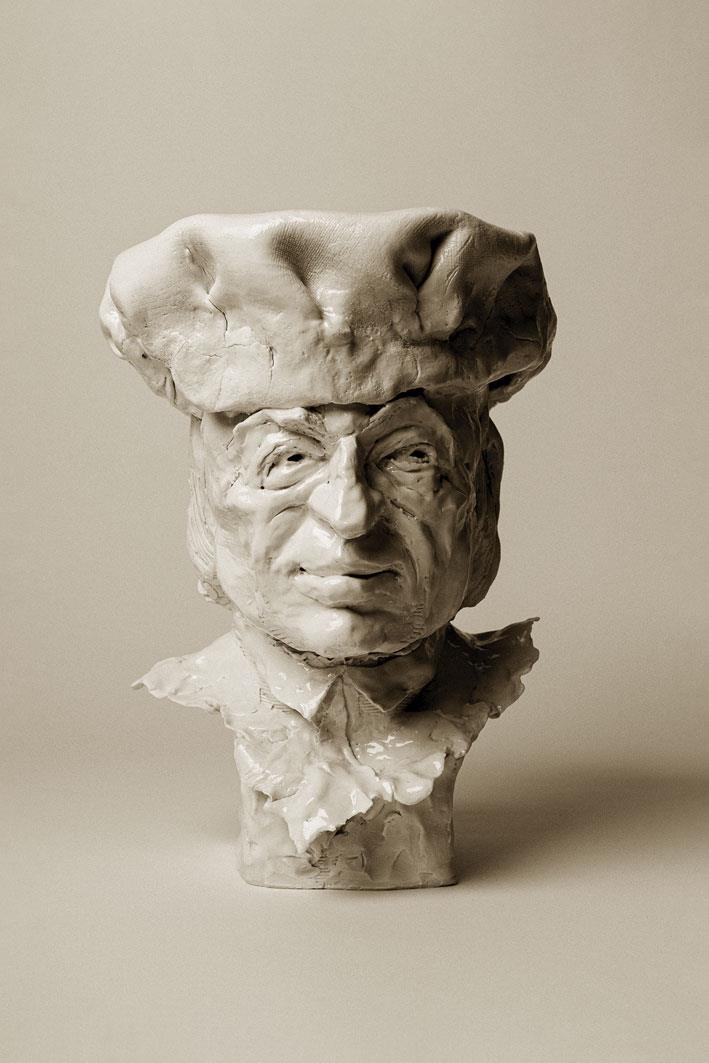
I make this very clear in the way I 'attack' the print. I completely overwrite in some cases and in others I allow the print to appear through my overwrite. I glazed the parts that were made by me in order to emphasise further and make it clear to the viewer what was made by (wo)man and what was made by the machine. I leave it to the viewer to decide whether my intervention has improved the bust or erased its machine-made beauty. Certainly, what can be said is that of the sixteen identical print outs, I have turned each one into completely different individuals by adding clay and reshaping and completely altering the print out.
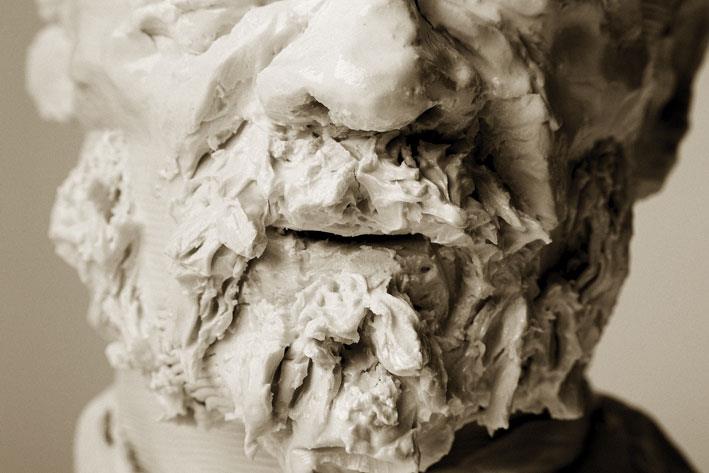
How do you hope viewers will engage with the contrast between precision and imperfection in your sculptures?
I imagine that the viewer will immediately distinguish between the 'precision' of the machine with its concentric row upon row, as opposed to my free, exuberant sculpting. By leaving unglazed the parts printed by the machine (that I have not over-written) this distinction becomes even more palpable.
Why did you choose porcelain as the medium for this series?
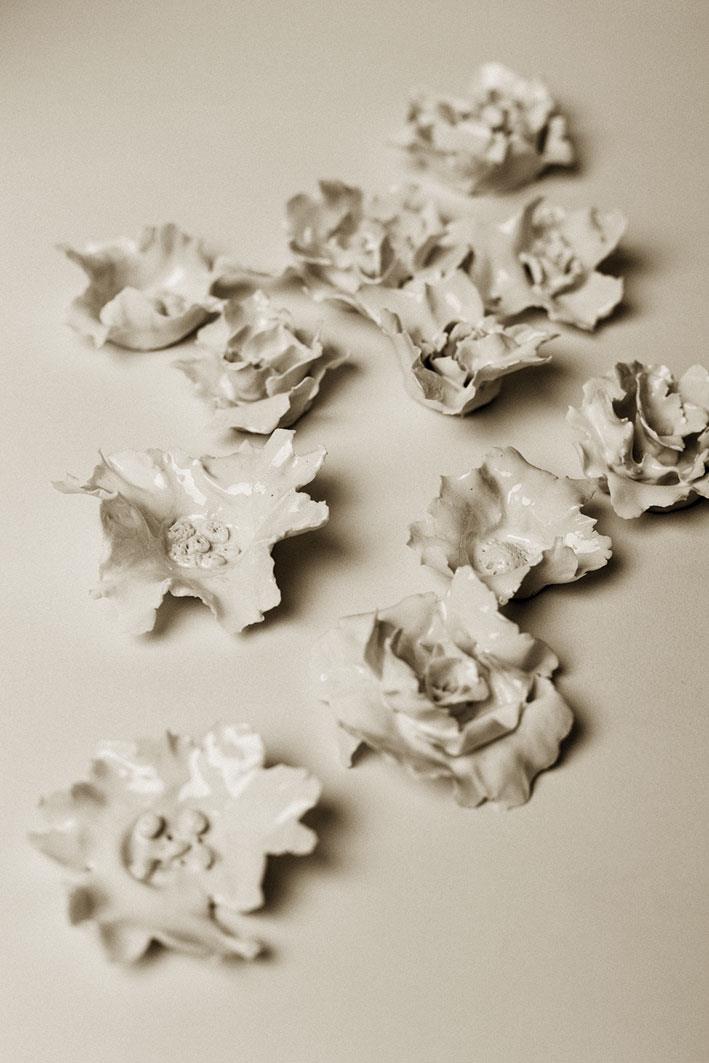
I had worked sporadically in porcelain in the past and it was Justine who suggested I take up this medium again for this exhibition. I instantly agreed because I wanted to challenge myself. Porcelain is a difficult clay to work with, much less forgiving than other clays. It shrinks a lot, does not hold its shape and is prone to cracking on firing. On the plus side, its colour is gorgeous and the translucency you can obtain is second to none. It is historically considered a precious clay and I felt that these restrictions coupled with the value attached to it were appropriate for our treasured Biblioteka. Its white colour, moreover, echoed the colour of paper – the most prevalent material at the library – and the neoclassical colouring associated with the architecture of the library.
What challenges did you face when combining 3D printing with manual sculpting?
The greatest challenge was that the 3D printer was in the Serendipity studio managed by Perit Matthew Catania in B'kara which meant that I had to collect the print outs around 12 hours after they were printed to give them time to harden slightly, enough to endure the drive to my studio in Burmarrad. After that, yet another challenge was to piece the print together by hand (we were printing the face in 5 sections in order to avoid overhangs where the wet porcelain would have sagged) building up the face. After that it was relatively plain sailing and I could sculpt the face with a combination of carving (removing) and building up with additional porcelain clay.
Are there any particular tools or techniques you've developed to manipulate the printed forms?
Not really, it was more the figuring out of how to attach the face together by hand without in any way leaving handmarks on it.
How did the collaboration with curator Justine Balzan Demajo shape the final presentation of the exhibition?
Justine Balzan Demajo, the curator of the exhibition, has been simply amazing. It was Justine who first approached me with the idea of siting an exhibition at the Biblioteka and from that moment was with me every step of the way, from research on the incunabula at the commencement of the project, all the way to viewing my work as it was coming along, giving me complete freedom to find my language with porcelain yet giving me essential input when I was in doubt. She has overseen every element of the production and sponsorships, without which this exhibition would simply not have happened. She has led the design and installation of the exhibition at Biblioteka with creative flair and good taste. A curator should take good care of the artist as well as the art, and Justine has certainly excelled in this.
Did any specific incunabula from the National Library's collection directly influence individual sculptures?
Yes, each sculpture, except for two more generic ones, is rooted in one or more incunabula and we ensure that we specify which in the captions. The viewer can then see up close the corresponding incunabulum as the National Library have very kindly acceded to our request to put on a concurrent exhibition of select incunabula (and other books relating to milestones in print-making locally). In effect this means two related exhibitions are running concurrently, one of my contemporary art and the other of related historic texts.
How do you see your work contributing to the dialogue between contemporary art and historical archives?
My work has almost always stemmed from research in archives and libraries. It is my original training as an art historian that sees me revisiting these old haunts, not to research and reproduce truthfully but to use these historic sources as points of departure. The more I examine our historical past the more I realise how relevant it is for our present and I can say this most eloquently through my art rather than through words. Whether this is a contribution on a bigger level is not for me to say. Time will tell.
What does the title Incunabula 1474-2025 mean to you personally?
1474 is the year of the earliest incunabulum in the Biblioteka collection. 2025 is what I produced throughout this year, specifically for the exhibition. I think the title sums up this dialogue across centuries, instigated and revolving around the incunabula collection.
Has working on this exhibition changed the way you think about technology or tradition?
Yes it has made me confront technology and embrace it in my art. I feel this is very much a response to what is happening right now in the field of AI and if we, as artists, do not face up to what is the greatest revolution of our time we risk being redundant.
If you could speak to the original creators of incunabula, what would you want to share with them about your work?
I would want to tell them how relevant they are all these centuries later. I would want to share with them how I obsessed about the various illustrations, how I studied them closely and how deeply appreciative I was of their beauty."
Francesca Balzan's Incunabula 1474-2025 is more than an exhibition - it is a meditation on time, technology, and the enduring relevance of human creativity. By reinterpreting historical texts through sculptural form, she invites viewers to consider the legacy of print culture and the evolving role of the artist in an age of artificial intelligence. Her work stands as a testament to the power of archives to inspire new narratives and to the resilience of the human touch in shaping meaning across generations.
Incunabula 1474-2025, an exhibition by Francesca Balzan is curated by Justine Balzan Demajo, is taking place at the National Library of Malta in Valletta from 14th November to 12th December