Meccano is a British brand of construction that was invented in 1901 by Frank Hornby in Liverpool, England. It consists mainly of metal or plastic strips, plates and other parts that are joined together with nuts and bolts to build working models and mechanical devices. Interestingly, individuals and even companies around the world still manufacture parts, some long out of production. Many exhibitions are held around the world, notably in France and at Skegness in England.
Meccano's early days
The death of Dr Hele-Shaw F.R.S. in January 1940 was significant to Meccano enthusiasts. He was the first prominent engineer to realise the enormous possibilities of Meccano as a constructional toy. Frank Hornby was in the early throes of developing his Meccano invention and seemed to be making little or no headway. When he submitted his ideas to Dr Hele-Shaw, he promptly gave Hornby his favourable opinion that the scheme was based on sound engineering principles and expressed his optimistic view. This was largely instrumental in securing the financial assistance necessary to launch Meccano on its unique path of success.
During the Second World War, Malta was a member of the Meccano Guild, which was a worldwide fellowship of boys. The Guild was launched formally by Hornby in September 1919 in the Meccano magazine, following an essay competition, How I would run a Meccano club, earlier that year. The stated aim was, "to make every boy's life brighter and happier, to foster clean-mindedness, truthfulness, ambition and initiative in boys, and to encourage boys in their studies and hobbies, especially knowledge of mechanical and engineering principles". At the time, it was unthinkable that girls would be interested in Meccano.
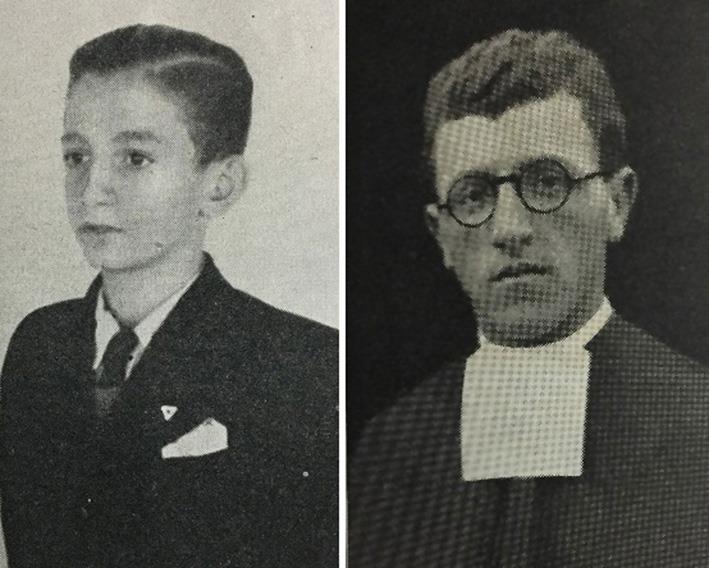
Andrew Caruana (left) and Bro. Anthony
Meccano during wartime Malta
Leafing through the Meccano magazine volumes of 1940-1943 interesting information was extracted as to how this hobby continued to flourish despite frequent air-raids over the Maltese islands.
At the time, the leader was Rev. Bro. Anthony F.S.C., who is seen on the right in the above photo and the secretary, Andrew Caruana. Caruana's address was at Floria House, Victory Street, Gzira. In the Meccano magazine of April 1940, the club was described as enterprising.
The Lasallians
Lasallian schools in Malta began in 1903 with the establishment of two colleges: De La Salle College in Cospicua and Stella Maris College, originally located at Villa Schinas in Sliema. The latter was later relocated to larger premises in Gzira in 1938. Both were founded by the Brothers of the Christian Schools.
The Lasallian club, which was very active, was affiliated in June 1939. It was founded by Bro. Anthony F.S.C. as leader. The Very Rev. Bro. Augustine F.S.C. was president. Model-building and fretwork were the chief activities. Model-building was the centre of interest and finished models of aeroplanes and other subjects were exhibited in the club room tables at meetings. Fretwork was another popular hobby. The club had already held a very successful exhibition in 1939. The number of visitors was 750 and all expressed their appreciation of the splendid display. Bro. Augustine opened the exhibition and the models on display included a dockyard and an aerodrome, with miniatures in Meccano of Britain's fighting forces. Fretwork models were also on display, and a special room was dedicated to Meccano Guild and club literature. The exhibition was followed a few days later by a party and a football match between Spanners and Screwdrivers, the two sections of the club. The result of the match was a draw.
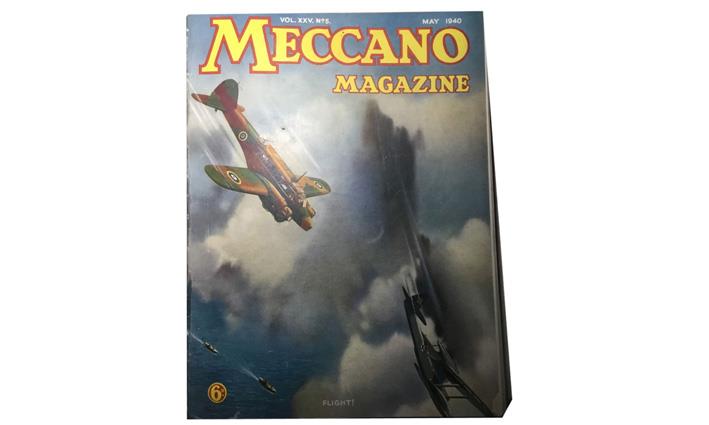
'Meccano' magazine 1940
In the issue of June 1940 of the Meccano magazine, it was reported that a special model-building contest was to be held. Models had to be constructed from 20 Meccano parts, and prizes awarded for the best three entries. At every meeting, time was given for private reading at the club's library. A talk on, My visit to Meccanoland was given by Mr. J. M. Demanuele who had visited the Meccano factory at Liverpool.
As the war continued to ravage the Maltese Islands in August 1940, the Lasallian Meccano Club continued with its model-building and fretwork. Parents of members kindly supplied plywood boxes for the Fretwork Section. An interesting lecture was also delivered by Rev. Bro. Walter Joseph F.S.C. on how to hold Meccano parts. A visit was paid to the Wembley ice cream factory in Gzira, the proprietors of which kindly allowed members to sample their products.
During the Battle for Britain in 1940, the glorious exploits of the Royal Air Force aroused much enthusiasm among the Meccano boys around the world, and a strong desire was expressed everywhere that a Meccano Spitfire would be presented to the R.A.F. to help in the war effort. Meccano produced a special miniature Spitfire in the form of a pendent.
During 1940, merit medallions were awarded. Malta received three medallions awarded to F. Busuttil and A. Tabone and J. M. Demanuele of the Lasallian Meccano Club.
'Meccano' magazine - 1941 and 1942
In March 1941, it was reported in the Meccano magazine that activities in the Lasallian Meccano Club of Malta had resumed, and several new members had joined. Instead of declining because of the war, model-building was embraced with even greater enthusiasm than before. Models of war were called for in a special contest and most entries represented ships of the Royal Navy. Rev. Bro. Walter Joseph F.S.C., former rector of the College and a great friend of the club, gave a very interesting lecture and lent a projector and films for a cinema display. Football and table tennis and air rifle shooting had also been taken by the club.
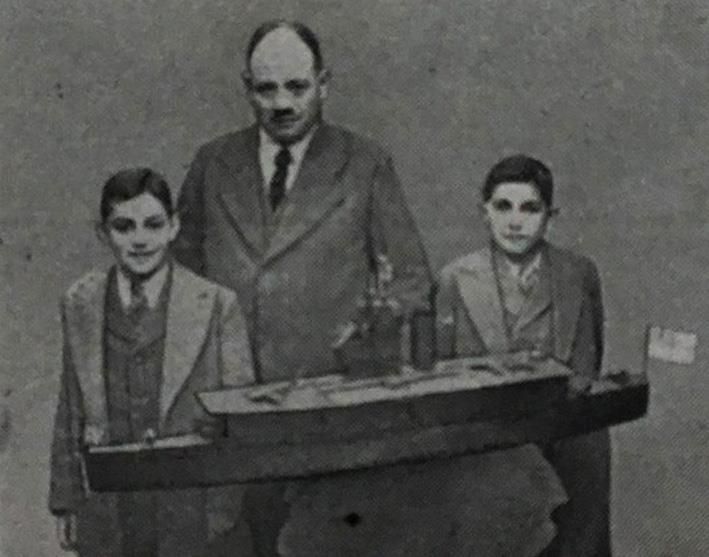 Mr Portelli with his two sons Lewis and Francis proudly showing their H.M.S. 'Illustrious' model
Economising on paper
As the war intensified across Europe, the Meccano magazine was obliged to reduce its number of pages to 40 due to the acute paper shortage. Also, the cover page was not published, a smaller type and smaller page were used to economise on space. Readers were warned that there was no guarantee that magazines would arrive on the first of the month due to transport difficulties created by aerial bombardments.
The magazine of May 1941 carried a two-page feature titled The Story of Malta - A Great Mediterranean Naval Base by Harold J. Shepstone, F.R.G.S. describing war-time Maltese streets as full of sailors, soldiers and airmen and men of the merchant service for convoys making a halt in Malta. Mention was made of the thousands of Maltese who had joined the King's Own Malta Regiment and the Royal Malta Artillery, all anxious to play their part in the defence of their beloved island.
Frequent air-raids did not deter members of the Lasallian Meccano Club from holding regular meetings in 1941 as model-building continued to be the chief activity. Aeroplane flying, Hornby train operation, roller skating, football, and tennis were also enjoyed. Cricket was introduced also as a club recreation. Members collected scrap metal, torch batteries, and other materials in aid of the war effort.
Despite constant alerts and other difficulties, the Lasallian Meccano Club continued its activities during 1942. To raise the morale of members, competitions for humorous sporting and mechanised army models were held with success and the annual sports meeting was held as usual. Rev. Father Manchi presided over these events and an exhibition of models was held with a prize for best exhibit.
1943
The Meccano magazine issue of April 1943 heaped praise towards the award of the George Cross to the island and described it as a fitting tribute to the courage and determination that the Maltese showed during the long and memorable siege they underwent, describing Malta as, "the most battered fortress in the British Empire".
'Meccano' in Malta Rock Shelter
A fine photograph, reproduced in the Club and Branch News of the Meccano magazine issue of August 1943 shows Lewis Portelli and Francis Portelli, keen Guild members, and model-builders with their father, who was equally devoted to model-building. The Portellis had suffered heavily in the severe bombing of Malta and spent many hours in the shelter they had dug for themselves. Throughout those difficult times, Meccano remained their constant companion. While taking refuge in the shelter, they constructed a model of the aircraft carrier H.M.S. Illustrious, which had played a crucial role in escorting the convoys that sustained the islands and aided in repelling the Axis forces.