What better way to close our 2025 exhibition programme at il-Kamra ta' Fuq than by hosting the tenth solo exhibition of Dominique Ciancio, ĊAFĊIF, curated by yours truly?
I've known Dominique for quite some years now (eleven, to be precise). I first met him, and his art, during his solo exhibition UNPACK at Pjazza Teatru Rjal back in 2014, and let's just say, I didn't leave empty-handed. Even then, it was immediately clear that he was fearless in his experimentation, with concepts that were both deeply researched and technically refined.
That sense of experimentation is no doubt rooted in his background in restoration, theatre scenography, and film. At twenty-six, while living in Oslo, he committed to painting full-time. His visual language has since become a blend shaped by these multidisciplinary experiences, integrating a variety of techniques into his practice. What I find particularly intriguing is his approach to each work as a "handmade image", a term he uses to describe his meticulous, process-driven method.
The exhibition ĊAFĊIF can be seen as a natural continuation of Dominique's 2021 solo show Return Island at the Malta Society of Arts. In that earlier exhibition, we encountered Maltese identity up close, our traditions, our character, our attitude. In ĊAFĊIF, however, Dominique pulls the camera back. We get more of a bird's-eye view: what remains of our identity, and all the contrasting layers of wishful thinking that hover around it.
Here, Ciancio invites us to imagine what the sea might say if it could speak, what stories it would tell of an island continually shaped by waves. "Ċafċif" is a Maltese word that describes the act of splashing about in water. It is onomatopoeic, echoing the sea itself as it makes a sound that is timeless, repetitive, and loop-like, much like the cycle in which both the sea and we, in Malta's current situation, often find ourselves caught.
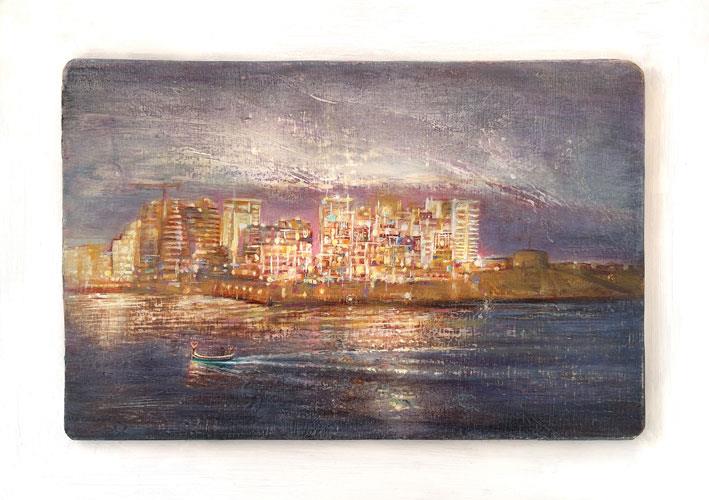
The works in this exhibition naturally group themselves into two sub-themes. First, we have visions of high-rise buildings swallowed by a wilderness of lights. In some of these, the towers dissolve into a hazy backdrop for the iconic St Julian's love boat; the little vessel that, every night, ferries a handful of tourists away from the chaos for a brief, romantic escape from it all.
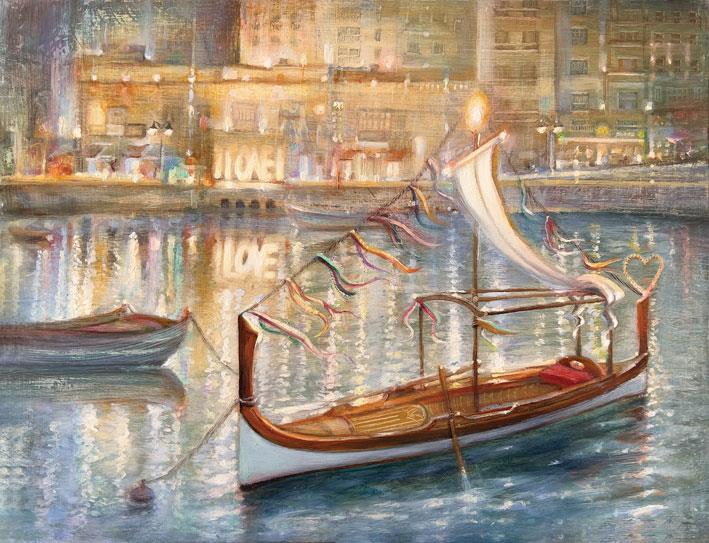
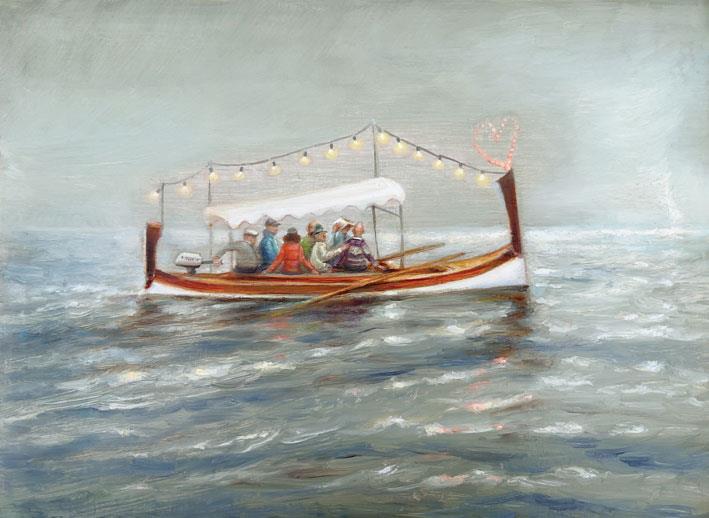
In Love, we see one of these loveboats in all its glory, the romance gently underscored by a blurred view of the LOVE sculpture in St Julian's. In The Excursion - Loveboats, we are presented with a scene that appears ordinary at first glance. Yet on closer inspection, we realise that Ciancio avoids the typical tourist imagery - no sunny Malta, no warm seas, no glowing tans. Instead, the passengers are wrapped in padded jackets beneath an oppressive grey sky. There are no skyscrapers in sight. No buildings at all.
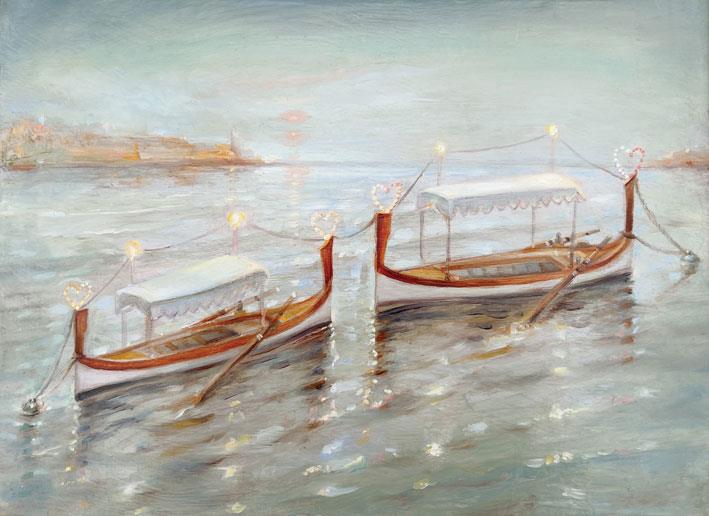
In Dgħajjes - Loveboats, the human presence disappears entirely. The towering high-rises dissolve, replaced by distant, blurry bastions. Here, the "love" exists solely between the two boats. No human intervention, just the sea and the gentle reflections of their own decorative bulbs.
It's time to move on from this beautified cry against overdevelopment and the longing to slow down, and shift to the exhibition's second sub-theme. Here, Ciancio transports us to an idyllic island, an island untouched by stress or drama, immaculate and construction-free, where time seems to pause. The works evoke a deep nostalgia: a longing for something many have never actually experienced, yet instinctively escape to it in their minds when life becomes too much.
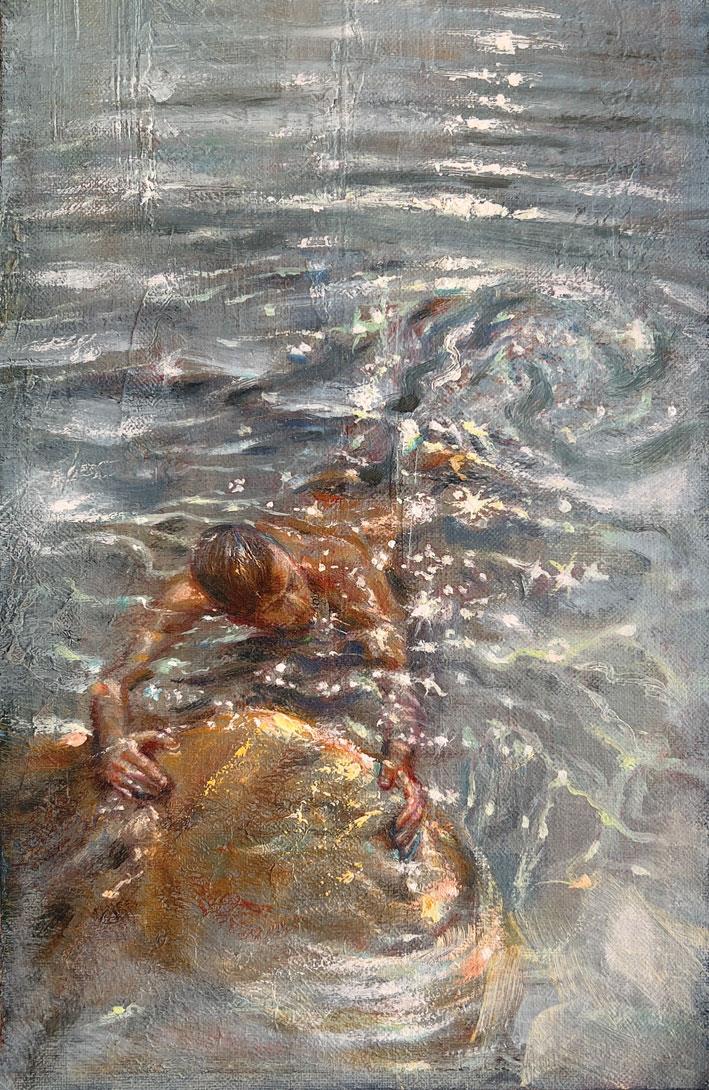
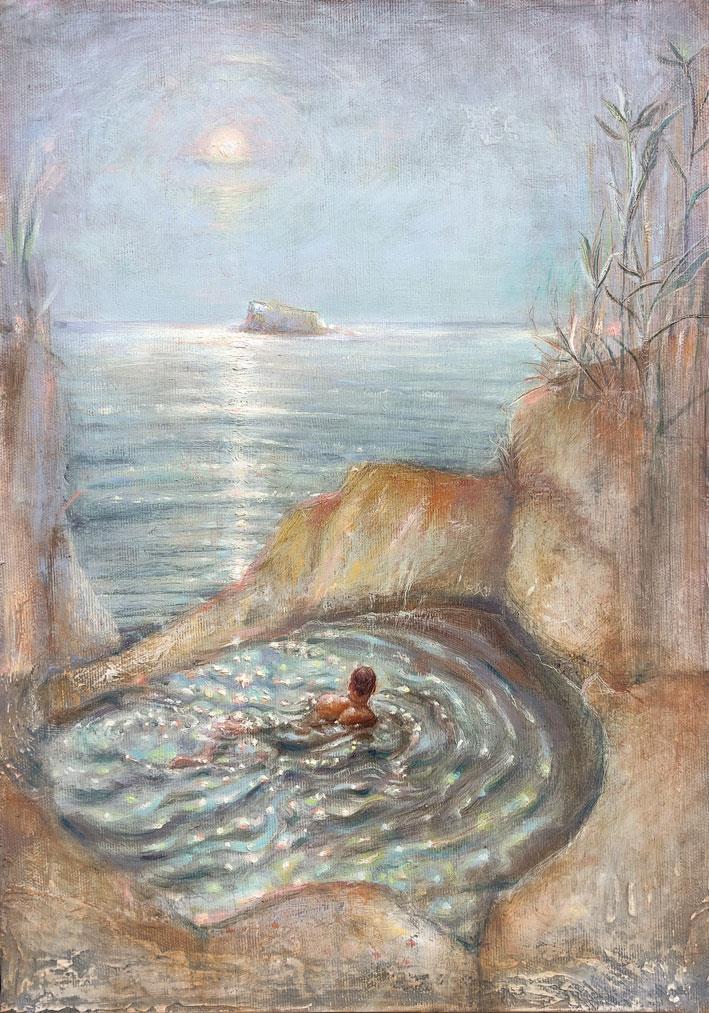
These scenes often feature a solitary figure bathing in crystal-clear water, where the reflections sparkle like stars scattered across a blue sky. Perhaps Ciancio is subtly hinting at light pollution, an issue that deeply affects our island. We lack places free from artificial light, where one can truly witness a sky full of stars. This too is a nostalgic idea, one that floods the memories of those who experienced it in childhood. In Idda, Il-Blata and Leqizza, there is this atmosphere of a "ċafċifa ħelwa", a sweet splashy escape that surely sparks a touch of envy. Who wouldn't wish to be that bather, surrounded by crystalline waters, far from everything and everyone?
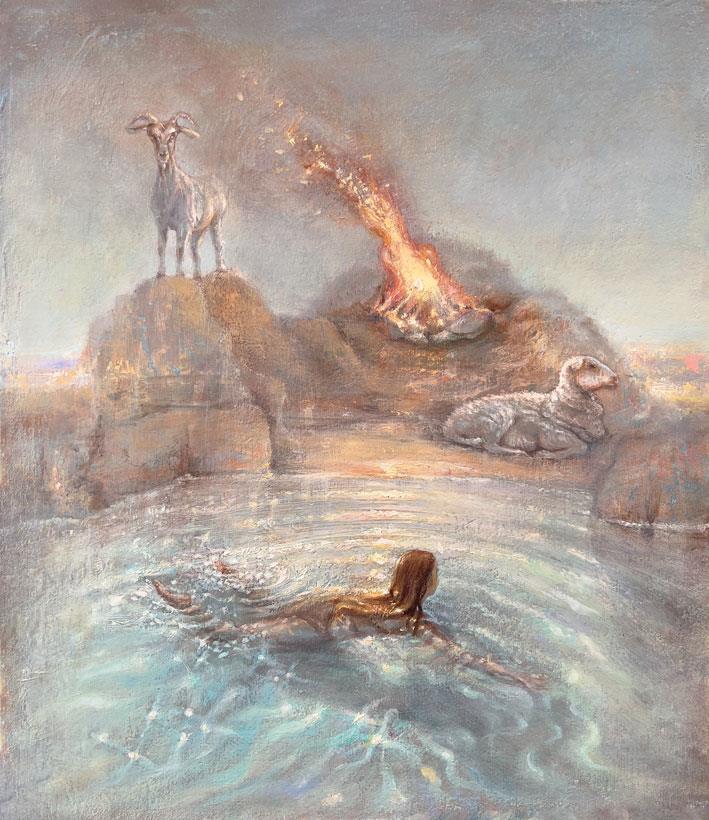
In Riserva, Ciancio creates an untouched haven overlooking Filfla. The lone swimmer sits in what feels like a natural jacuzzi, isolated and bathed in Turner-esque light. One of the most enigmatic works in the series is without doubt Il-Ġebel ta' Xalura - my personal favourite, along with Il-Blata. "Xalura" is a fictitious word coined by Ciancio, adding to the mystery of this place where one can enjoy a slice of beach entirely alone, a stark contrast to the towel-and-deckchair battles that now define the once-utopic Blue Lagoon and so many other Maltese beaches. The rocky cove feels sacred, guarded by a goat angrily marking its territory. On the right, a sheep lies cozily, unbothered by our swimmer. At the centre burns a fire, emanating a faintly sacrificial aura. But who lit it? If humans aren't permitted in this sacred space, is this entire scene a wishful dream, an expression of our collective craving for pristine land, clear waters, and a dose of solitude in our overcrowded lives?
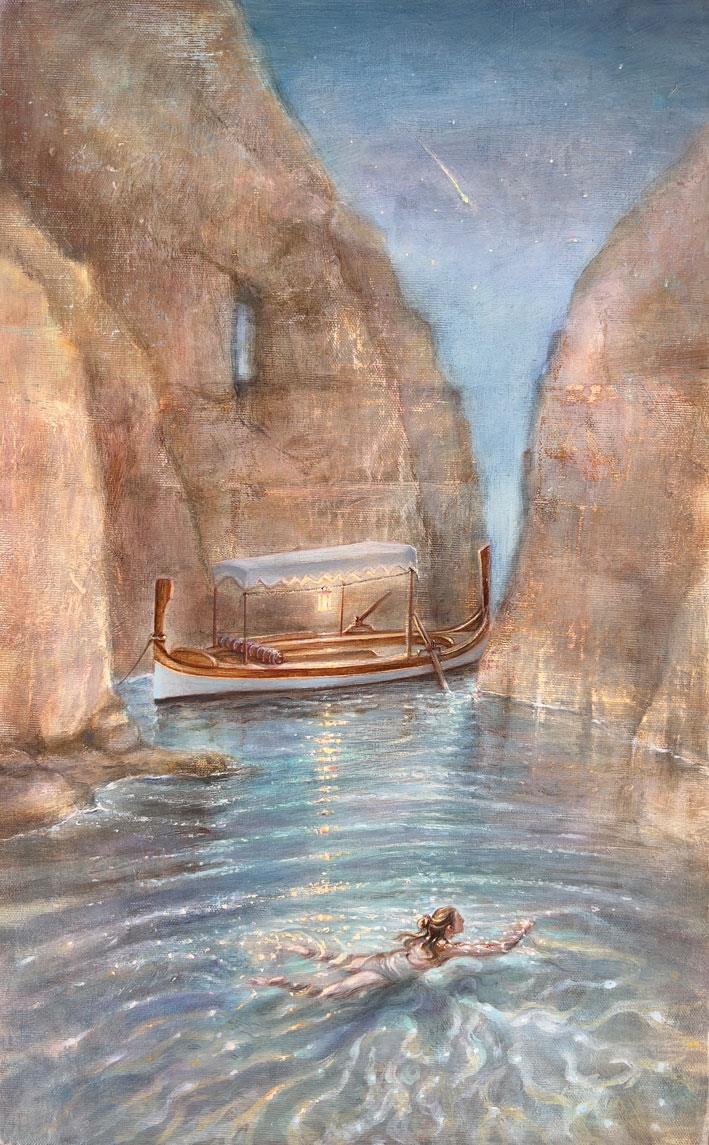
The two sub-themes are beautifully tied together in the hero image of the show, Lejla. Here, a solitary swimmer occupies the foreground, while through a narrow corridor formed by high, imposing rocks, the loveboat makes its quiet entrance. The magic of the scene is heightened by a shooting star streaking across a blue-purple sky scattered with glimmering stars.
The largest and perhaps most enigmatic work in the exhibition is Fuq Wiċċ l-Ilma. This surreal piece presents two bastioned shorelines, both glowing in the honey-coloured hues of Globigerina limestone, that precious stone so central to our identity, yet increasingly lost to over-construction and the destruction of older buildings. From the left bastion, we see impressive bursts of fireworks, almost like sparks from a magic wand with the power to restore a "real" Malta.
At the centre of the composition floats a beautiful woman curled in a fetal position, cradling a small boat as if it were a toy. She wears a white nightdress printed with tigers. This becomes an allegory for our society: our traditions turning into playthings; objects to amuse ourselves with, and to entertain tourists, all while we live in a jungle of construction sites and cranes. And the tigers? Perhaps they symbolise those moments when we try to fight back, only to be tamed again, easily distracted by a new (or old) toy placed before us.
These works carry a personal nostalgia for Dominique, who spends a lot of time in the Italian countryside, where he finds himself surrounded by calm, space, and silence, a stark contrast to Malta. The paintings become a call to awareness: a reminder of the wild architecture sprouting everywhere like concrete trees in a forest, with little care for harmonious skylines or respect for our historic buildings. There is the light pollution, the excessive noise in certain areas, and the growing disregard for residents, to the point that sometimes the only way to escape it all is to drift away on a boat, far from the shore.
Ciancio's past exhibitions include WIRE (Oslo, Norway, 2008), The Curious (Cittadella, Gozo, 2010), Silent Pulses (Palazzo Ferreria, Malta, 2011), Malerier (Rjukan, Norway, 2013), and UNPACK - A Visio-Phonic Experience (Pjazza Teatru Rjal, Malta, 2014). He also created murals for Malta's Esplora Science Centre (2015) and collaborated on AJITP in The Hague, Netherlands (2016). Later projects include TATOM (Gozo, 2019) and Return Island (Palazzo De La Salle, Malta, 2021).
ĊAFĊIF is open until the 21 December at il-Kamra ta' Fuq, Mqabba. For more information, find us on social media.