We never stop at il-Kamra ta' Fuq! And just four days into the new year, our first exhibition of the year opens, by none other than Antoine Paul Camilleri.
The perhaps selfishly chosen title - Poġġejt għax għajjejt (I sat down because I am tired) - feels like the story of my life lately. But it was chosen for a more valid reason. When I visited Antoine Paul's studio in Pembroke, a number of existing sculptures immediately caught my eye, all portraying figures sitting or resting. I admit I was tired myself, trying to find a real chair to sit on, and, almost enviously, looking at these figures, the title came to mind. The artist was intrigued by this and began working on new pieces that further explore and complement the subject.
We continued exploring the notion of sitting down and realised how much we take this small gesture for granted. The exhibition captures that beautiful, almost meditative feeling of simply sitting down and letting go, that moment when all you wish for is a place to sit, and once you settle in, every bone in your body begins to release its tension.
The exhibition celebrates the art of "doing nothing", learning to resist the constant impulse to be productive every moment of the day. It invites us to sit without our phones, like these sculpted figures, and simply notice the people and things around us, allowing ourselves the space to think. When we find ourselves seated and waiting somewhere, a quick glance around usually reveals people absorbed in their phones, some even watching endless & useless reels at full volume. Rarely do we see someone reading a book, and even more rarely someone simply immersed in thought, quietly observing and digesting what is around them.
The act of sitting has long occupied a central place in the history of art, often charged with meaning beyond rest. From the authority and composure of ancient Roman seated figures to the intellectual tension embodied in Rodin's The Thinker, the seated body has frequently represented power, contemplation, and control. In more intimate terms, Lucian Freud's seated figures confront us with the weight of the body itself - gravity, flesh, and presence - stripped of idealisation.
While contemporary works such as Marina Abramović's The Artist Is Present transform sitting into an act of endurance, discipline, and relational intensity, Camilleri's figures move in the opposite direction. They do not sit to withstand time or to perform stillness, but to release it. His sculptures depict bodies that have chosen rest over resistance, surrender over control. Sitting here is not a test, but a relief. It is a moment in which productivity dissolves, and the body is allowed to simply exist. Through these quiet gestures, Camilleri reclaims sitting as an intimate, human act: not monumental, not heroic, but profoundly necessary.
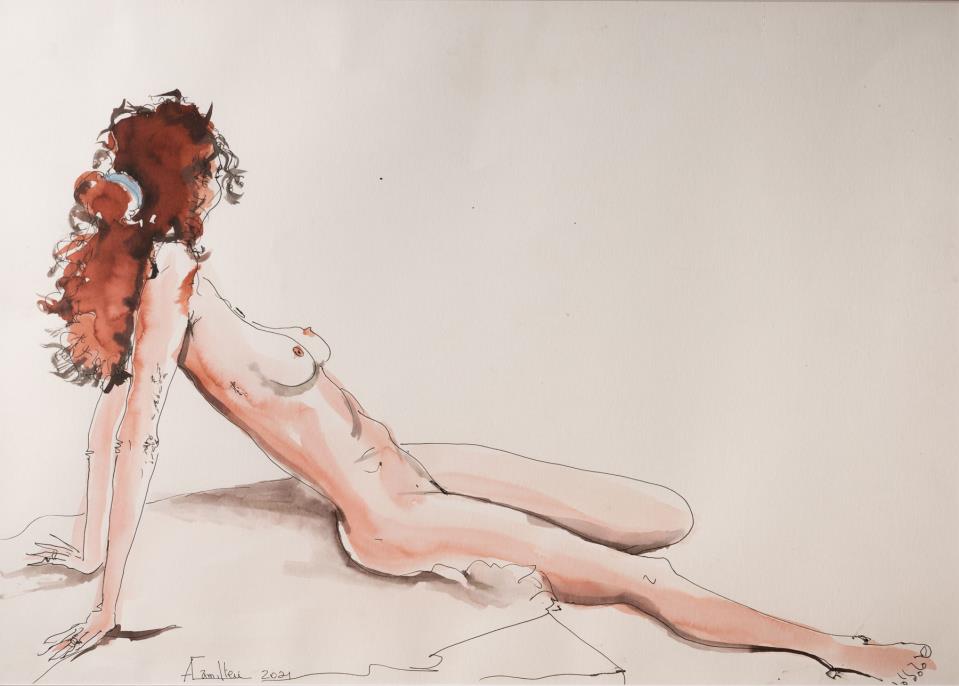
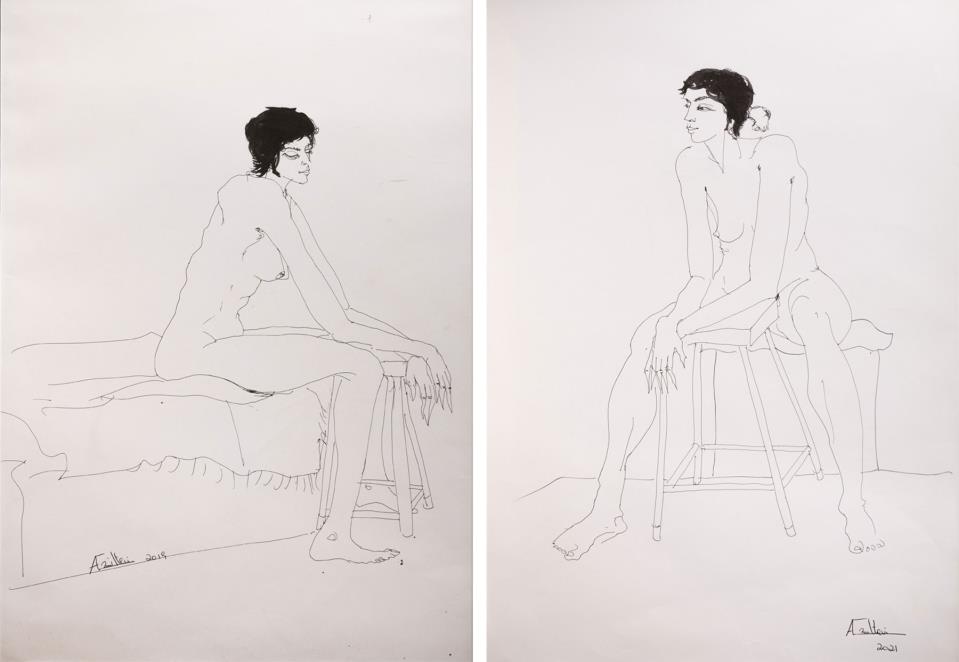
All the sculptures are created from sessions with live models. Camilleri explains how he produces very quick sketches from multiple angles, circling the model to capture a full 360-degree view. These rapid studies later enabled him to translate the sitter into a three-dimensional sculpture. Through this process, Camilleri transforms his figures. They are not merely posing - they are inhabiting rest. The works presented in the exhibition span ceramics, bronze, and drawings, all capturing these intimate moments of pause.
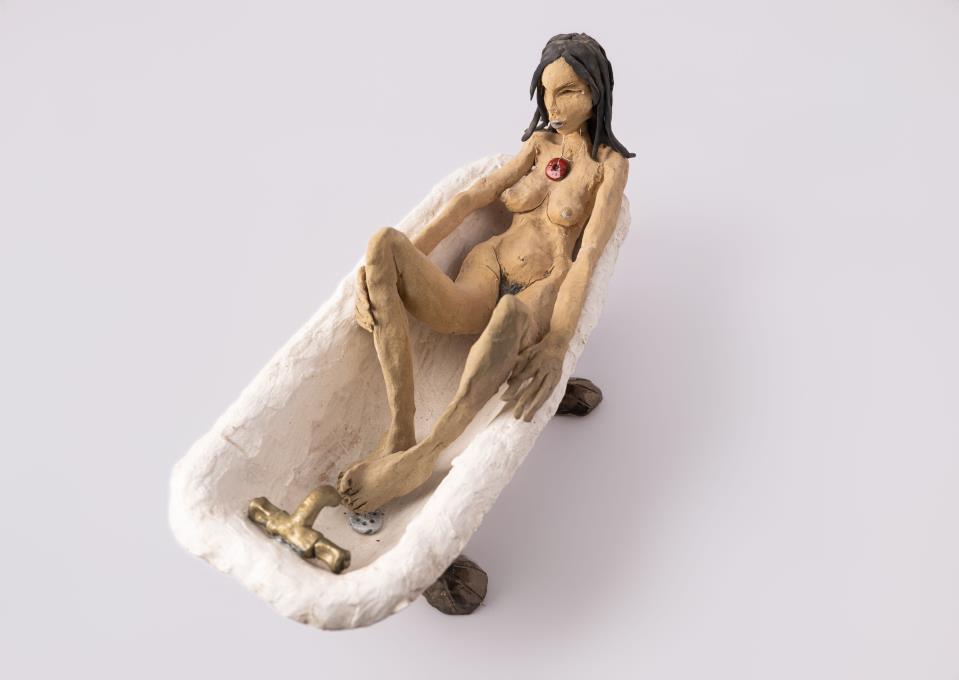
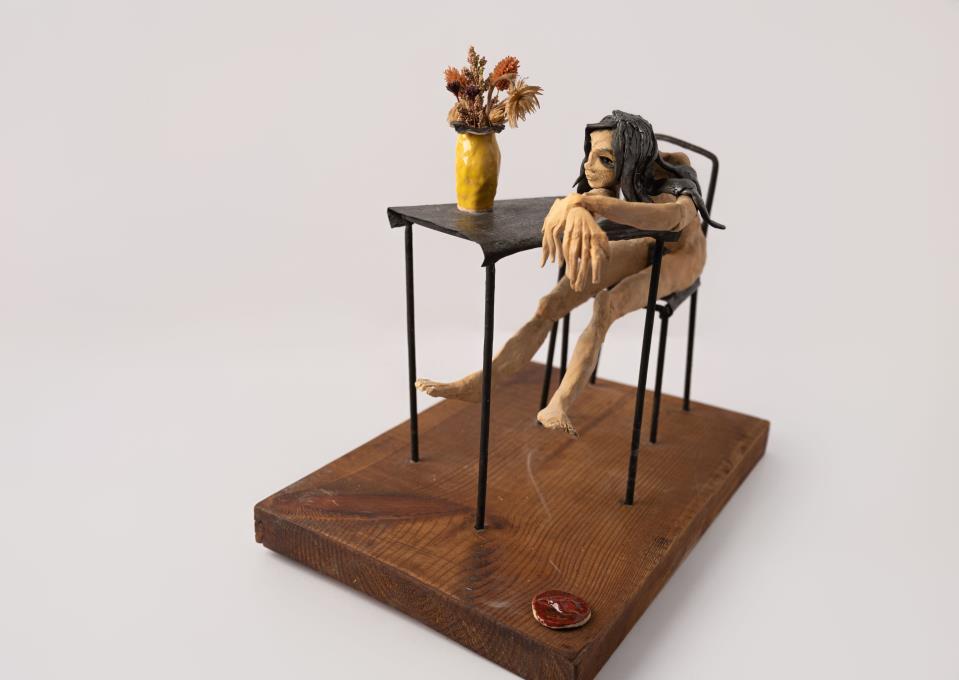
In Seated Nude near Vase with Flowers, we encounter a female figure executed in ceramics, seated on a metal chair and lazily stretched across a metal table, alongside a vase of flowers. The flowers are dried, creating an interesting and playful harmony within the mixed-media composition. Taking a Bath presents a female figure reclining in a four-lion-legged bathtub. The meticulous attention to detail is striking: the water tap, the delicate legs of the bath, and the relaxed posture of the figure herself. With no additional props for distraction, she wears only a necklace with a large red pendant. It is the ultimate image of relaxation. A quiet tableau in which only the presence of real water and a hint of bubble bath are missing.
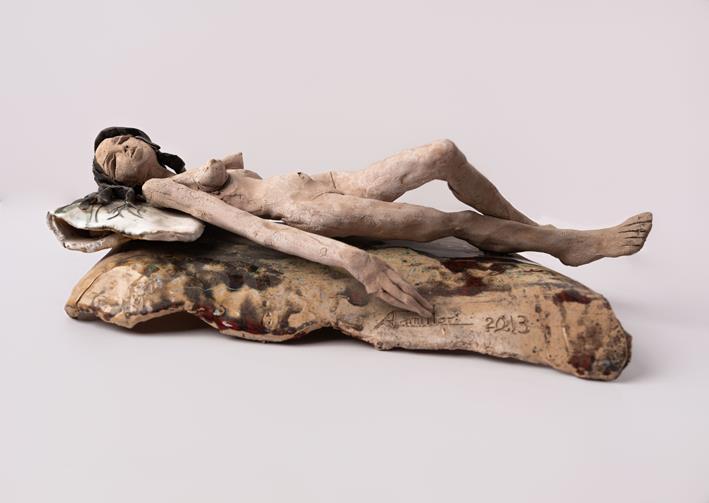
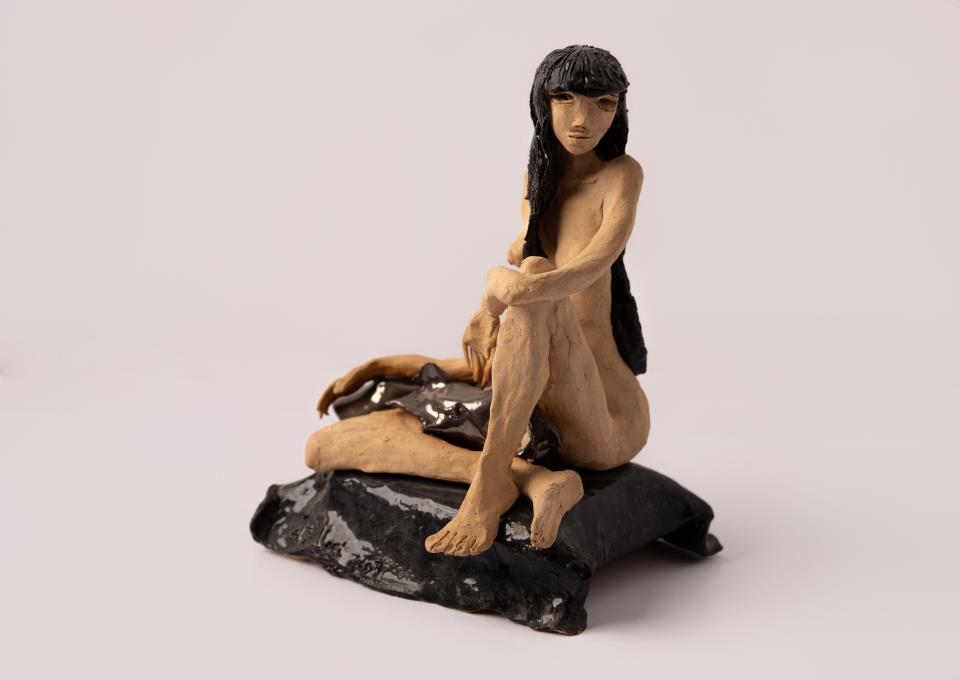
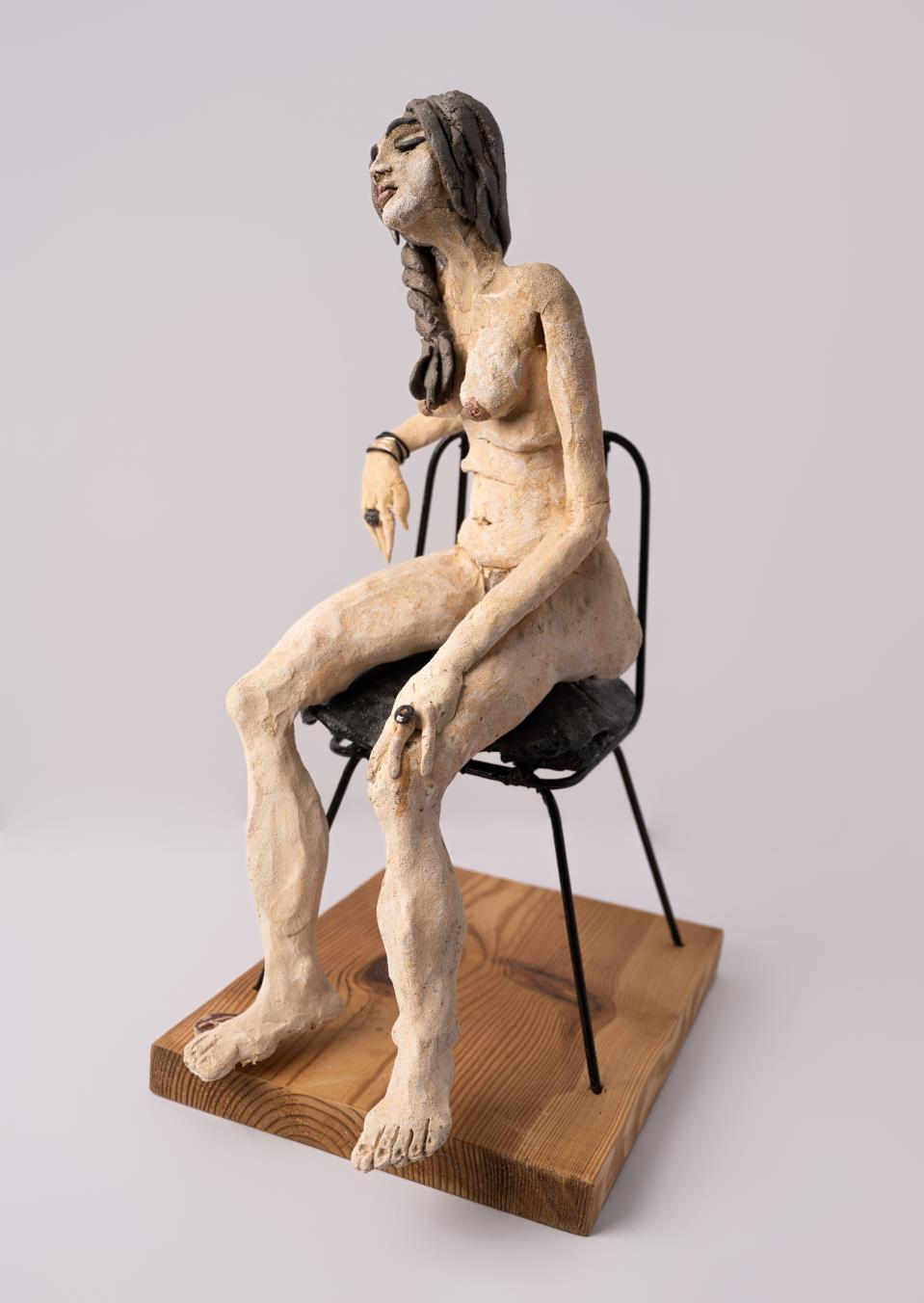
Further relaxation is explored in Nude Lying on Bed (2013), where a female nude is fully stretched out on a 'mattress' and pillow, her head slightly tilted to the right. The pose is sensuous yet unguarded, inviting the viewer to contemplate the ease and vulnerability of the resting body. Three additional works depict figures lying down in repose, all executed in bronze and combined with ceramic props. Nude I and Nude III present female figures seated in relaxed poses with one knee raised, and the other leg crossed, with their intimacy partially concealed by a small ceramic towel. In Nude II, we encounter what feels like the most distilled expression of the exhibition's core idea. The young woman appears utterly exhausted: one hand rests on her knee, the other drapes over the back of the chair, her eyes closed as if momentarily withdrawing from the world around her.
Some of these figures are seated on more elaborate chairs than others, such as Seated Nude on Red Sofa, where Camilleri presents a highly stylised, slim, sleek red one-seater chair. Another work portrays a young female figure, executed in bronze, seated while gently caressing a cat resting in her lap. The presence of the cat leads to a particularly site-responsive artwork inspired directly by the architecture of il-Kamra ta' Fuq, with its irregular walls and seemingly haphazard 'niches' in the wall. One specific hole, situated high up on the wall, triggered a memory for Antoine Paul: a photograph he had taken around 45 years ago of a cat emerging from a window. This image held special significance for him, having been submitted to competitions at the time. The idea was to recreate that window within the existing hole, with a life-size ceramic cat emerging from it, complete with whiskers and sharp, menacing claws. I confess I said more than a few prayers while taking the measurements, and all of them were answered: the ceramic structure fitted perfectly, like a glove.
The largest sculpture in the exhibition portrays the only male figure present. He is shown precariously kneeling on a metal chair, his pose both imposing and tense, introducing a subtle shift in energy within the otherwise restful atmosphere of the exhibition.
A number of large drawings are also presented in this show, from ones executed in ink to others in ink and watercolour wash. Ultimately, through these works, Camilleri encourages us to slow down, relax, and savor for a few minutes the joy of il dolce far niente.
Camilleri was born in August 1959, one of five children. At a young age, he was apprenticed to his father, the late Antoine Camilleri, one of Malta's most influential modern artists. At upper secondary school, he studied under artist Esprit Barthet and took pottery classes with the much-admired ceramist Gabriel Caruana. He has participated in numerous collective exhibitions and held a number of solo shows. His work spans a wide range of media, including pen and ink drawings, acrylic paintings, etchings, watercolours, glass fusion combined with metal sculpture, and ceramics. Now retired, he is able to focus fully on painting and sculpture from his studio in Pembroke.
The exhibition is on until 18 January at il-Kamra ta' Fuq, in Mqabba. For more information, follow us on social media.