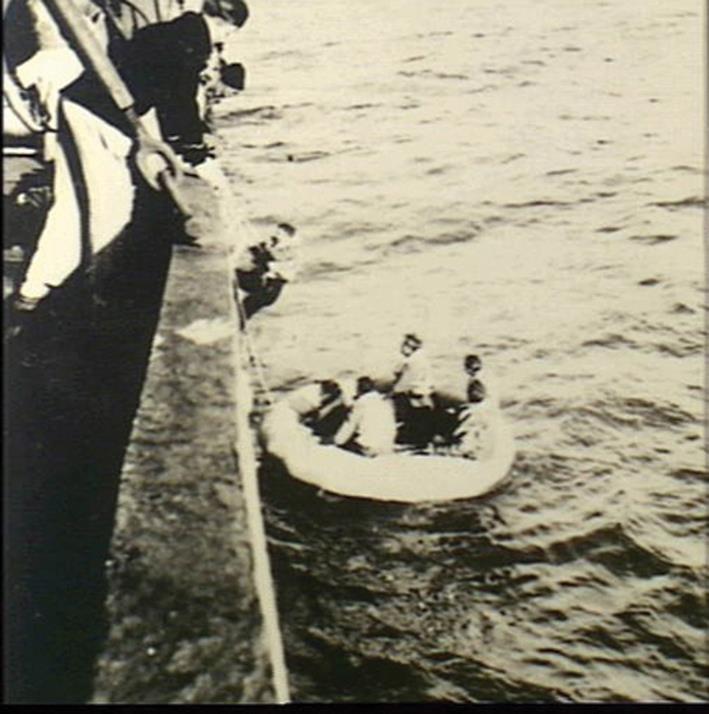
There are incidents of Commonwealth airmen being captured after taking off from Malta, such as the case of a Vickers Wellington bomber from No. 458 Squadron RAA (Royal Australian Air Force) the crew of which were rescued at sea by the ship SS Destro, after they were forced to ditch their aircraft. No. 458 Squadron was based in Malta at this time and was carrying out operations against enemy shipping in the waters around Sicily.
"The Malta Memorial commemorates almost 2,300 airmen who lost their lives during the Second World War while serving with the Commonwealth Air Forces flying from bases in the Mediterranean region, including Malta, and who have no known grave."
As mentioned at the outset, during hostilities, the duties of RAF airmen were not only confined in defence of the Maltese islands, but they were also assigned on missions over enemy territory.
For this purpose, the RAF issued specific instructions and guidance to all officers and airmen of the RAF on the precautions to be taken in the event of falling into the hands of the enemy. These precautions included, in addition to other information to be provided in the event of capture, what the enemy would seek to learn from captured airmen, the sources and methods the enemy might use to obtain information, what should not be disclosed, and the rights of prisoners.
The information in this feature has been mainly extracted from Air Publication 1548 (2nd edition, June 1941). The information contained in the publication is based on the Geneva Convention of 1929. The information is based on facts and the experiences of airmen who had been POWs and who knew what they were talking about.
The Geneva Convention and the rights of prisoners
The rights of prisoners of war during the Second World War were fully safeguarded by the Geneva Convention of 1929. The Geneva Convention of 1929, officially known as the Convention relative to the Treatment of Prisoners of War, was signed on 27 July 1929, in Geneva. It was developed in response to deficiencies in the Hague Conventions of 1899 and 1907, particularly highlighted during the First World War, and aimed to improve the treatment of prisoners of war (POWs). Observance of the Geneva Convention was to be displayed in every POW camp. Airmen were to insist on this being done.
Also, there was to be a neutral Protecting Power to whom all serious complaints could be addressed through the Camp Commandant. The most prominent neutral powers included Switzerland, Sweden, Spain, Portugal, Ireland, Turkey and Switzerland. The airmen who managed to escape from POW camps into a neutral country claimed their freedom and were to report to the nearest British representative.
During the Second World War, the role of neutral protecting powers for POWs was critical due to the widespread loss of national protecting powers, as many governments were either occupied or ceased to exist. Switzerland and Sweden emerged as the most prominent neutral protecting powers during the conflict.
According to the Geneva Convention of 1929, signed by all the Great Powers (47 governments, including the major world powers such as the United States of America, the United Kingdom, France, Germany, Italy, Japan, and others), a POW must only give his name and rank, or his identity disc number. In practice, all three would be given. No further information whatsoever was to be given. Interestingly the identity disc did not give the squadron number and the airmen's identity card for RAF and WAAF (Women's Auxiliary Air Force) personnel (all ranks) was not to be carried during flying operations. This also applied to instructions regarding precautions in case of falling into the hands of the enemy.
Airmen were instructed that enemy threats were not intended to be carried out, and that prisoners who consistently refused to provide information would be respected by their captors.
Information sought by the enemy
The enemy employed several methods by which they would attempt to find out details from the airmen about any unit of the Air Force or of the Navy and Army. These methods would include impersonating British or Allied prisoners mixing with genuine prisoners and by using agents such as hospital nurses or attendants, who professed to sympathise.
The use of microphones was another possibility to obtain information in that these could be planted in every room at every stage of the airmen's imprisonment. The enemy would also give the impression that other airmen had spoken freely and preventing silence was no longer of value. Other methods employed were friendly reception and good treatment on capture, such as being offered drinks and treats.
Usually, the information sought by the enemy from RAF airmen consisted mainly of the following:
1. Types of aircraft, performances, new designs and armaments;
2. Aerodromes and landing grounds at home and abroad;
3. Any information about training - tactics, British, or how much the airmen knew of enemy tactics;
4. Information about air-raid damage in Malta or any other places of interest, or to British ships;
5. Meteorological information about the weather, recent or forecasts;
6. Air defence organisation and anti-aircraft defences in Malta or any other places of interest; and
7. Home conditions (politics, food supply, spirit and morale of the people and serving forces).
Despite all the measures not to divulge any information, the enemy would be on sharp alert to examine any captured material from the downed aircraft, if available, such as papers found in the aircraft, notebooks, diaries, personal letters and effects as well as letters written by and to POWs.
Don'ts
The most effective way not to divulge information was to say nothing and to go on saying it. Having said that, airmen were instructed not to carry or allow anyone else to carry any papers, official or private on a flight. A simple envelope could give away information. A simple tram or cinema ticket or a bill could reveal important information. So, airmen were advised to turn out their pockets as a matter of routine before going airborne even if they were not expected to go over enemy territory.
Even, trying to be clever and invent false information on the part of airmen was dangerous as the interrogators had the necessary experience to find the airmen out.
Airmen were advised to keep their spirits high and not be downhearted if captured. Opportunities for escape presented themselves and it was the duty of the prisoner to make such attempts which in themselves had a very appreciable nuisance value.
In the event of escaping and arriving in a friendly territory, airmen were advised not to discuss their experiences with anyone at all, whether in the service or otherwise and not to mention the name of any person who helped them in their escape, until they were interviewed by the proper military authorities.