In the quiet village of Nadur, perched above Gozo's terraced landscape and wind-hewn valleys, resides an artist whose work refuses stillness. For more than a quarter of a century, Graham Gurr, Scottish by birth, Maltese by choice, has cultivated a body of work that is as diverse as it is deeply personal. His paintings oscillate between exuberant colour and contemplative shadow, between fantasy and architectural precision, between symbolic abstraction and documentary observation. Few artists in Malta today embody such breadth with such conviction.
A life shaped by design, discipline and drawing
Born in 1951 to an English father and Scottish mother, Gurr grew up mostly in Scotland. Creativity surfaced early: at 16, he won the Andrew Carnegie School Art Prize, and by that same age had launched into a formal path of visual study, leaving school in 1967 to pursue a three-year certificate in furnishing and interior design at what is now London Metropolitan University.
This early immersion in structured visual thinking, interior design, architecture, form, and space would leave a lasting imprint on his later paintings. After five years working in both governmental and private architectural projects, Gurr shifted course and undertook fine art and illustration studies at the John Cass Art Faculty. A period illustrating children's books followed, coupled with evening life-drawing classes at Goldsmiths College. The intensity of drawing became a lifelong discipline; Gurr still describes drawing as "a driving force in my work".
His studies continued well into adulthood, including a BA in Interior Design at Napier University and a postgraduate teaching qualification at Moray House. Alongside this, he became a reservist in the Royal Naval Auxiliary Service, an experience that rekindled an attraction to maritime imagery. It is characteristic of Gurr that life experiences are never compartmentalised; they bleed into the studio, generating new visual languages.
From Scotland to Gozo: An island becomes home
In 1996 he took a lecturing post in Art and Design at Lauder College in Fife. Two years later, a serendipitous visit to Malta changed everything. He met Mary, who would become his wife, and relocated to Gozo in 1998. Since then, he has built a life rich in artistic purpose, earning Maltese citizenship and a Master's by research from Gray's Art School at Robert Gordon University in 2008. In 2011, Gurr was elected a Fellow of the Royal Society of Arts (FRSA), a distinction that recognises both artistic achievement and contribution to cultural life.
From his studio in Xewkija, he continues to paint, draw, and develop new bodies of work in preparation for forthcoming exhibitions. His paintings form part of private collections across the world, and he has exhibited widely in Gozo as well as internationally, including in New York, Osaka, Italy, and the United Kingdom.
An artist who refuses to be contained
Gurr's stylistic range is striking. He openly rejects the notion of artistic uniformity or "being a sausage machine", as he puts it. His world is one of shifting experiences; for him, reality is not fixed but fluid, and so too must be his art.
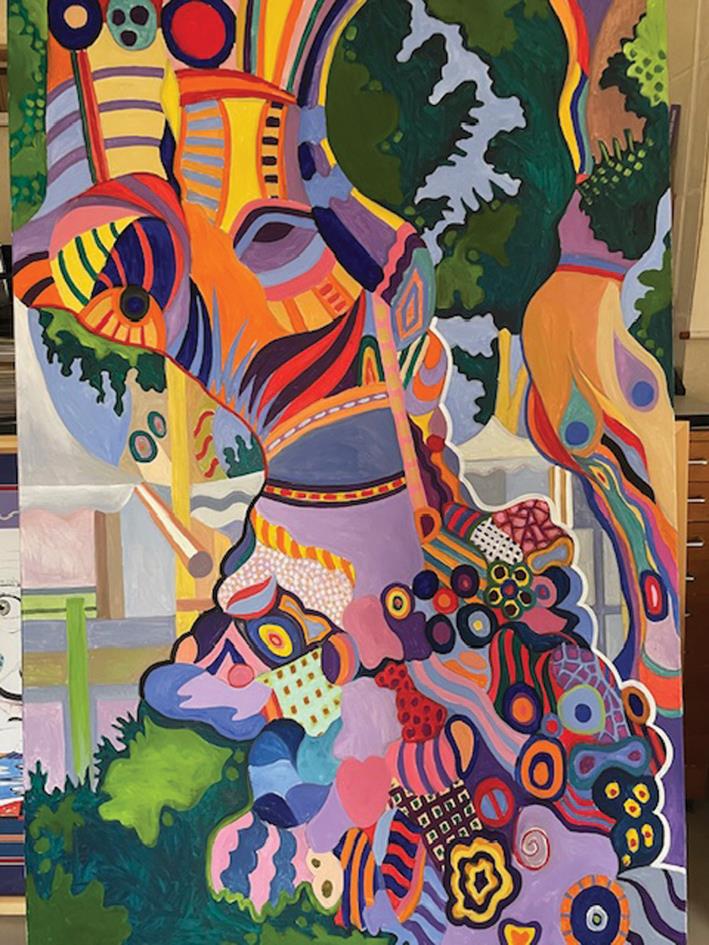
One day, his canvas erupts in kaleidoscopic colour, such as in Kaleidoscopic Tree (2025), where a natural form is transformed into an effervescent, patterned entity, pulsing with geometric rhythms and surrealist energy. Here Gurr embraces an expressionistic use of colour, guided not by imitation but by sensation, recalling the playful invention of Hockney or the choreographed collage of Peter Blake.
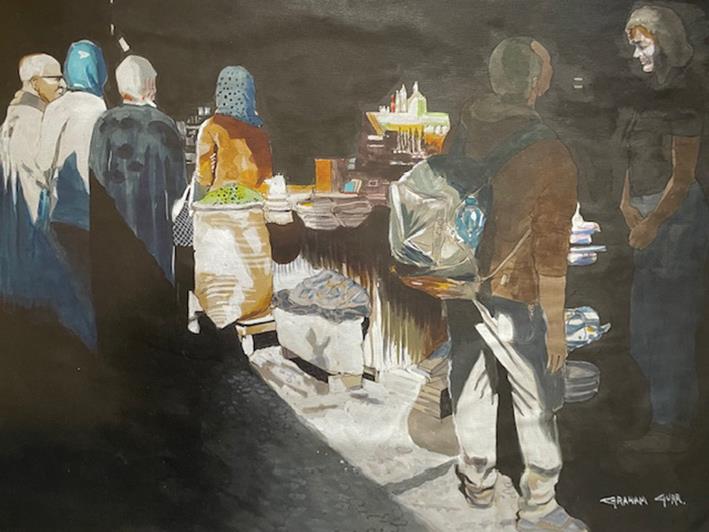
On another day, he turns to crisp observation and shadow, as in Souk in Morocco (2018), where a group of figures gather at a market stall illuminated against the darkness. The scene is both documentary and psychological, its realism tempered by mood and tonal drama.
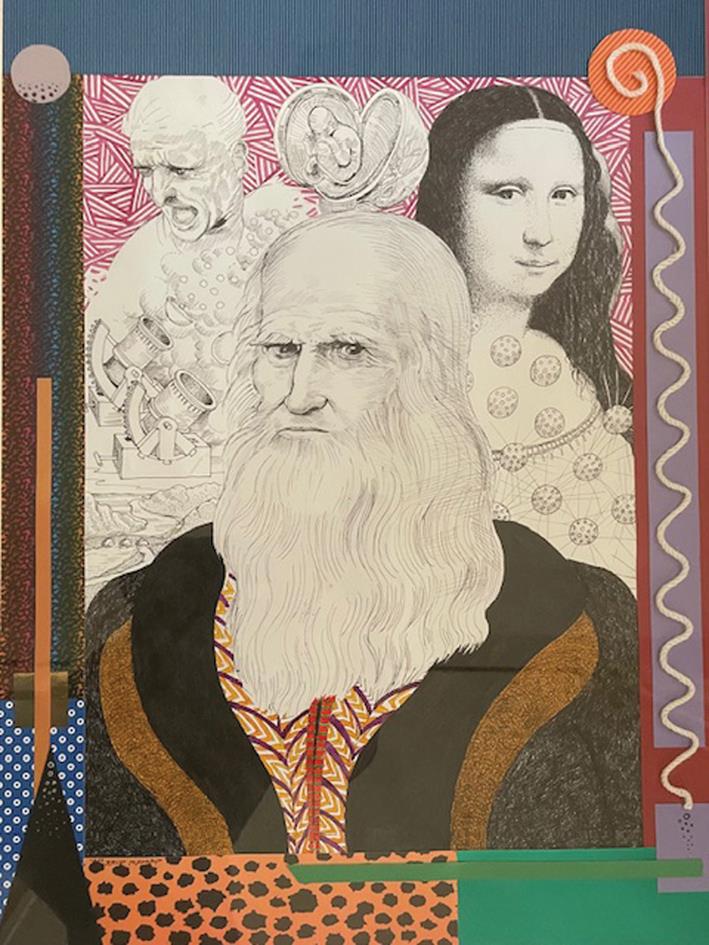
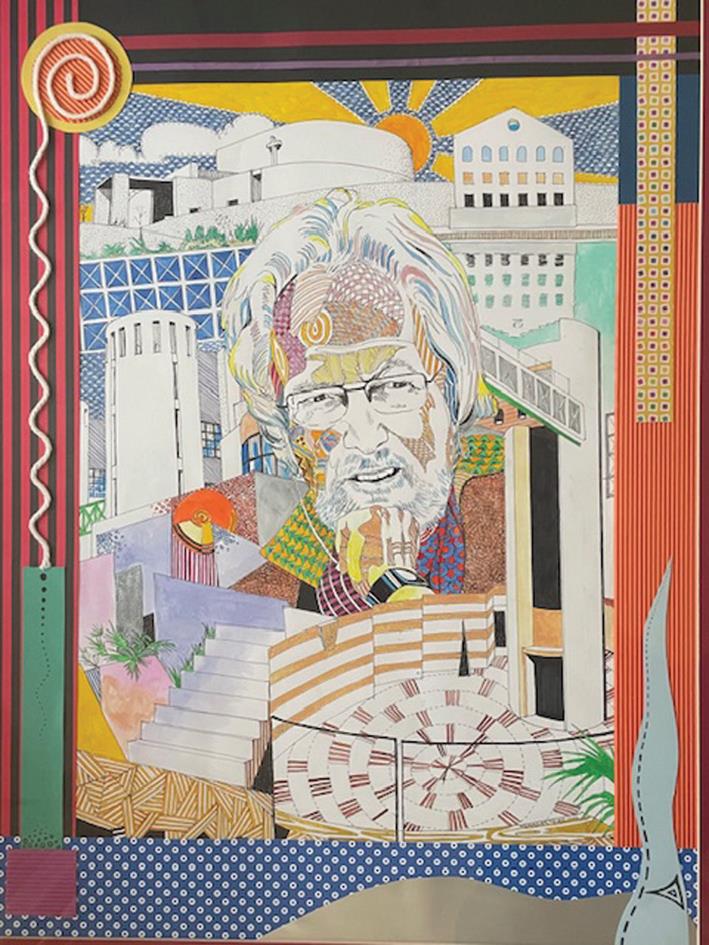
Then there are works such as Richard England (2025) and Dimensions of Leonardo da Vinci (2025) where portraiture, architecture, collage, and surrealism intertwine. The architectural elements evoke his early training, while the intricate patterning and symbolic motifs reveal his ongoing fascination with ideas, identity, form, politics, and memory are filtered through personal imagination.
Influences without imitation
Gurr acknowledges inspiration from several major 20th century artists like David Hockney, Frank Auerbach, Francis Bacon, R. B. Kitaj, Picasso, and Peter Blake but stresses that resemblance is accidental rather than intentional. His work's diversity reflects curiosity rather than mimicry; each phase is a new exploration rather than a stylistic allegiance.
In recent years, he has gravitated toward vibrant pattern, decorative abstraction, and surrealist juxtapositions. His sketchbooks, many of which brim with ideas from observation and memory, act as reservoirs of thought. These are the seeds from which his paintings grow. As he explains: "Fresh ideas and if possible, originality is important to me all the time. The world is not a fixed constant reality. Every day I have new or different experiences... so I tend to change my work according to what I experience day to day."
Colour, symbolism, and the human condition
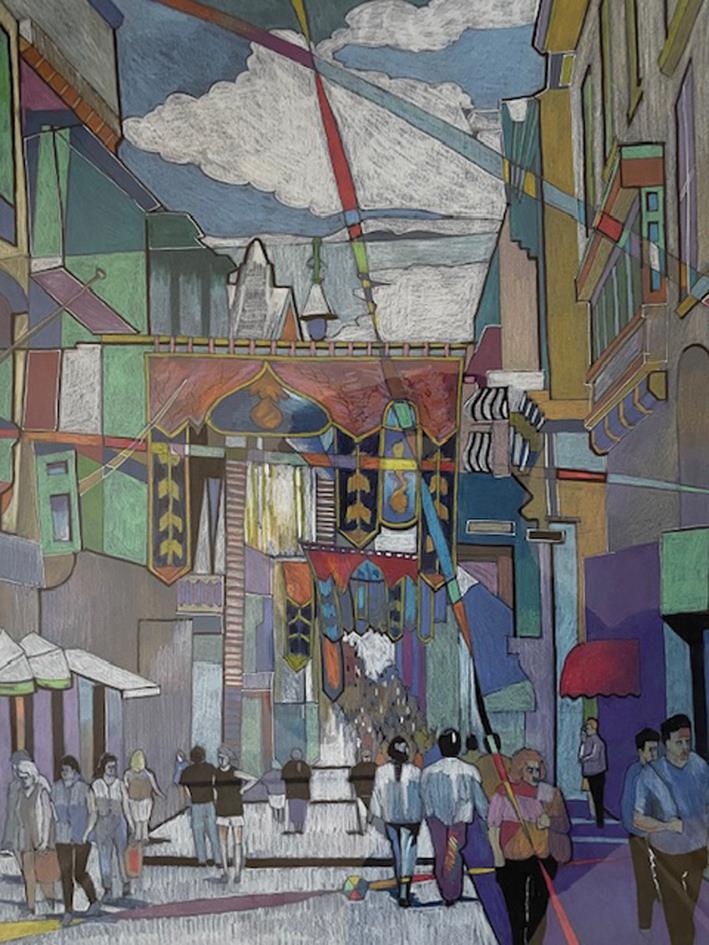
Across his oeuvre, colour operates not merely as aesthetic device but as emotional code. His use of colour is expressive, symbolic, intuitive, often responding to the world he sees rather than replicating it. Fantasy, architecture, and reality coexist; symbolism and worldly issues like love, identity, and politics surface in shifting configurations. Rather than a single signature style, Gurr's work offers a philosophy: that artistic practice must remain alive, responsive, and evolving.
A unique voice in Malta's art landscape
In a Maltese cultural scene, where many artists feel pressured to cultivate a recognisable "brand", Gurr stands apart. His refusal to be pigeon-holed is not indecision but artistic integrity, a belief in experimentation over repetition, imagination over marketability.
After more than 50 years of artistic activity, his work continues to surprise. From bold surrealist fantasies to quietly observed realities, from patterned abstraction to architectural studies, Gurr's art is the expression of a mind in motion, a restless imagination that has found a home in Gozo but refuses to stand still. The artist is presently engaged in preparations for a forthcoming solo exhibition to be held later this year.
Professor Louis Laganà PhD (Lough) is an academic, curator and practising artist