Gozitan sculptor Mario Agius (b. 1956) returns to public view with Journey, a new exhibition presented at the Grand Hotel, Mġarr, Gozo, from 31 January to 8 February. Working across a diverse range of materials, from indigenous olive wood and Gozo hardstone to Carrara marble and weathered limestone, Agius continues his sustained exploration of the human condition through sculptural forms that mediate between matter and meaning. His works resonate with both archaic instinct and contemporary sensibility, articulating a sculptural language grounded in touch, gravity, and human presence.
Agius' artistic formation is deeply rooted in both local and international traditions. He studied under the late Mons. Michelangelo Apap, trained in wood sculpture with Anton Agius, and later expanded his practice in the UK under sculptor Ian Norbury. His sculptures inhabit public spaces, ecclesiastical interiors, and private collections in Malta and abroad, and his participation in international exhibitions evidences a career committed to craftsmanship, material intelligence, and enduring form.
Primitivist sensibility and the voice of material
Much of Agius' oeuvre reflects what may be described as a primitivist sensibility and not in the reductive or appropriative sense historically associated with early modernism, but as a poetic engagement with elemental form, and the expressive autonomy of material. Like the modernist sculptors Constantin Brâncuși and Henry Moore, Agius recognises that sculpture can speak through reduction, through the essential rather than the descriptive. Yet where Brâncuși pursued metaphysical purity and Moore explored mass, void, and landscape analogy, Agius allows the material itself the grain, fracture, and erosion to actively participate in meaning-making.
Olive wood, limestone, and hardstone are not neutral carriers of form; they retain memory, resistance, and temporality. Chisel marks remain visible, surfaces are often deliberately unrefined, and volumes feel wrested rather than imposed. In this respect, Agius aligns with a lineage of sculptors for whom process and tactility are part of the expression. His works invite a haptic mode of viewing, where the eye follows the logic of the hand and the resistance of the medium.
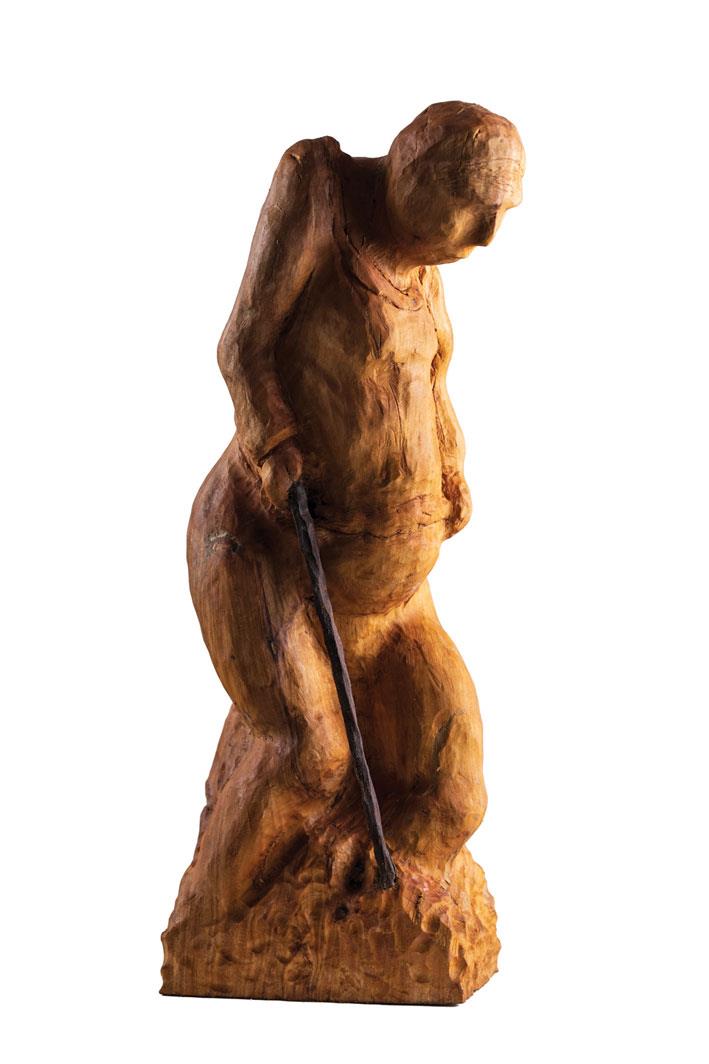
Carrying time: The body as accumulated duration
In Carrying Time, executed in olive wood, the human figure appears burdened yet resolute, leaning forward with the aid of a staff. The body is thickened, weighted, and inwardly compressed, suggesting not merely physical age but the psychic accumulation of lived experience. Time here is not abstract; it is embodied, borne within the flesh. The downward tilt of the head and the compacted torso evoke endurance rather than defeat, recalling existential sculptural figures by Giacometti, yet rendered with a warmer, more organic density.
Stylistically, Carrying Time exemplifies Agius' ability to fuse figuration with near-archaic solidity. The figure seems to emerge from the wood itself, as though time has been carved out rather than imposed upon the form. The work resonates strongly with Mediterranean notions of labour, ageing, and continuity, where the body becomes a site of memory and resilience.
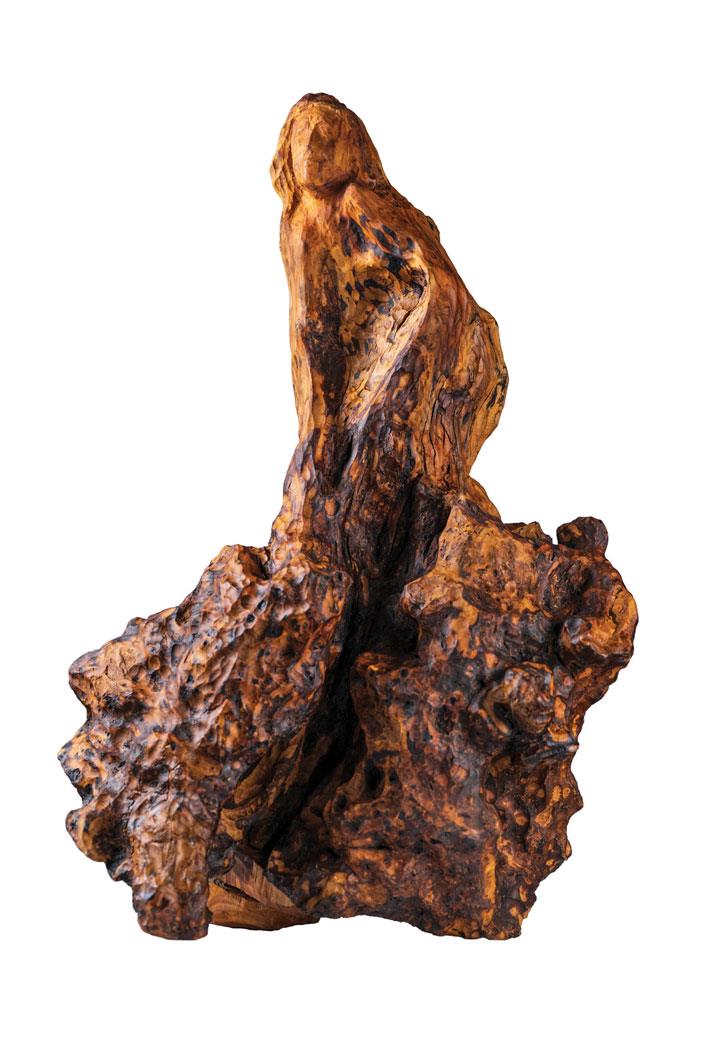
Calypso: Myth, landscape, and feminine presence
Calypso made in olive-wood, introduces a mythic dimension that is deeply inflected by Gozo's cultural and geographical imagination. The work can be read as a sculptural meditation on the legendary figure of Calypso, associated with the cave in Gozo traditionally identified with Homer's Odyssey. Rather than illustrating the myth narratively, Agius distils Calypso into an elemental presence, a solitary, elongated form that appears both human and geological. The figure rises from a rugged, cave-like mass, its surface darkened and pitted, evoking erosion, enclosure, and duration. This formal integration of figure and base is crucial: Calypso is not merely in the cave; she is of it. The feminine body becomes part of the landscape, memory, and waiting. There is a quiet tension between concealment and revelation, between shelter and entrapment, mirroring Calypso's dual role as both nurturer and captor. Stylistically, this work shares with Carrying Time and other solitary figures in this exhibition, a concern for vertical compression and inwardness, yet here the emphasis shifts from temporal endurance to mythic stillness. The work exemplifies Agius' ability to translate local myth into universal archetype without illustrative excess.
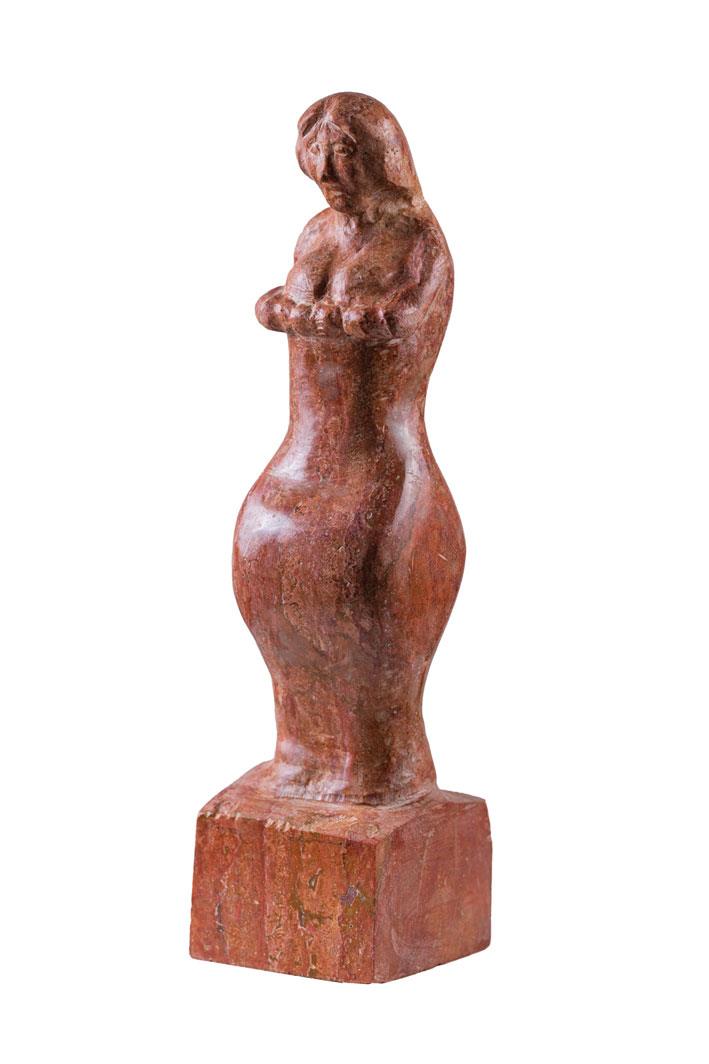
The Quiet Gaze: Interiorised femininity and stillness
Agius also excels in marble-carving and in this exhibition, an interesting piece called The Quiet Gaze stands out from other works done in this collection. The female figure is reduced to a calm, self-contained presence depicted with arms folded inward. The body also forms a continuous, gently swelling volume that recalls prehistoric fertility figures while avoiding overt symbolism. The gaze is not outward-facing but inwardly directed, suggesting contemplation and emotional self-possession.
Unlike the rougher surfaces of Carrying Time and Calypso, the polished marble here introduces a sense of stillness and refinement. Yet the formal logic remains consistent reduction, solidity, and the prioritisation of inner life over anatomical detail. The figure functions less as an individual than as an archetype of feminine interiority, echoing both ancient goddess forms and modernist sculptural restraint.
Stylistic affinities and thematic continuities
In this unique personal art exhibition, Agius demonstrates a clear stylistic and conceptual affinities with the primitivists. In most works we notice privilege compact volumes, downward or inward orientation, and a refusal of anecdotal detail. Figures are not posed but settled, as though shaped by time, memory, and gravity rather than by narrative action. There is a consistent tension between emergence and containment: bodies appear to rise from their material origins while remaining inseparable from them.
These works also share a profound engagement with archetype: the aged bearer of time, the mythic feminine bound to landscape, and the sacred female presence. Through such figures, Agius appears to be searching for a renewed sense of spirituality; one that he perceives as largely absent from contemporary life. This impulse may be understood as a modern primitivist appeal to the spirit, a position likewise present in strands of modernist art that sought to re-engage with religious or metaphysical experience as a source of inner, or "spiritual", well-being. Agius' sculpture thus operates at the intersection of the personal, the cultural, and the universal, transforming local materials and myths into resonant human forms.
A Gozo-inflected vision
Agius' sculptural language is intimate from Gozo itself, its stone, its myths, its rhythms of labour and solitude. From public commissions such as Il-Komunità to intimate gallery works, his sculptures articulate a vision of humanity that is grounded, reflective, and quietly monumental. They invite viewers not only to look, but to linger, to sense the slow dialogue between hand, material, and meaning.
Journey is thus more than an exhibition title: it is a metaphor for Agius' ongoing sculptural enquiry, a journey from earth to essence, from raw matter to human presence. In an age of acceleration and spectacle, his work offers something increasingly rare: solidity, silence, and depth.
Prof. Louis Laganà PhD (Lough) is an academic, curator and practising artist