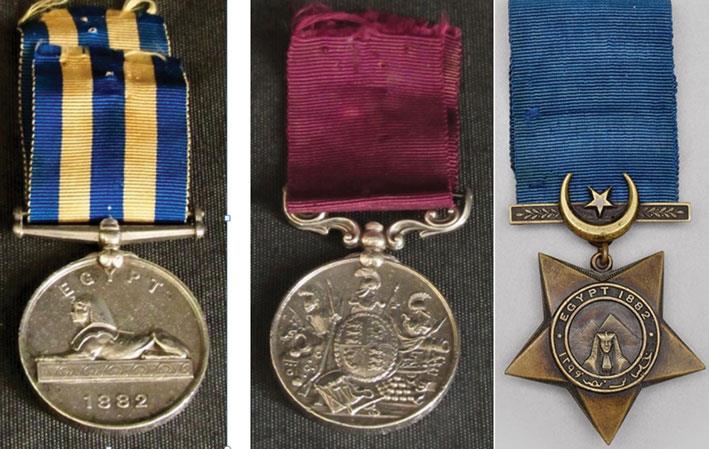
While exploring ex-voto offerings in the Oratory of Saint Joseph in Rabat, three medals stood out from a cluster of Second World War decorations: the Egypt Campaign Medal, the Khedive's Medal, and the Long Service and Good Conduct Medal. They belonged to Corporal Aloisio Dimitri, a Maltese artilleryman who survived the perils of imperial warfare and offered his gratitude to his patron saint. Alone, these three medals tell a story of duty, danger, and empire, linking riotous Alexandria to disciplined barracks far from Malta.
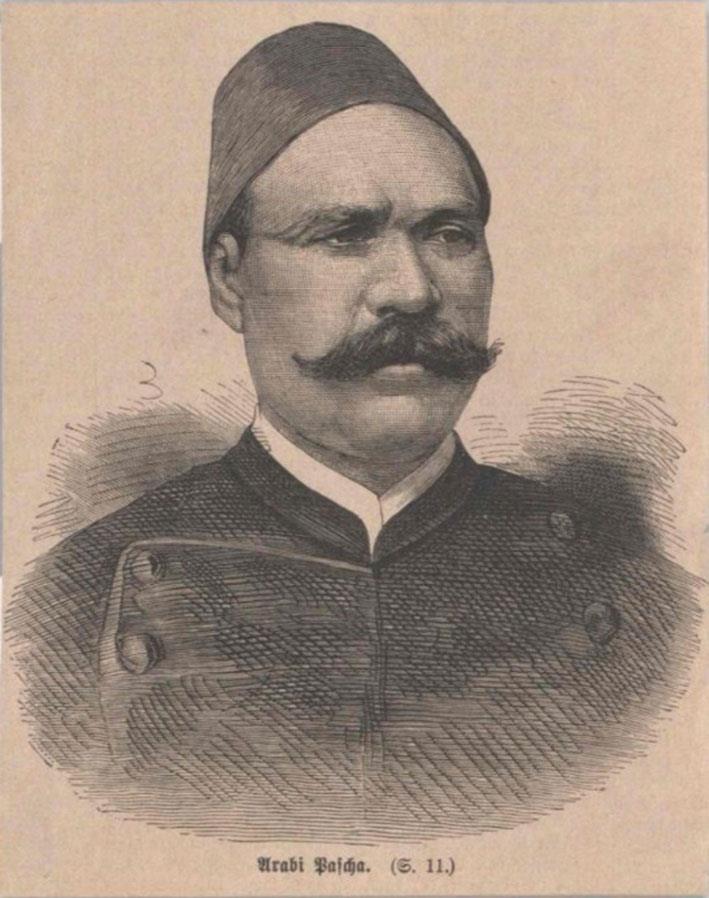
In the summer of 1882, Egypt teetered on the edge of chaos, rife with anti-Western sentiment. The bankrupt Khedival government struggled to contain the nationalist, proto-Islamic fervour of Colonel Ahmed 'Arabi, a peasant officer and antecedent of future Egyptian nationalism. Tensions flared into riots after the stabbing of a Maltese man, drawing artisans, labourers, and shopkeepers into the unrest - both as victims and as participants.
Amid the turmoil, 100 men of the Royal Malta Fencible Artillery joined Wolseley's conquest of Egypt. They were part of Britain's well-oiled war machine, operating away from the open battlefield yet performing vital roles, guarding the rear, stabilising towns, and ensuring the campaign progressed smoothly. From civilian upheaval to disciplined military service, Dimitri's medals remain a tangible emblem of Malta's dual experience, glorious, perilous, and profoundly human etched into the annals of imperial history.
Maltese knife sparks Alexandria riot
The riots were ignited when a Maltese clerk, employed by the British authorities, became embroiled in a quarrel near the Rue des Soeurs in Alexandria's European Quarter on 11 June 1882. The dispute began, according to the most consistent reports, over a contested carriage fare, during which the Maltese was allegedly shoved or mocked by local bystanders. Some witnesses claimed that religious insults were exchanged, while others offered variant accounts including that he seized a knife from a café counter. What remains firmly attested is that he stabbed Ahmed al-Ajjan, an Arab local. Al-Ajjan's fall drew an inflamed crowd from the surrounding streets, and in the dense, volatile quarter rumour spread instantly, igniting the riot that soon engulfed Alexandria.
Outrage erupted through the streets with terrifying speed. Egyptians poured into the European quarter as residents barricaded themselves indoors. The skirmish spiralled into a savage riot. A Greek baker and an Italian policeman tried to intervene - one was killed, the other wounded. Gunshots rang from European-owned windows as mobs armed with sticks, knives, and crude weapons swept through the alleys.
Maltese caught in the chaos were beaten, stabbed, or trapped in shuttered shops and homes. By nightfall, the carnage left around 50 Europeans and between 125 and 250 Egyptians dead, though exact numbers remain uncertain - a grisly prelude to the empire's heavier hand.
Reactions from European observers were swift and often harsh. Newspapers such as The Times, the Pall Mall Gazette and the Standard characterised the Egyptian crowd as "ignorant", "fanatical" or "anti-Christian", language that reflected both contemporary anxieties and colonial prejudice. Some commentators extended this criticism toward elements of the Maltese community as well. An American economist and traveller, writing in the same period, described Maltese and Ionian wanderers of the eastern Mediterranean as "the worst set of ruffians", claiming they bullied and defrauded others under British protection.
Such sweeping disdain must be contextualised: the Maltese community was far from monolithic. While some Maltese labourers had gained an unruly reputation in café districts and dockside brawls, the majority lived ordinary, working lives as masons, clerks, craftsmen and sailors. They were participants in a wider economic struggle, not caricatures of foreign anger.
As the scale of the riot became clear, accusations circulated about who had triggered the unrest. M. E. Chamberlain, the historian, later suggested that the Khedive himself may have allowed or even encouraged the early disturbances, hoping they would force France or Britain to intervene militarily and thereby crush Arabi's rising nationalist movement. Whether or not this interpretation is entirely correct, it illustrates how intensely politicised the riot became. Yet despite later claims, the riot did not cause the British invasion of Egypt. Intervention had already been set in motion by disputes over fortifications, threats to the Suez Canal, and the British government's desire to protect imperial interests. The riot merely accelerated the inevitable.
Sea power and stone: Alexandria's fall
In the weeks following the riot, British warships, including some of the most powerful Royal Navy ironclads, anchored off Alexandria. They faced Egyptian coastal batteries entrenched in 15th century fortifications, whose heavy guns were numerous but poorly maintained, slow to load, and limited in traverse and elevation. Admiral Sir Beauchamp Seymour demanded their dismantling; when negotiations failed, he ordered the bombardment. At dawn on 11 July 1882, Rifled Muzzle-Loading (RML) shells from HMS Inflexible and HMS Alexandra thundered against the city. Despite determined Egyptian fire, the outdated batteries were silenced and fires swept Alexandria.
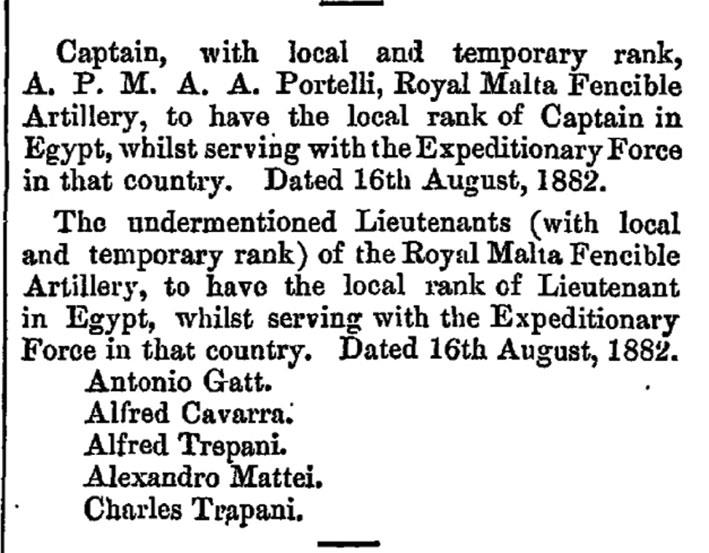
As the cannons fell silent and a tense ceasefire held the harbour, Arabi and his forces retreated inland, preparing their final stand near Cairo. Meanwhile, Britain's expedition disembarked onto Egyptian soil, landing troops, artillery, and support detachments including a disciplined contingent of 100 Maltese artillerymen, four officers, a surgeon and a Reverend, alongside Maltese muleteers from the Malta Auxiliary Transport, ferrying ordnance and supplies across the battlefield ready to consolidate positions, secure harbours, and assist advancing columns toward the Nile.
Holding the Delta Line
The Royal Malta Fencible Artillery traced its lineage to 1802, raised to defend Malta after the French expulsion. Evolving through decades of coastal defence, garrison duties, and internal security, it was reorganised as an artillery corps in 1861, earning a reputation for discipline, steadiness, and skill under Mediterranean conditions. This small but professional detachment joined Britain's Egyptian campaign, serving as vital artillerymen and embodying Malta's enduring military tradition.
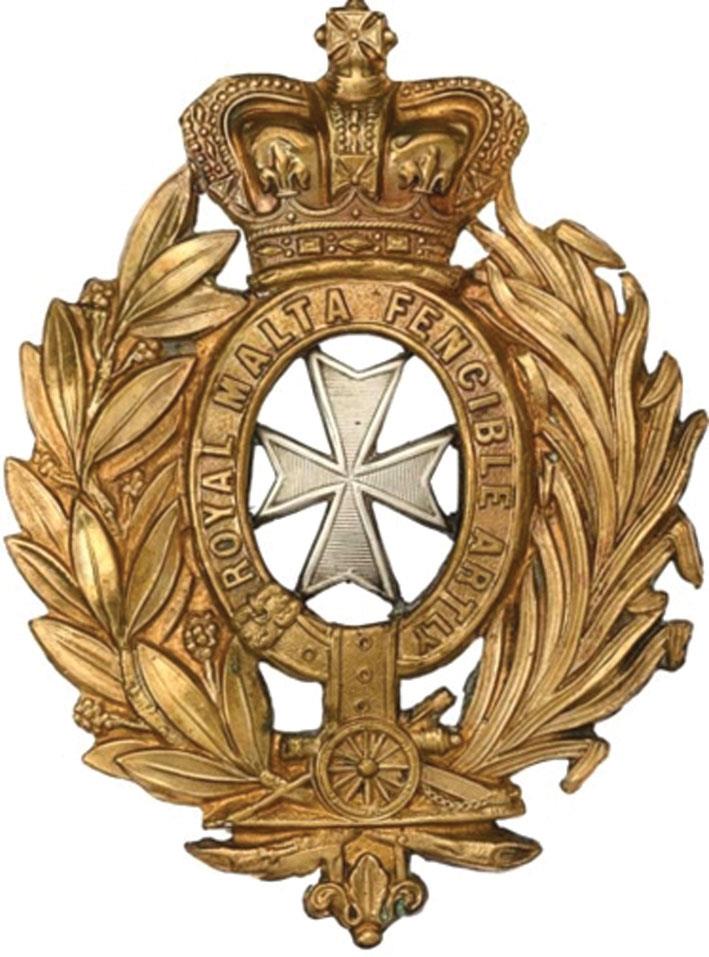
Throughout the 1882 Egyptian Campaign, the Royal Malta Fencible Artillery (RMFA) formed a reliable backbone of Britain's expeditionary force, performing essential but often unheralded duties that ensured operational success. Following the bombardment of Alexandria, a small detachment of 100 men was deployed from the Coastal Brigades to support Wolseley's manoeuvre strategy. While Sir Evelyn's forces consolidated ports, coastal batteries, and strategic positions, he simultaneously threatened Abd-el-Al on land and blockaded the Damietta seafront, applying pressure to outflank 'Urabist dissidents.
At Fort Mex, overlooking Lake Mariyyut on Alexandria's western approaches, the RMFA assumed vital rear-area responsibilities during the opening phase of the campaign. On 26-27 August 1882, the Maltese gunners manned heavy ordnance, patrolled the narrow causeways, and kept constant watch on Bedouin irregular cavalry and Egyptian infantry testing the defences. Their steady vigilance and timely reports enabled British troops, including Major De Salis' detachment of the 2/95th Sherwood Foresters, to advance and meet the enemy in sharp bayonet encounters, inflicting several casualties. In early September, the Fencibles were redeployed along the Ramleh Line, where on the nights of 5-6 September they repeatedly thwarted Bedouin attempts to spike the seven-inch guns. By holding these exposed batteries and denying sabotage, the regiment secured Alexandria's outer artillery defences and ensured the safety of the rear while Wolseley's main force pressed inland toward its decisive objective.
Redeployed to Damietta and Rosetta, the Fencibles undertook the unglamorous but essential work of empire policing harbours, guarding ammunition stores, and overseeing disarmed elements to maintain stability across the Delta. Later redeployed to Cairo, as part of the occupation force, their steady presence helped secure the rear and flanks of the British advance, allowing Wolseley to draw 'Arabi's army far from the capital and crush it at Tel el-Kebir. These quiet but resolute duties proved indispensable to victory and to the consolidation of British control in Egypt.
13 September, Tel el-Kebir
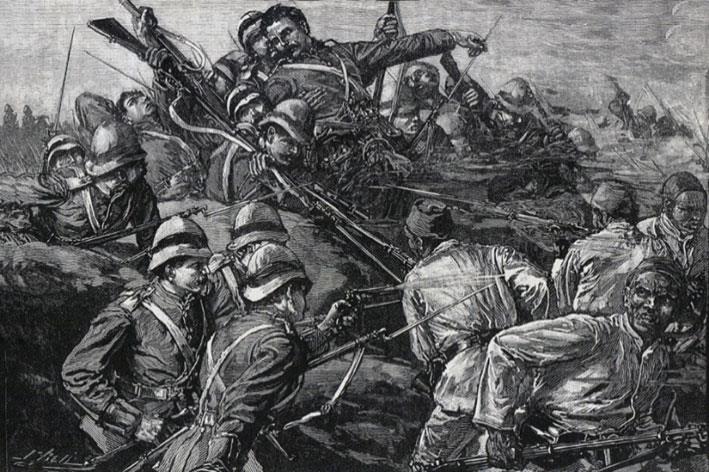
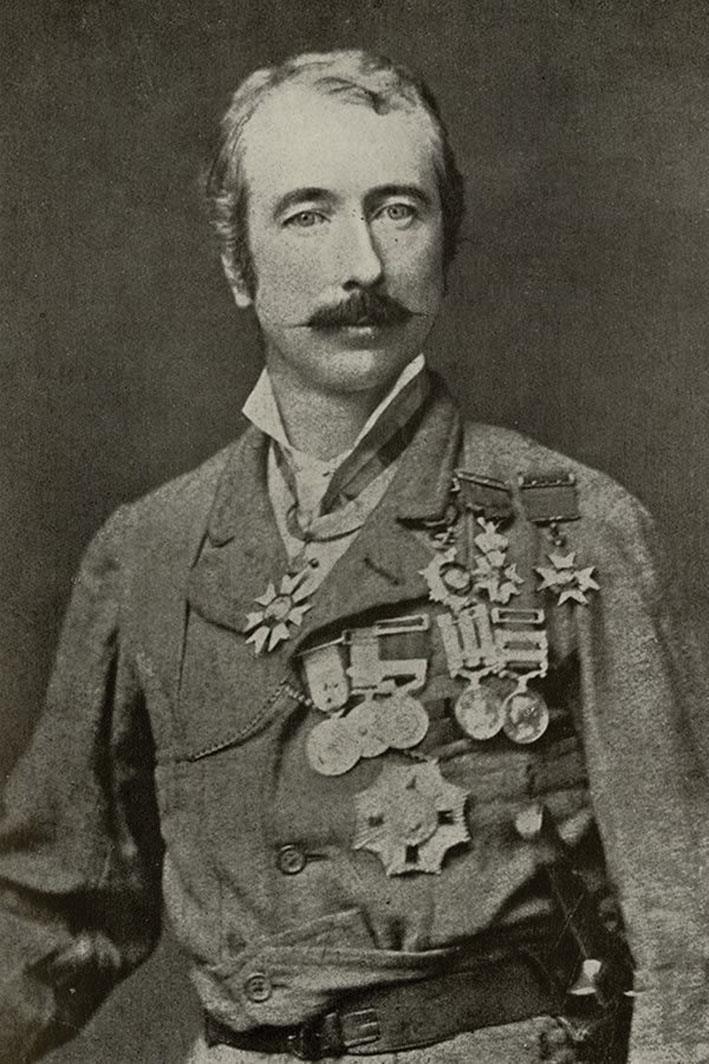
Tel el-Kebir marked the culmination of the Anglo-Egyptian campaign. Sir Garnet Wolseley led British and imperial troops, including Highland regiments such as the Black Watch and Gordon Highlanders, as well as Indian cavalry and other British regiments, in a daring night march across several miles of desert. Maintaining silence and strict discipline, the troops advanced in extended line under the stars, bayonets fixed, until they reached the Egyptian trenches in the half-light before dawn. The resonance of bagpipes, bugles, and the steady march of disciplined soldiers added an almost ceremonial weight to the assault, which contemporary writers described as the "tunes of glory".
Egyptian defenders, expecting a daylight attack, were caught off guard. Many forward parapets were unmanned. Fierce close quarters combat erupted, and the Egyptian lines broke, clearing the way to Cairo.
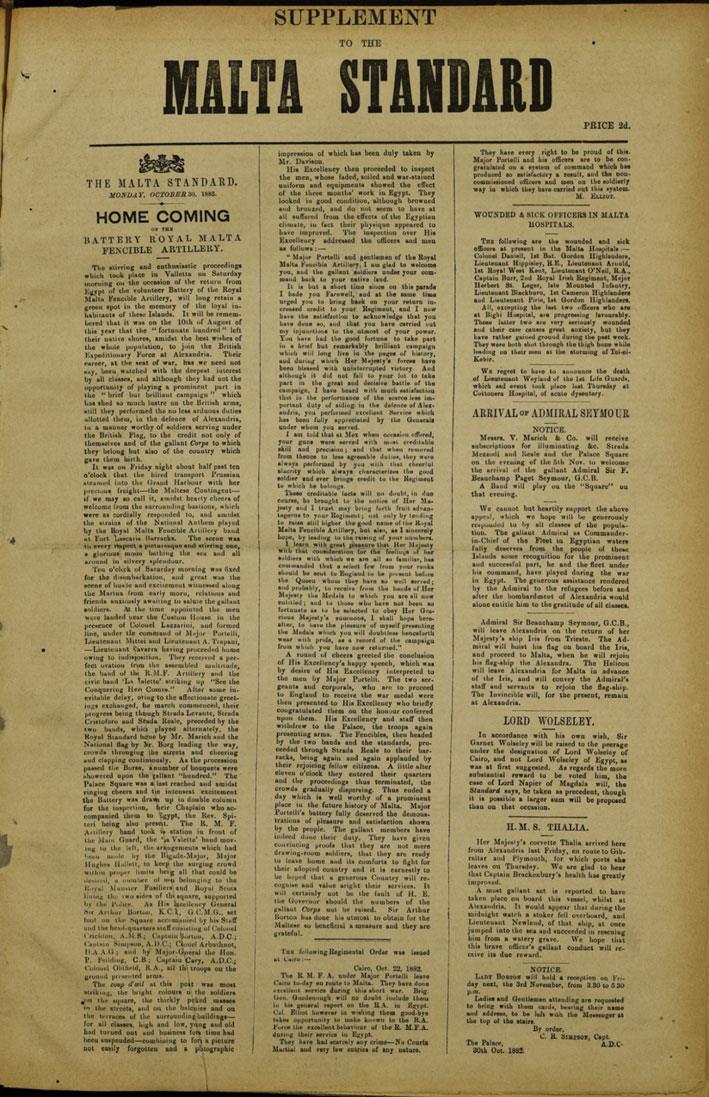
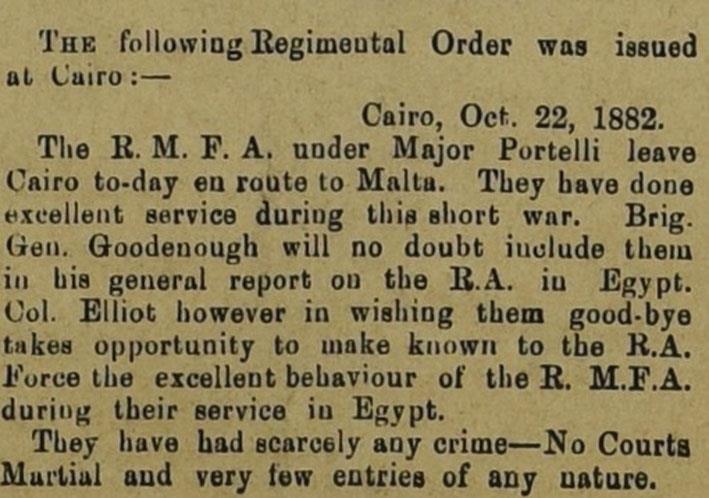
"The gallant members have indeed done their duty. They have given convincing proof that they are not mere drawing-room soldiers; they are ready to leave home, and fight for their adopted country."
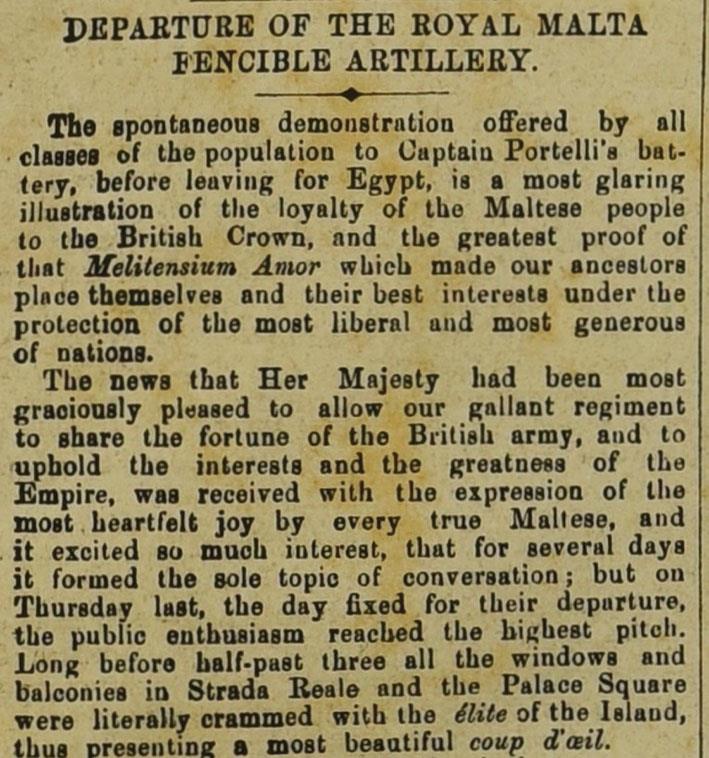
Following the stabilisation of Egypt, the Royal Malta Fencible Artillery detachment embarked aboard SS Prussian, entering Valletta Harbour on 30 October 1882. On 31 October, the men disembarked and marched along Strada Reale beneath the bastions, greeted by great ovations from the crowded streets. The RMFA band, joined by the civic band of La Valette, played See the Conquering Hero Comes, before an inspection by His Excellency Sir Arthur Borton. Weathered by service and bearing the marks of campaign life, the men stood in faded, war-stained uniforms yet without a single casualty and in high morale.
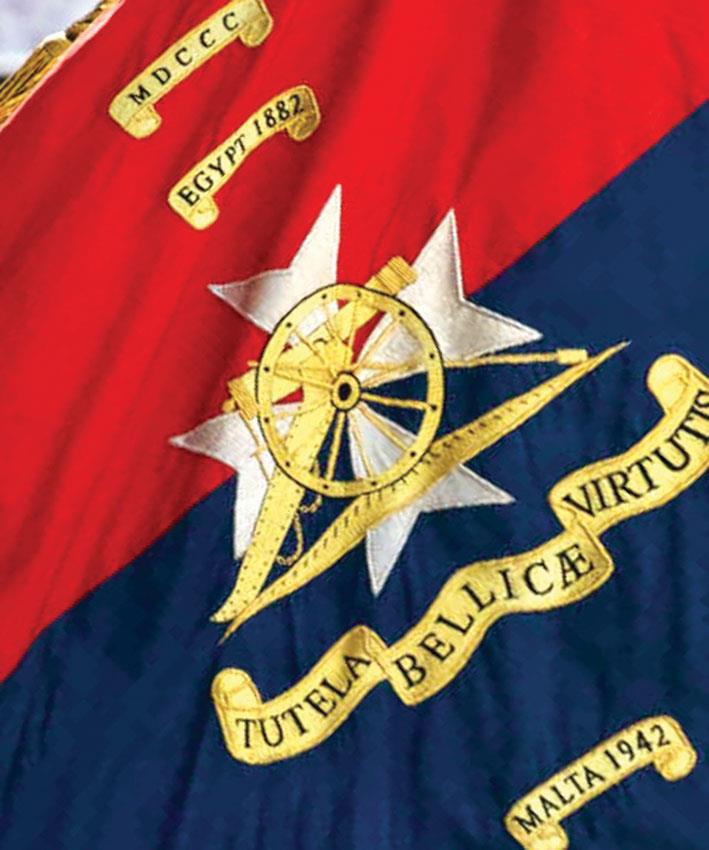
Their service endures on the colours of today's Armed Forces of Malta, inscribed Egypt 1882. From the riots of Alexandria in June to disciplined duty along the Nile, the Maltese artillerymen had briefly exchanged routine garrison life for the fog of war. They returned not as conquerors, but as steady soldiers of the empire, their loyalty and endurance quietly woven into history - a testament to the reach and resolve of a small island's martial history.