For the month of February, we will be showcasing the works of an artist whose practice I have always found intriguing and enigmatic, and with whom I finally have the opportunity to collaborate. I am referring to Gozitan artist David Debono, who will be presenting his solo exhibition titled Echoes of What Never Was.
As I often do, I'll begin with a brief background check. Debono studied under the mentorship of world-class artists Vincent Desiderio, Steve Huston, Bernardo Siciliano, among others. His preferred media are charcoal and oil paint. He prepares the surfaces himself, allowing him to achieve the specific textures and effects that characterise his distinctive style. I first encountered Debono's work at his solo exhibition Unspoken Bonds, held at Art Space, Ta' Qali, and was immediately intrigued.
His inspiration stems from the simplicity of everyday life, particularly that of his homeland, which he transforms into poetic and, at times, symbolic compositions. This is especially evident in this body of work, where Debono explores the phenomenon of false memories, also known as confabulations, a subject first examined by Pierre Janet and later expanded upon by Sigmund Freud. These are recollections that feel vividly real yet are partially or entirely fabricated by the mind. Often referred to as memory errors, such fabricated, distorted, or misinterpreted memories are created about oneself or the world, without any intent to deceive.
Rather than presenting memory as deception, Debono approaches it as a fragile and shifting terrain shaped by emotion, time, and imagination. Many of the works are inspired by the artist's own memories, at times tinged with confabulation, where certain details are real while others are imagined or altered.
The works take the viewer on a journey, perhaps real, perhaps not, but undoubtedly captivating, where the narrative remains ambiguous and elusive. This ambiguity draws the viewer in, making it difficult to look away before attempting to decipher what lies beneath the surface of what first meets the eye.
The palette in some of the works triggered a sense of déjà vu for me. I soon realised that this feeling led me to the film Interstellar. I find it interesting how my mind associates these paintings with certain scenes from the movie, particularly the dusty environments that generate hazy, almost disorienting visions. This is evident in the soft, undefined execution of some of the works, as well as in the grain-coloured fields surrounding a solitary, desolate house in the middle of nowhere. The association also stems from the film's exploration of time and its non-linear narrative, concepts that closely resonate with those explored in this exhibition.
You might agree when I begin with the painting Silver and Gold. It depicts a scene, but a scene of what, exactly? The composition is divided into two sections: a lower band of yellow ochre, reminiscent of hazy golden fields, set beneath an indecipherable, mist-laden sky. The image is subtly harmonious and quietly captivating, even though there is nothing specific within it that demands our attention.
The predominantly ochre-based palette imbues these compositions with a nostalgic quality, as though the scenes belong to a distant, half-remembered past.
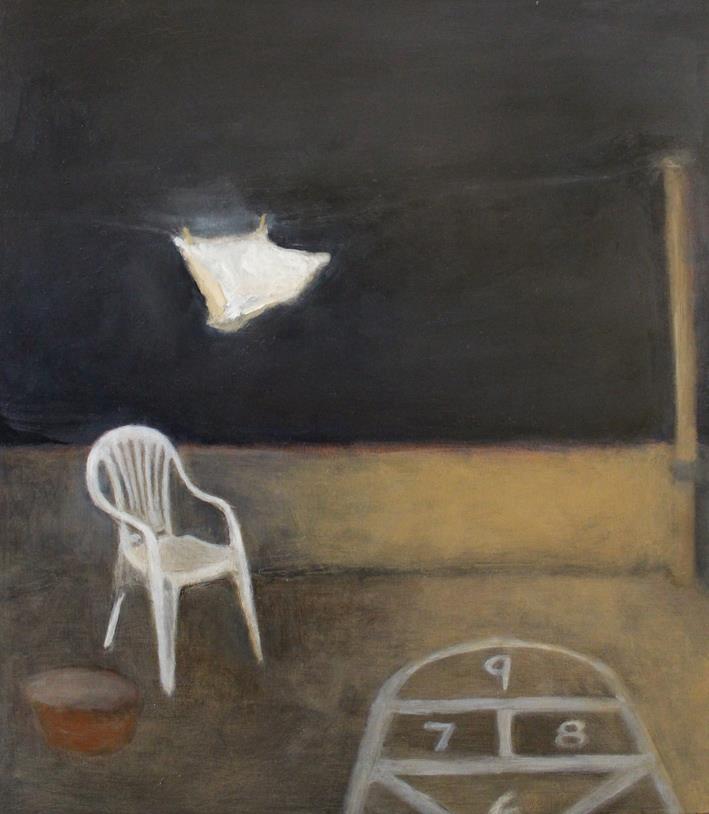
In No War Not Here No More, we are presented with a scene in the middle of nowhere, devoid of any clear context. A white plastic, classical outdoor chair sits beside part of a hopscotch grid marked on the ground, surrounded by stark darkness. A bright white cloth pegged to a washing line cuts through the stillness, its movement suggesting a sudden gust of wind. The brightness of both the cloth and the chair feels eerie, particularly as there is no evident source of light within the composition.
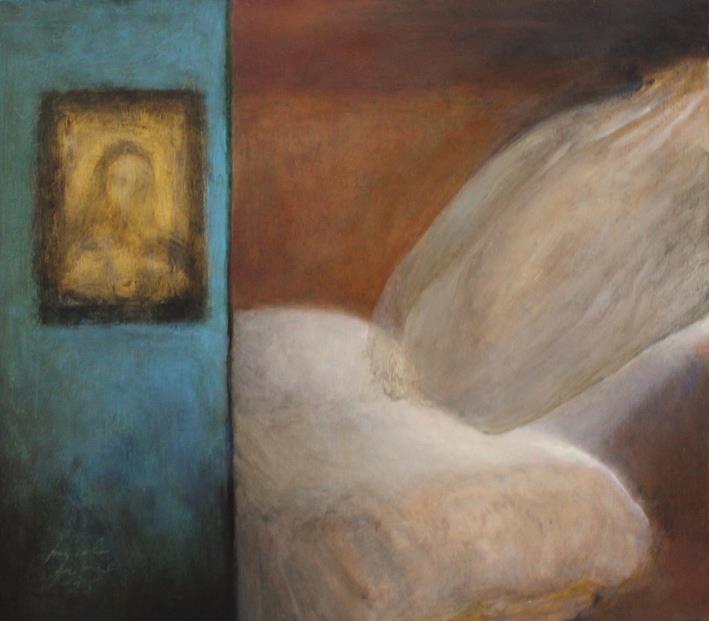
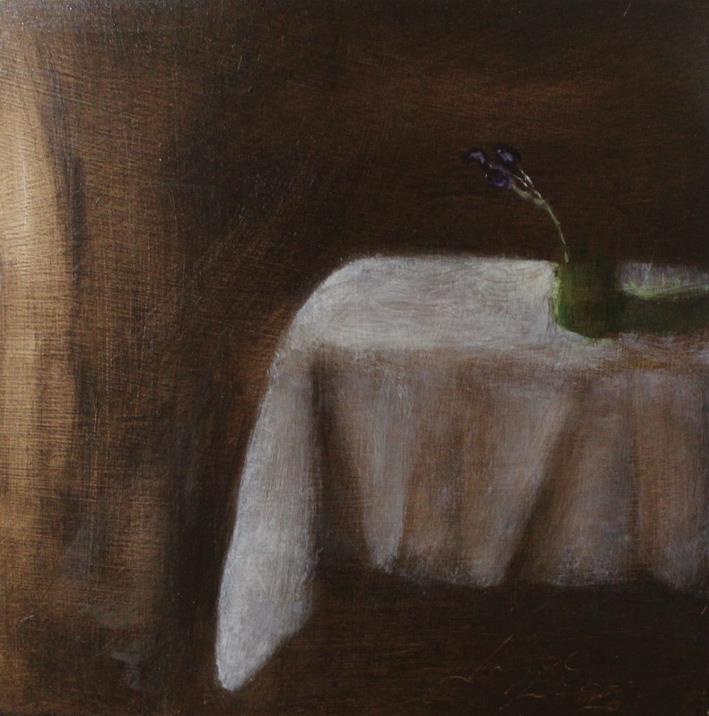
Drapery caught in gentle currents of air recurs throughout many of the works, acting as a quiet metaphor for the passage of time and moments of stillness, introspection, and unspoken thought. A clear example is Cor Iesu, which depicts a billowing curtain stretching almost across the entire length of an empty bed, under the watchful presence of a painting of the Sacred Heart of Jesus.
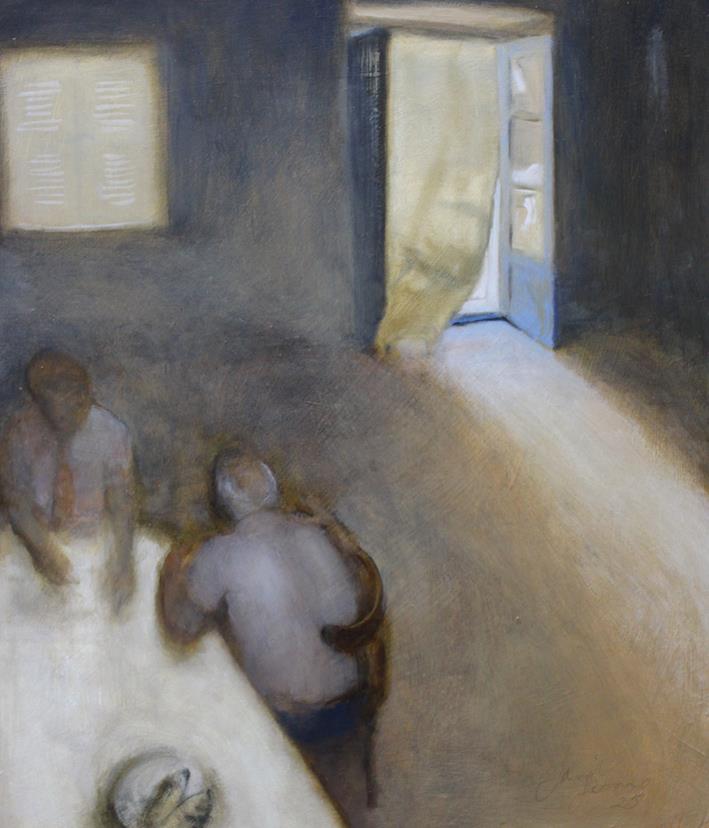
A similar sense of nostalgia permeates Two Fishes, an interior scene in which two hazy silhouettes, possibly two men, appear engaged in conversation. A wide-open, two-panelled door allows a translucent white curtain to be softly caressed by a breeze, evoking the atmosphere of a bygone era.
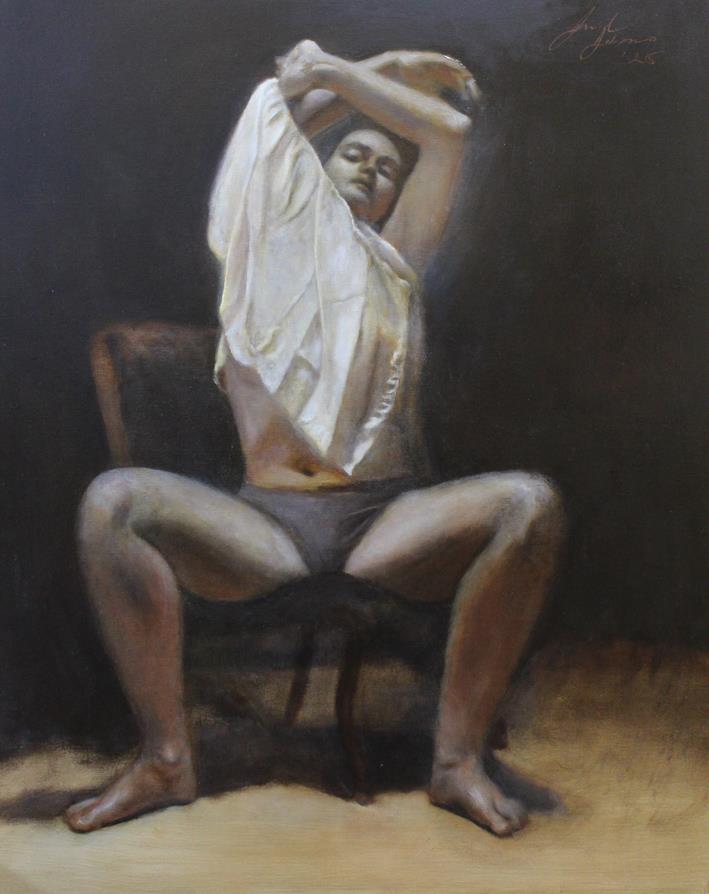
Domestic interiors, familiar rooms, chairs, curtains, and everyday gestures such as undressing and sleeping, ground the works in the ordinary. The largest work in the exhibition, Intermission, presents a seated figure in the act of removing her vest. She is left in her underwear, legs spread wide, in what feels like a melancholic striptease, one devoid of seduction, while staring directly back at the viewer. The confrontation is unsettling, intimate, and deliberately uncomfortable.
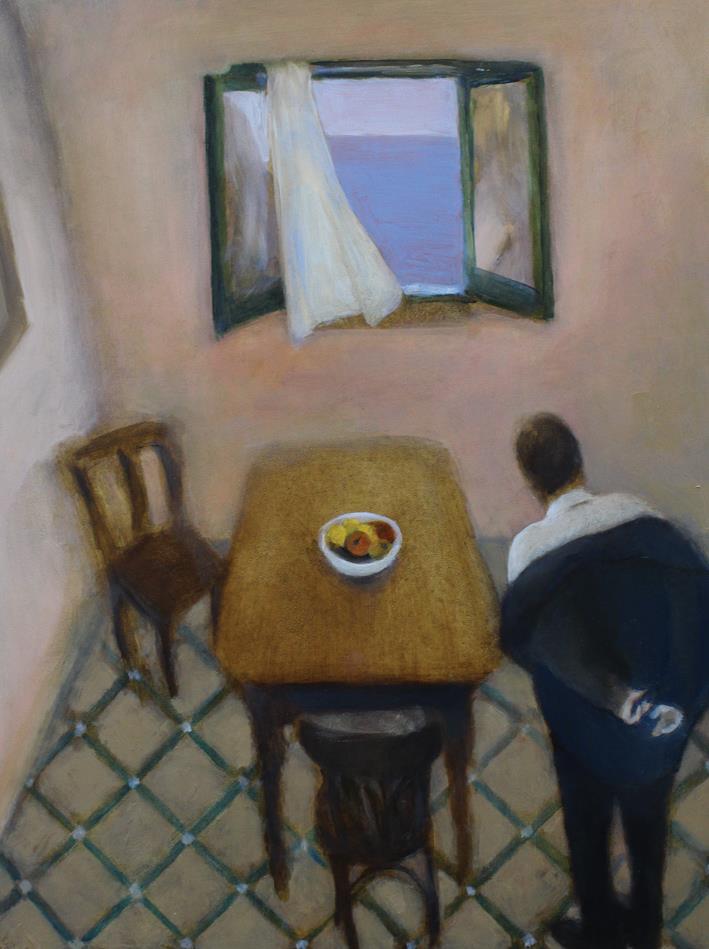
More raw domestic scenes can be observed in The Kitchenette and Last Autumn. In At the Other End of the Horizon, the viewer is placed within a room rendered in a strange, distorted perspective, as though seen through a door's peephole. A man is captured mid-action, unknowingly removing his jacket, unaware of being watched.
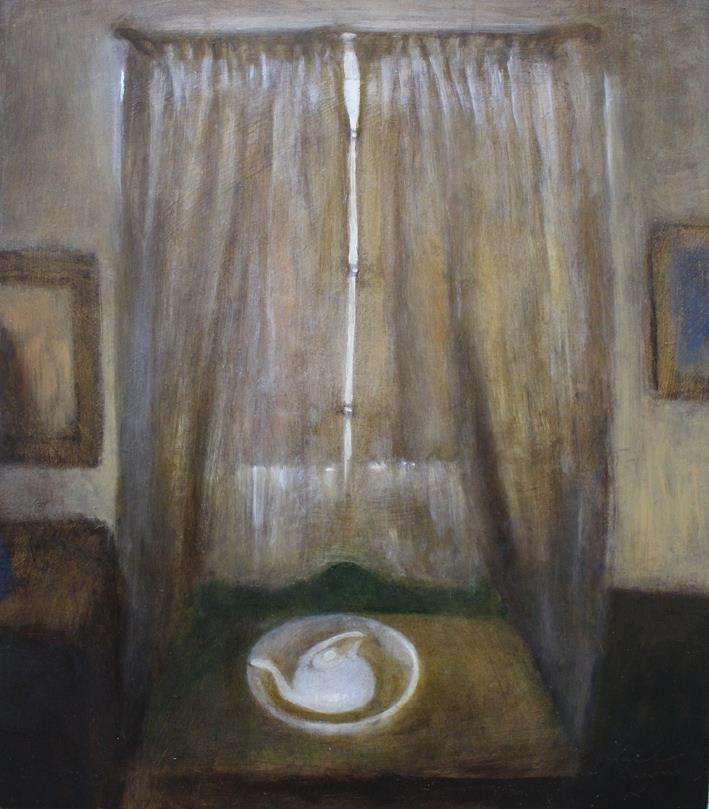
In The Vessel, we encounter a more restrained composition, perhaps restrained in its surrealism. The scene is imbued with a still-life quietness. The curtains remain motionless, the composition is very symmetrical, and at its centre sits a vintage water jug, which one might presume to be the titular "vessel."
In the hero image of the exhibition, Angelus, an elderly figure, sits on a rooftop, surrounded by clothes hanging out to dry, perched on the iconic white plastic chair. The moment feels suspended in time. Perhaps captured at 6 a.m., or just as likely at 6 p.m.; your guess is as good as mine.
The interior scene in Iris is so still, so almost spiritual, perhaps even monastic, that one feels compelled to refrain from breathing in its presence. It is painfully beautiful, if you understand what I mean.
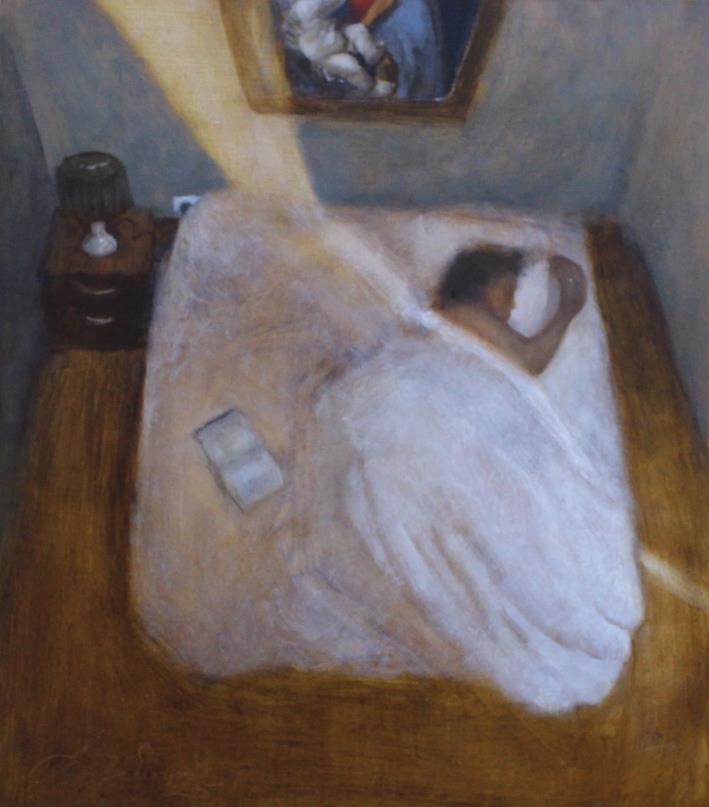
The Goldfinch Is Gone is the title of a work depicting a bird's-eye view of a bedroom, where a figure sleeps peacefully, partially illuminated by a slice of ochre light cutting in from an unseen aperture. But why this title? The painting partially visible above the bed appears to reference a Renaissance image. It is not Raphael's Madonna of the Goldfinch, or could it be Tiepolo's version? Or perhaps the open book resting on the bedsheet is The Goldfinch by Donna Tartt. Or maybe the reference exists only within the dream of the sleeping figure.
(The answer, as I later discovered after asking David, is that the painting is Leonardo's Madonna Litta, without the goldfinch.)
The titles chosen by Debono are my favourite kind: even more enigmatic than the paintings themselves. Just when you think you may have deciphered a work, you read the title, and suddenly you're cast back into orbit, floating in a parallel universe of possibilities.
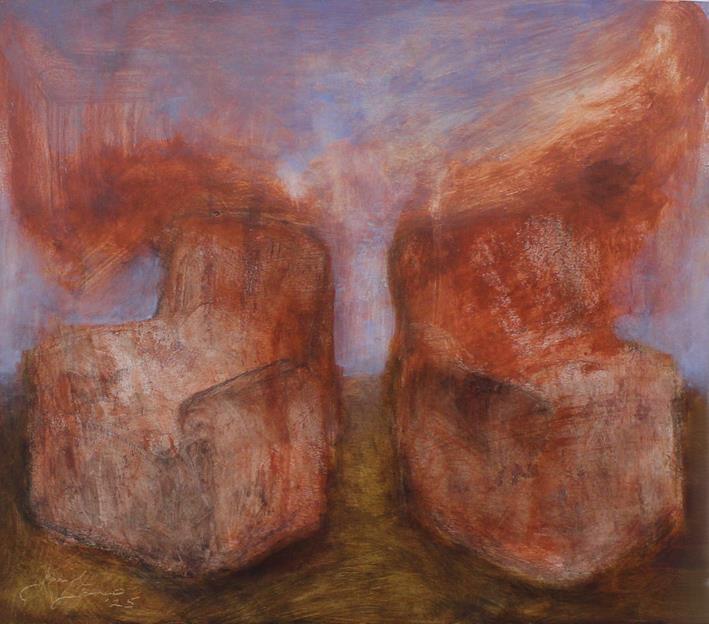
Which, tada, brings me to my favourite painting. Yes, as always, I get to choose a favourite, although I am torn between two, or perhaps five, but this one was love at first sight. When David first began sending me visuals of the works during one of our many conversations about the exhibition, I was immediately struck by the image of two burning armchairs. Set facing away from each other, engulfed in flames, they sit on a classical yellow-ochre ground against a backdrop of a luminous blue sky. The scene brings to mind the strange narratives depicted by artist Julia Soboleva and her recurring motif of little fires.
Naturally, I asked the artist to explain this work. His response was disarmingly simple: "Oh, that's called Friends with Benefits." And just like that, the mind boggles. I tried, repeatedly, to arrive at a clear explanation for this beautiful surge of surrealism, but those flames simply consume me.
Debono's painterly and deliberately undefined execution further dissolves clarity, heightening the sensation of inhabiting a dream, or perhaps someone else's memory, where what is remembered, imagined, or forgotten remains unresolved, because perhaps it never was.
The exhibition runs until 15 February at il-Kamra ta' Fuq, Mqabba. For more information, follow us on social media.