Could you share the inspiration behind your exhibition Arti - my land, my drawings?
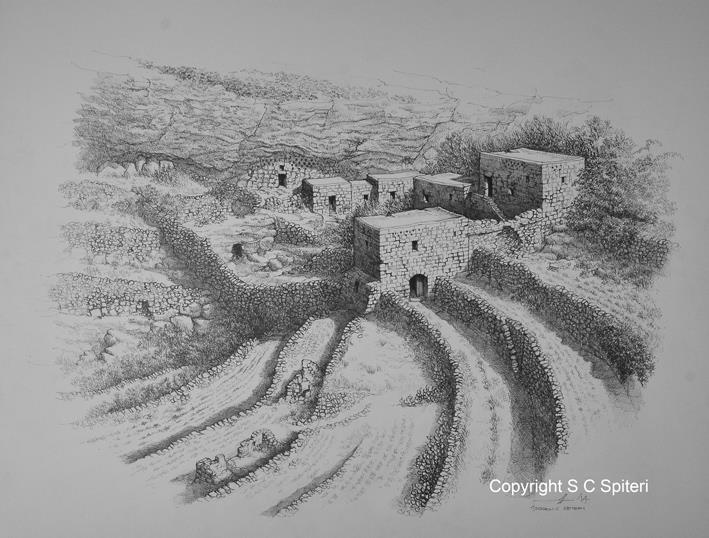
This exhibition is the product of a long personal journey born out of a love for drawing and the Maltese countryside, both of which were instilled in me by my late father, Perit Joseph M. Spiteri. It was only after my father had passed away in 2013, however, that I intentionally embarked upon the courtship with the romantic notion of the rustic idyll that would crystallize into these drawings. For up to that point in time, my art had been largely employed in the pursuit of the study of fortifications. The shift from depicting fortifications to rural buildings, when it materialized, came effortlessly, perhaps because both fortifications and rural structures are, after all, a product of the landscape - they respond to it, exploit it, and are in turn conditioned by it. Moreover, it served to unshackle my artistic imagination in a manner that the more disciplined depiction of historic fortifications, based on visual faithfulness and historical accuracy, could never possibly permit. My drawings and drawing style, as a result, changed from being simply descriptions of buildings into scenes that now seek to nourish the soul more than satisfy the intellect: drawings that now strive to 'taste', as James Shelley put it, rather than 'reason to conclusion', the beautiful.
Your drawings are remarkably detailed - how do you approach the process of capturing texture, atmosphere, and historical nuance?
The drawings in this exhibition revolve around representations of real places and buildings as well as images of fictitious scenes and structures. Most of the latter are loosely-based on real places I have visited over the years - the product of memory and imagination, drawn together from the reservoir of recollections encountered on my many forays into the countryside. Many of the settings revolve around the humble, defining vernacular qualities which rural buildings and their settings possessed when Maltese villages were still villages, and the countryside still open unsullied countryside. Places of tranquillity, stillness, and peace.
Do you work from sketches, memory, or direct observation? How do these methods influence the final result?
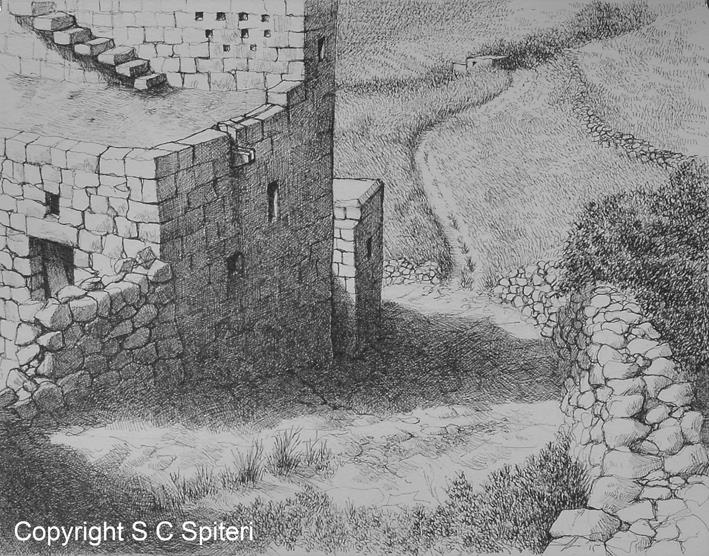
Mostly, I enjoy exploring the countryside for inspiration, often making quick sketches on the spot. I tend to gravitate towards ruins that exert what Peter Ackroyd calls the 'spectacle of desuetude and decay' - ones that prompt a strong nostalgic appeal in the same aesthetic tradition of the ruinlust. In many other instances, however, I just rely on my imagination and memory. In both cases, the final drawings are done at home. Often, the drawings I seek to create are meant to express an 'aesthetic' form of experience, with their nostalgic purpose, as it were, being aesthetic pleasure, where memory is allowed to shape itself in a manner that resonates with the soul.
How has your technique evolved over time, and did this exhibition push you in new directions?
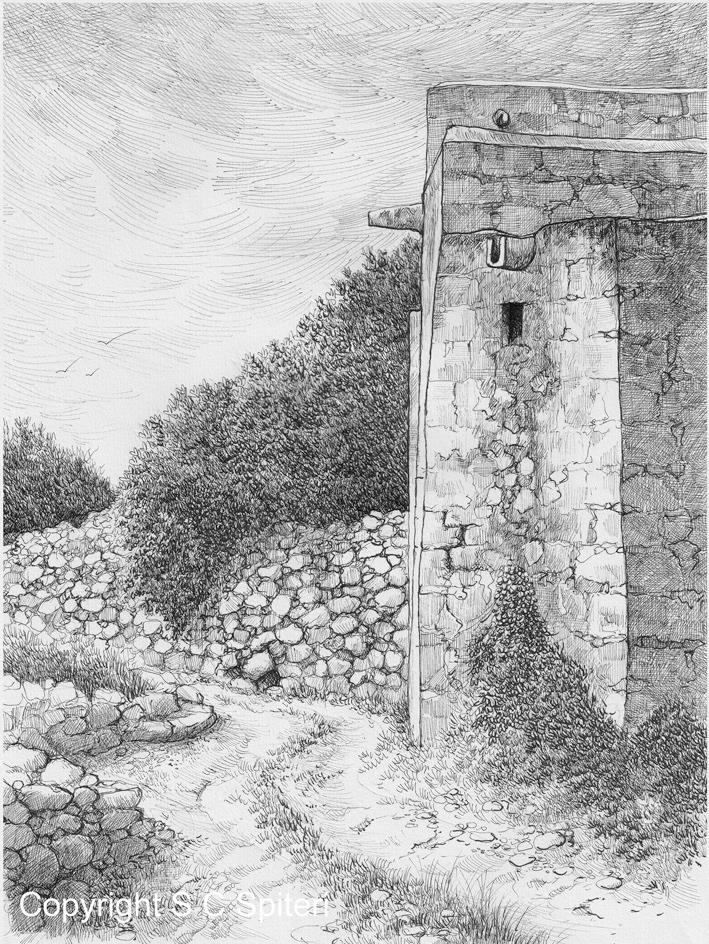
The line is the main, and often sole, element of most of my drawings. I am attracted to monochromatic art primarily because I enjoy sketching and drawing and adore the qualities of the pen and pencil as they allow me to rapidly get at the core of a scene. I use line to build up forms and structures, to define space, and to create texture and weight through shading and cross-hatching. My line work is freehand and intuitive, based on a very rough outline first sketched lightly in pencil. Most of the time I simply seek to collect shadow and light as I instinctively gravitate towards monochromatic portrayal; I find it imparts a certain gravitas and a dramatic chiaroscuro poise to a composition that is sometimes impossible to capture or convey with a full palette of colour.
Are there any recurring motifs or architectural elements that you find yourself drawn to again and again?
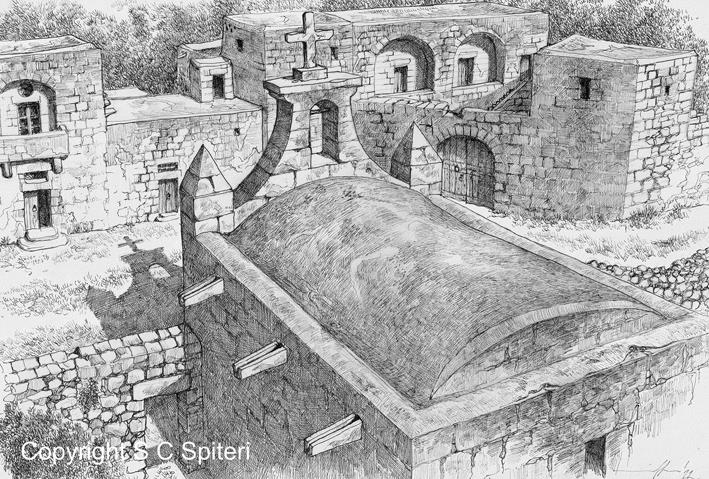
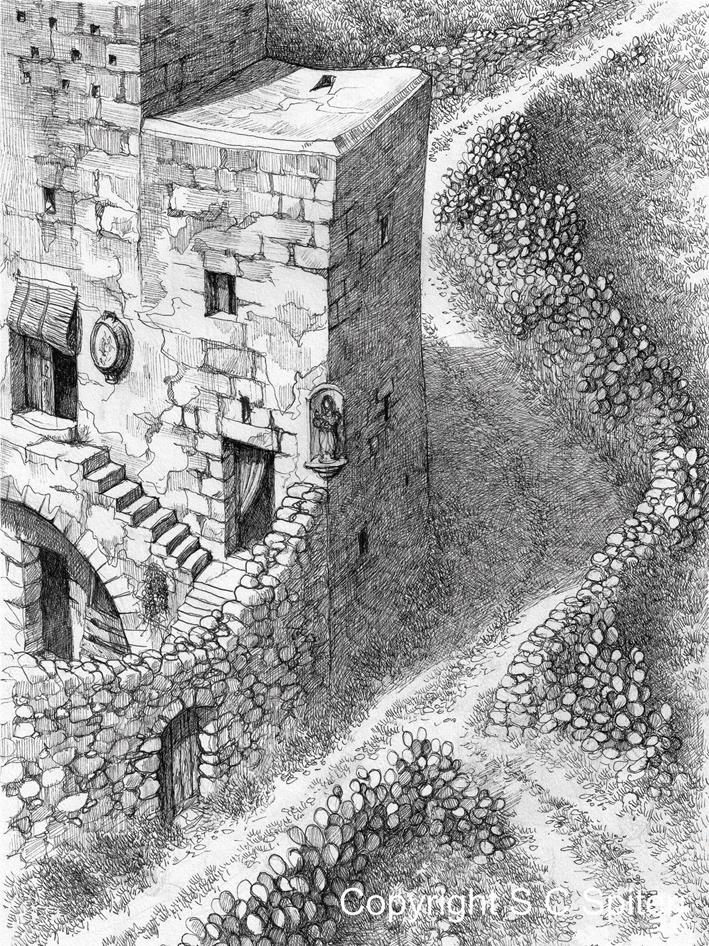
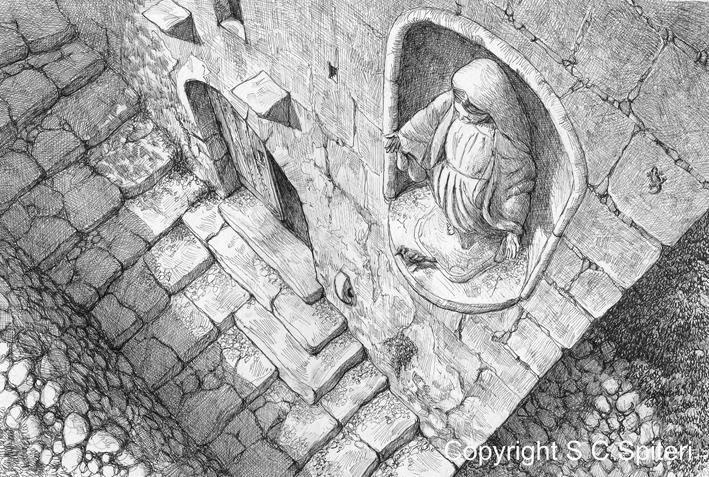
A personal preference, and one which I often adopt, is the use of slightly elevated vantage points in my pictorial compositions - I like to draw a subject from a bird's eye view, as if I were overhead in an imaginative leap into the air.
Do you see your work as a form of storytelling, and if so, what stories are being told in this exhibition?
Yes, in a way it is. In my artistic compositions, however, it is the buildings, and their features, which are the characters, the living beings, so to speak, vying for attention. For this reason there is a purposeful absence of human figures. For their presence is unnecessary as they have already passed through these buildings and landscapes and moved on, leaving only the buildings behind them as their footprint - masonry shells and walls that have long been washed, to cite the words of John Ruskin, 'by the passing waves of humanity'. This allows my images to keep the silence of empty, abandoned buildings and their haunting atmospheres - the silence they had when I found them and the sensation that they are shrouded in when I close my eyes, think back and see them. This 'blankness' serves to focus undivided attention on the humble buildings aspiring for recognition and dignity in my drawings, endowing them, as the Romantics believed, with a 'greater solitude, resonance and grandeur'.
How does Malta's landscape and architectural heritage shape your artistic voice?
The Maltese countryside provides the inspiration for many of my drawings in general although I also pursue other themes and subjects. All the drawings on display in this exhibition, however, are part of a larger collection that I have created and brought together over the past decade, all of which betray a fondness for ordinary rural settings and the anonymous buildings which punctuate them - sombre and staid structures that are often rarely allowed a second glance when encountered by the undiscerning eye. I believe in the adage that 'the more anonymous a painting is, the more real it is' a quote attributed to Balthus and like HM Bateman , in his depiction of Gozo, I seek mostly to capture 'the raw beauty of the mundane'. I am particularly hypnotized by the patterns and textures of rustic stone buildings with their low-lying skylines, simple cubic forms and volumes, and the organic disposition of their unassuming vernacular compositions, as well as the minutiae of their structural features - doorways, stairs, balconies, windows, wellheads, animal sheds, etc. What I search for, in the choice of subject here, apart from intriguing shapes and forms, is that quality of aesthetic resonance between buildings and their surrounding land, particularly where it is dictated by accidental irregularity.
Is there a particular building or path in your drawings that holds personal meaning?
I tend to look at the Maltese landscape on many different levels. I am equally fascinated by the vast open patchwork of fields of dry-farmedland (raba' bagħli) bound by dry-stone walls (ħitan tas-sejjieħ) as I am by the vein-like web of country roads and lanes, punctuated at frequent intervals by small farm buildings (irziezet), which link them all together. Perhaps the element which mostly fascinates me and forms the focus of many of my drawings is the ubiquitous farmstead, the razzet. It is encountered in all shapes and sizes, and even though they all follow a basic cubist form and grammar, no two farmsteads are alike.
Many have been lost over the passage of time, either by being unceremoniously discarded and swept away to make room for modern development or because these were simply abandoned and forgotten and left to fall apart. Several of my drawings, as a result, depict such descaling ruins. But they do so not simply out of an obsession to pursue ordinariness, but also because in their state of ruination, rural buildings acquire an added aesthetic quality that derives from an accidental interplay of space, form and nature.
What kind of dialogue do you hope to spark with viewers - curiosity, nostalgia, preservation?
I do not have a particular audience in mind whenever I choose a subject for a drawing or painting. I simply draw and paint for myself whenever inspiration strikes. The subjects I choose need, above all, to intrigue and challenge me. I have learnt, over the years, not to try to force the process and, often, I play around with an idea in mind for years before I eventually commit it to paper. I spend considerable time searching for unusual or dramatic viewpoints, studying the fall of shadows on walls and surfaces, and the textures of stone and materials.
Although ink drawing cannot offer the range of effect of paint to elicit emotional response, I find that sensitivity of touch can nevertheless serve to create a gradation of shadow and light as well as imitate the feel of textures and weight of materials. Still, managing complicated compositions is more often than not a challenging task, one made even more difficult by the unforgiving nature of the medium of ink itself.
I tend to work in cycles, and whenever ideas start to run dry, I move on to other creative pursuits like music-making and writing.
I find that each drawing and work of art reaches out and touches people in very different ways, depending largely on the viewer's own aesthetic and emotional sensitivities. Some subjects and themes, nevertheless, tend to resonate more than others. Foremost amongst these is 'nostalgia', the yearning for lost places of the past, what the Welsh term as 'hiraeth'. It is a theme that runs through most of my artwork, the product of my own natural disposition for a restorative nostalgia, a Sehnsucht, so to speak.
Are there plans to publish or archive this collection beyond the exhibition? I understand that your work is not for sale.
I am working to bring together all the drawings in this series in a publication, as a sort of large-format catalogue/ picture book. At this stage, this is still just a PDF document solely for my personal use but, hopefully, it will eventually make it to print. In any case, most of these drawings can easily be viewed on my Facebook page. Since I only draw for my own personal satisfaction and reflection, and tend to develop a sentimental attachment to every piece I produce, my drawings are not for sale. Hopefully, whoever gets to inherit the whole corpus when I am no longer around will continue to keep them together as a collection.
What's next - are there themes or places you're longing to explore in future work?
I have several other themes that I also explore in my drawings. Two of these revolve around the aesthetics of fortifications, namely the 'Imaginary Castles' series, and the 'Castral Forms' series. Many of these drawings have been uploaded to my Facebook page over the past few years and hopefully others will follow suit as I continue to pursue these themes. God willing, I may have the opportunity to exhibit these drawings too in the near future.
Ultimately, Arti - my land, my drawings is a love letter to a landscape in flux. Through his meticulous, intuitive linework, Stephen Spiteri captures not only what remains, but what has already slipped away. His drawings become a refuge for the eye and the spirit, inviting us to pause, breathe, and remember.
Stephen Spiteri's exhibition Arti - my land, my drawings is hosted by Malta Libaries at the National Library, Valletta. It is open from 7 February to 7 March.