People tend to equate new with better, but in the rush toward progress, some powerful tools are left behind. Why bother with techniques from ancient times? Wioletta Kulewska Akyel reminds us that these tools not only endure but evolve, revealing the purity and lasting potential of the fresco technique.
Kulewska Akyel (b.1980) is a Polish-born artist based in Valletta, working across painting, design and installation. Following formal training in Poland and further development in London, her practice has been shaped by residencies in Lisbon, Latvia, Iceland, Skopelos and Cyprus, which have deepened her engagement with the visual and cultural currents of the Western and Eastern Mediterranean. Building on her varied artistic journey, she had also taught painting and experimental visual practice at the Malta School of Art.
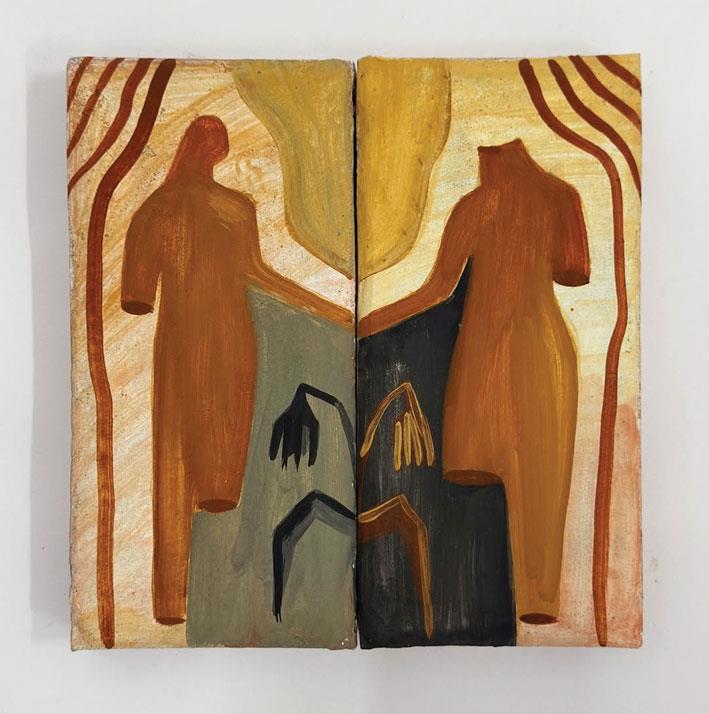
Her latest exhibition, Dormiveglia, at Studio 87, presents a series of frescoes created over the past three years. The title, suggested by curator Justine Balzan Demajo, comes from a word encountered during her studies in Florence describing a state suspended between sleep and wakefulness. This intermediary state resonated with the works, which emerged from the artist's subconscious, guided by memory, sensation, and intuition rather than a fixed theme. In this exhibition, Kulewska Akyel reuses this ancient technique of fresco within a contemporary context, transforming a historically monumental, architectural medium into portable, intimate works that capture fleeting gestures and permanent impressions.
Fresco is among the oldest painting techniques, emerging in ancient Egypt and later refined by the Minoans through the buon fresco method, in which pigments are applied directly onto wet plaster. This is the same technique used in most of the works on display, yet its demanding process, technical ability and irreversible factor keep a lot of artists from using it today. Kulewska Akyel first encountered fresco on a study trip to France while in secondary school in Poland, where she saw Renaissance frescoes. Among her earliest impacts was also her exposure to minimalist red-ochre frescoes in Cappadocia, Turkey, which contrasted sharply with the Western tradition of later periods. Even in 2026, viewing Giotto's frescoes continues to leave a strong impression, reinforcing her ongoing fascination with the medium.
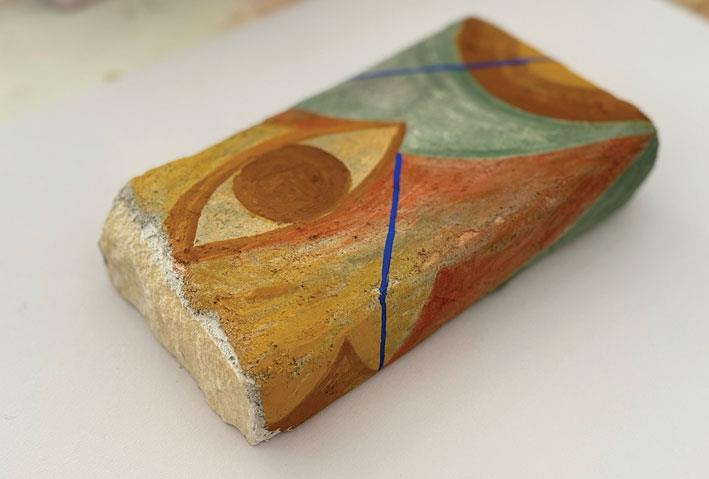
Her engagement with fresco is grounded in extensive research and experimentation using different surfaces, such as terracotta tiles and Maltese limestone. Despite being taught in Bosa, Sardinia, where terracotta was widely used, she has chosen to work with Maltese limestone. Although porous, the stone remains viable and anchors the works within the material heritage of Malta. Notably, Blue Lines is painted directly onto this material, a gesture that recalls historical precedents such as Mattia Preti's frescoes at St John's Co-Cathedral, yet reclaims the medium in the contemporary. As Kulewska Akyel notes, "as a contemporary artist, for me fresco-painting is just another surface", framing her work as both rooted and forward-looking.
Inverting fresco's historic immovability, these portable frescoes provide new depth to the materiality itself. Unlike those in an ecclesiastical context, their size allows them to be viewed at close range. The dichotomy is reinforced in their display, with some works floating on the wall and others resting on a marble slab, a nod to the marble dust embedded in the top layer, which contributes to their earthy palette. This intimacy exposes the roughness, translucency, and surface imperfections of the frescoes, qualities the artist embraces as essential to the medium's character. Using only natural pigments, Kulewska Akyel constrains her style to reflect this purity. She states, "this medium is purity and the beauty is in its limits. In my case, I am using this medium to transform my personal experiences". Installing the works in this historic stall, with its tiled floors and stone walls, creates a new domestication within the space that reflects and amplifies the character of the frescoes themselves.
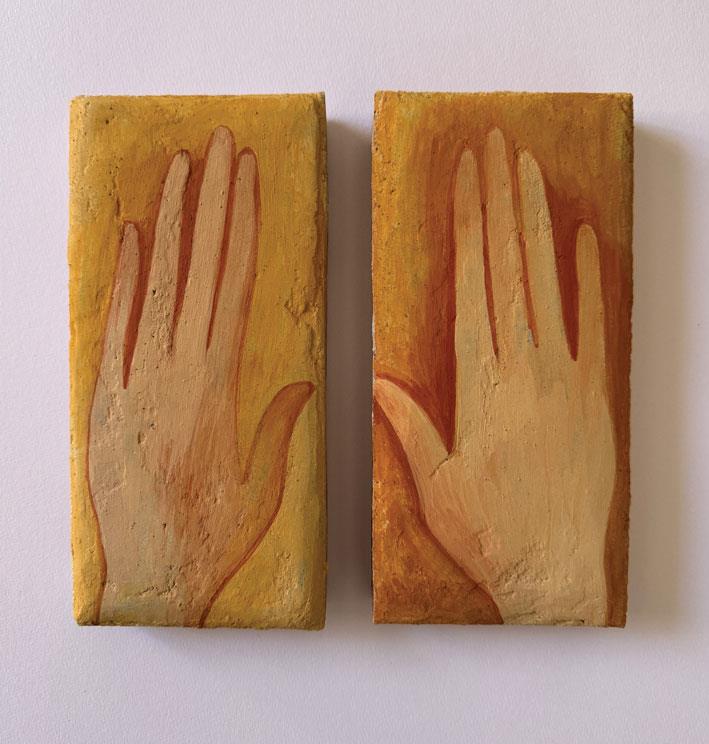
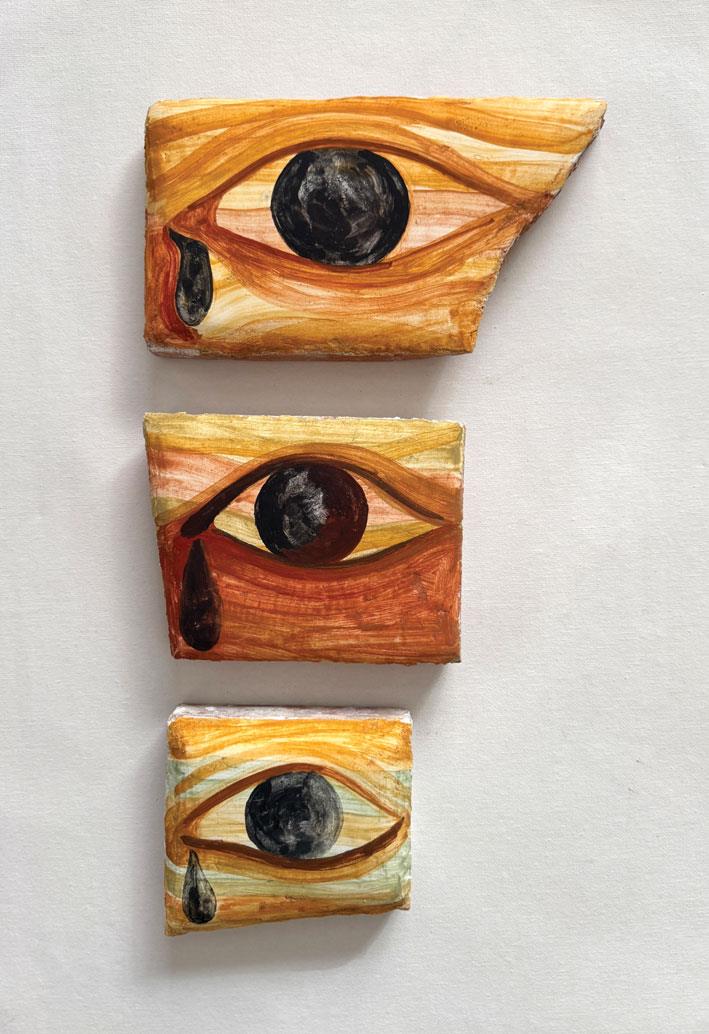
Kulewska Akyel begins each fresco without a fixed plan, letting the unconscious and memory guide the imagery into forms that hover between abstraction and figuration. During her travels, she creates sketches that serve as a visual diary. These are later reworked in her studio, but the experiences and impressions that couldn't be captured in the moment continue to strongly influence her subject matter. As Balzan Demajo reflects on the outcome, an underlying element of the ancient and medieval emerges. Eyes for her finds strong reference to the Egyptian Eye of Hours while other works including Grotta and Hands show subtle elements of medieval religious art, with their emphasis on simple form and pronounced hands, which now is taken outside of an ecclesiastical setting and placed in the contemporary context.
Even in a medium as unforgiving as fresco, she approaches it with a sense of play, turning accidents in the studio, like a broken tile, into new opportunities for creation. The entire artistic process is a pursuit of truth, and by working from memory and travelling inward, she seeks to understand herself and life more deeply, reflecting her own words: "This is the closest way I can get to try to find my own answers of why we are here, through art." While contemporary artists often strive to reinvent the wheel, as noted by the curator, it is equally vital to remain connected to our artistic roots. This engagement with the past, and the inspiration it provides, is deeply important for both the artist and curator, shaping the way the exhibition reinterprets fresco.
The exhibition seeks to present fresco with a completely fresh perspective, redefining the medium for the contemporary moment. By bridging past and present, memory and intuition, Kulewska Akyel transforms this centuries-old technique into a living, intimate language that engages the viewer directly, revealing the beauty in its limits and the possibilities of its reinvention.
Dormiveglia is open to the public until 27 March at Studio 87, Valletta.