Victor Diacono (1915-2009) occupies a singular place in the history of Maltese modern art. This place becomes most clearly legible when read in dialogue with Italian sculptor Medardo Rosso (1858-1928). More than a matter of stylistic influence, Rosso offered Diacono an alternative way of thinking about sculpture itself: not as a monument, but as an impression; not as a polished object, but as a surface activated by light and touch. Through this lens, Diacono emerges as the sculptor who most convincingly appropriated an impressionistic aesthetic into an authentically Maltese sculptural language.
Diacono's artistic direction was decisively shaped by his formative years in Rome, where he studied at the Regia Accademia di Belle Arti between 1937 and 1939 after obtaining a scholarship. While museums and churches exposed him to the grandeur of historical sculpture, it was his encounter with Rosso's work - seen in an exhibition near Piazza di Spagna - that proved decisive as it introduced him to non-traditional approaches to sculpture. Diacono later acknowledged this moment as pivotal, crediting Rosso with reshaping his understanding of what sculpture could be.
Rosso's significance lies in his challenge to the academic conception of sculpture as static and timeless. Rejecting the grand narratives of 19th century sculpture, he sought instead to capture fleeting sensations: a passer-by glimpsed in motion, a face dissolved by light, a moment on the verge of disappearance. His small-scale, anti-monumental works, often executed in wax over plaster, privileged surface over form and atmosphere over anatomy. Sculpture, for Rosso, was no longer a solid mass occupying space, but a sensory experience, dependant on the viewer's position and the shifting play of light. The mutable vitality of Rosso's work is epitomised by Ecce Puer where form seems perpetually to dissolve. The child's face in Ecce Puer exists not as a fixed form but as an impression - fragile, transient, and profoundly human.
I remember standing before Ecce Puer at the Galleria d'Arte Moderna in Milan, struck by how the sculpture seemed almost to withdraw from the eye the longer one looked at it. Rather than asserting its presence, it hovered, suspended between appearance and disappearance. One had the sensation that the face might dissolve at any moment, as though on the verge of vanishing into its own substance. That encounter made palpable what I had previously understood only in theoretical terms, namely Rosso's radical redefinition of sculpture as an event of perception rather than an object of permanence, a redefinition that would prove illuminating when considering Diacono's sculptural practice.
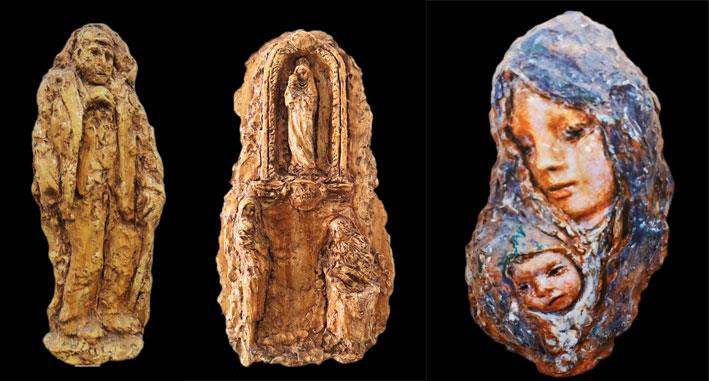
It is precisely this attention to surface, light, and impermanence that invites a broader reflection on Diacono's place within European modern sculpture. Like Rosso, Diacono can be understood as a sculptor who shares the painter's efforts in the direction of illusion. Diacono rejected polished surfaces in favour of rough, sketch-like modelling. Thumbmarks, scratches, and irregular textures are not concealed but foregrounded, preserving the immediacy of the sculptor's hand. Light becomes a co-author of the work, shaping and reshaping forms as it moves across the surface. As Diacono himself explained, it was light that gave shape to his modelling, each fragment casting its own shadow, each irregularity contributing to the sculpture's expressive charge.
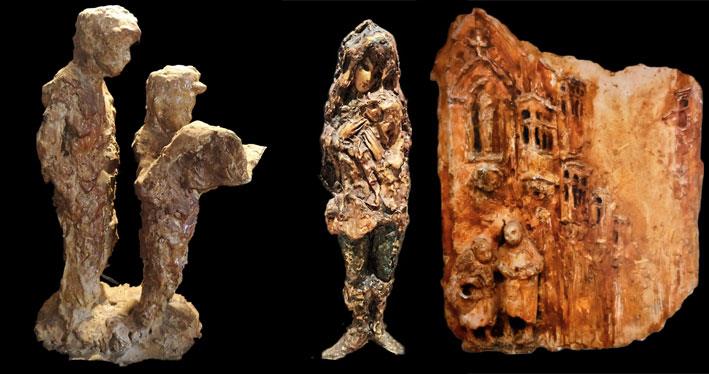
Both sculptors share what French poet and art critic Charles Baudelaire famously described as the condition of the modern artist: in a perpetual state similar to that of the convalescent, the modern artist is capable of finding wonder in the most trivial aspects of life. Yet Diacono's adoption of Rosso's idiom never resulted in imitation. Where Rosso drew his subjects from Parisian urban life - passers-by, weary workers, anonymous figures glimpsed in motion - Diacono turned his gaze inward, towards the modest rhythms of everyday Maltese life. Women gossiping on street corners carrying shopping bags, children, the elderly, horse-drawn carriages or devotional statues tucked into street niches populate his reliefs and small-scale works. These, however, are not staged scenes of picturesque folklore, but quiet observations of everyday existence, rendered with empathy.
Material choice further reinforces this affinity. Like Rosso, Diacono favoured soft, mutable materials such as plaster and clay, and occasionally wax, precisely because they permitted continuous reworking. These materials enabled him to explore atmospheric effects and to prioritise texture over finish. Diacono often spoke of his love for plaster's fluidity - its capacity to be roughened or softened at will. He sometimes left his sculptures exposed on his studio roof, allowing the natural elements to develop patinas that deepened surface complexity.
Despite these affinities, however, Diacono's work maintains a distinct artistic identity, rooted in folklore, social observation, and religious culture as lived within Maltese society. It is precisely through religion, one of the most pervasive frameworks of local visual culture, that the tensions in his practice become most visible. Although his religious imagery adhered iconographically to established Church tradition, his impressionistic handling of form and preference for rough, tactile surfaces ran counter to the conservative aesthetic expectations of ecclesiastical institutions. As a result, despite his recognised standing as a portrait sculptor, Diacono was largely excluded from formal church commissions.
In this light, Diacono's sculpture can be understood as a quiet yet resolute act of resistance. Drawing on Rosso, he appropriated an impressionistic avant-garde language without abandoning his national roots, while consistently remaining true to figuration, and this aspect places him in a liminal position between tradition and modernity. Quiet, anti-heroic and deeply humane, Diacono's sculpture thus offers one of the most sincere articulations of Maltese identity into modern sculpture.
Rowna Baldacchino is a Maltese art historian and cultural critic with postgraduate specialisation in art history, literature, and translation, focusing on modern and contemporary art in Malta